
This is your first glimpse of the much-anticipated Ferrari Luce, the Italian manufacturer’s first foray into a pure EV. The anticipation – and trepidation – pours in from all quarters for several reasons. For the Ferraristi, the challenge is how the company can transition from a legacy based on combustion into the electric era. For everyone else, it’s the first time that two of the most accomplished industrial designers of an era – Jony Ive and Marc Newson – have been tasked with designing a production car.

The Luce nameplate has also been unveiled
The road to this point is long and windy and the final destination – for the public and media at least – has still not been reached. The full picture and complete reveal of the Luce will take place towards the end of May. What you see here was unveiled at an event in LoveFrom’s native San Francisco, attended by a smattering of design, tech and automotive media and presided over by Ive, Newson and Ferrari’s Chief Design Officer Flavio Manzoni.

Ferrari Luce steering assembly
The Ferrari Luce has to do many things, forging a new technological identity for the brand, as well as a new path through largely uncharted but undeniably treacherous territory. You see, the electrification of luxury and performance hasn’t gone quite as well as the auto industry wanted it to. Even though EVs bring bushels of performance, innovative design and levels of luxury and craft that equals traditional platforms, the world’s superrich haven’t exactly fallen over themselves to buy into the zero-emission era.
Ferrari’s statement on the matter is therefore eagerly awaited. The decision to hand design over to Ive and Newson and their team at LoveFrom is therefore simultaneously bold and prudent. Bold, because few brands have the self-confidence and the financial wherewithal to support such a complex project, and prudent, because by hiving off the Ferrari EV to an outside consultancy – however esteemed – there’s always scope to walk it back should the venture not live up to expectations.

The presentation suite in the revamped Transamerica Pyramid, San Francisco
Having experienced the second stage of a three-part reveal, we reckon that expectations – thus far – have been exceeded. Ive and Newson were brought on board at the behest of John Elkann, the youthful chairman of Ferrari and Stellantis and member of the mighty Agnelli dynasty.
Elkann’s global outlook is why we’re here in America to see an Italian car designed by an Englishman and an Australian. LoveFrom have chosen the 27th floor of the Transamerica Pyramid for the reveal, recently spruced up to impressive effect by Lord Foster (who worked closely with Ive on Apple Park, lest we forget).

The team. From left, Ferrari CEO Benedetto Vigna, Ferrari chairman John Elkann, Ferrari CDO Flavio Manzoni, Sir Jony Ive and Marc Newson
It’s been nearly four and a half years since the collaboration was announced and four months since Ferrari unveiled its new bespoke Elettrica platform to the world. Stage two of this process is the unveil of both the new car’s name – Luce, or ‘light’ – and the key interior components. The exterior (most people’s only experience of a Ferrari) will be shown in May.

Sailing Lantern by LoveFrom and Balmuda
But for those familiar with Ive, Newson and the LoveFrom ethos, with its compulsion for flawless kerning, pixel-perfect graphics and the ability to coax hitherto unseen quality from the mass production process. All this is the product of decades of experience, not least at the head of one of a vast, hugely profitable company that had – and still has – the ability to ensure suppliers obey its every whim.

Characters created by the studio for their own in-house typeface, LoveFrom, Serif
Ferrari is no faceless tech supplier, however. Fiercely independent and beholden to no one in its pursuit of excellence, it is uniquely suited to this kind of partnership. ‘It was a very intense collaboration – our chairman wished to make a clear statement in terms of innovation,’ says Manzoni, resplendent in a black Ferrari baseball cap, ‘the first electric Ferrari had to be something special.’ ‘A designer’s duty is to seize the opportunity of new technologies,’ he continues, citing the work of Bruno Munari, Achille Castiglioni and the other pioneering names who made Italy an industrial design nexus in the 1970s. ‘The idea was to avoid the conventions and codes of car design,’ Manzoni concludes.
'The idea was to avoid the conventions and codes of car design'
Ferrari CDO, Flavio Manzoni

Moncler LoveFrom Jony Ive Collaboration, 2024
After a brief presentation, at which Ferrari’s CEO Benedetto Vigna and Chief Design Officer Flavio Manzoni extol LoveFrom’s virtues, the farsightedness of Mr Elkann and their own humility at handing over such a large and important project, we’re shown a short brand film which introduces the Luce name for the first time.
Let’s be clear, with an EV, Ferrari is going out on a limb regardless of LoveFrom’s involvement. Public opinion – the wealthy, 1%-er Ferrari-buying public that matter – is still lukewarm about the idea of an electric luxury car, let alone one coming from the manufacturer of some of the most famous and fulsome combustion cars in automotive history. Vigna might enthuse about the Luce’s role – ‘a project that will enlighten the future and the road ahead’ - but first the weight of expectation needs to be banished by the jab of cutting-edge design.

Portrait of Marc Newson and Sir Jony Ive by photographer David Bailey, 2010
Then it’s over to Newson and Ive, each resplendent in casual but contrasting pastel suits. ‘We’re enormously excited, completely terrified, but also honoured,’ Ive begins, before speaking of a ‘strong sense of affection between the two teams’ over the multi-year development program.
LoveFrom’s USP isn’t just for clients; Ive and Newson have carefully constructed a fortress of excellence for themselves, buoyed up by 60 multidisciplinary designers. The lion’s share of the design work, right down to the coding was done here in San Francisco, with Maranello handling the engineering and the all-important drive testing.
‘We’re enormously excited, completely terrified, but also honoured'
Sir Jony Ive, LoveFrom

The interior of the new Ferrari Luce EV
The Dash
It’s still a while before anyone outside of Ferrari gets behind the wheel. First, we have to actually see it. Ushered up a few more floors, the fruits of LoveFrom’s labours are revealed; the instrument binnacle, steering wheel, centre screen, control panel, centre console and overhead control panel, along with elegant seats trimmed in tan leather.
At first glance, the ensemble exudes a classical elegance, an analogue familiarity that invites touch and engagement. This is not an intimidating interior, far from it. It’s a space that celebrates materiality, engineering, innovation, craft and information design, rendered with a signature precision that preserves the dominance of the physical over the digital, even though there's a reliance on the latter for the actual display of information.

The interior of the new Ferrari Luce EV, showing the centre console and control panel
‘It’s a bizarre and lazy assumption that the interface should be digital if the power source is electric,’ Ive says simply, ‘I love Ferrari’s connection with the joy and love of driving. Their engineering team are breathtaking – we spent a lot of time trying to make this functional, simple and effective.’
In essence, the control surfaces of the Luce have been broken down into these discretely individual elements, related through function, material and aesthetics but treated as individual components. It’s strongly reminiscent of the kind of gadgetry the team has associated with in the past – a smartphone, a Leica camera, a wristwatch, a turntable.

Limited edition Linn Sondek LP12-50 turntable by LoveFrom for Linn, 2023
The centre screen has touch capability but it’s not the priority interface. Instead, an array of five toggle switches and a dial provide the primary interaction to control the HVAC. Along the top, two layers of crisp graphics show power output and efficiency, while the centre section of the screen will presumably contain mapping and entertainment information (not yet revealed).
Most essentially, the centre screen contains an analogue clock embedded in the upper righthand corner. Featuring physical hands over a digital face, the clock can be repurposed as a compass and a chronometer, the graphics seamlessly shifting beneath the hands. Two physical buttons add another layer of engagement.

Ferrari Luce central control panel
Many contemporary Ferraris offer an optional driver information screen embedded in the dash, but the Luce avoids any duplication by means of a simple mechanical device; the display can be orientated to the passenger by means of the aluminium grab handle mounted below the screen. This doubles up as a palm rest for activating switches or entering information – no hovering over a grimy touchscreen trying to stab the right spot.

Detail of the control panel toggle switches
The primary instrument binnacle is another self-contained unit, only this time it’s united with the steering column and wheel; they all move and adjust together as a single object. Three digital dials, with another analogue needle in the large centre dial, provide a clarity of information more akin to a helicopter cockpit than a road car. The glass here is lens-like, creating a parallax effect when you move your head, reinforcing the sense of depth and quality.

The three dials in the instrument binnacle
LoveFrom developed their own typeface for the car, LF Maranello, overseen by resident typographer Antonio Cavedoni. It's all part of a user-centric approach that aims to simplify and demystify. ‘Within a minute of looking at this, you know how to use it,’ says Ive, adding that ‘we’ve drawn on everything we know as a team.’
The Wheel

Ferrari Luce steering wheel
The wheel is another piece of purist industrial design, the distillation of decades of Ferrari heritage with the utmost graphic simplicity. It has three spokes, as per tradition, with the aluminium structure laid bare. The leather clad rim has a slim, delicate profile, while Ferrari’s signature manettino dial is duplicated – one for driving mode, one for handling mode – set each side of the wheel along with other key drive functions. Indicators are recessed aluminium buttons on the centre spokes, while the paddles operate the Luce’s regenerative braking system.

The left hand manettino selector operates the Luce's driving modes

The right hand manettino selector operates the Luce's handling modes
The Centre Console
The centre console contains the drive selector, window controls and key dock. The latter is a rectangular yellow Ferrari badge, with an e-ink display that turns the yellow background black when the key snaps magnetically into its receptacle and sinks into the glass finished surface. It’s a little piece of theatre, one that goes part way to replacing the snarl and bark of conventional ignition.

The yellow Ferrari badge is the Luce's key...

... it clips magnetically into the centre console, sinks down flush with the glass surface and the e-ink badge background turns black
The Overhead Console
A separate overhead console houses the aviation inspired Launch Control selector, which must be pulled down and twisted to activate the Luce’s maximum acceleration mode. The centre console extends through the cabin to serve the two rear seats, with another screen, switch bank and two of the most meticulously composed air vents you’re ever likely to see.

The overhead console houses the aviation-inspired launch control switch
These mirror the vents on the dash, with matt aluminium housing and a simple twist mechanism to open the airflow. The move is accompanied by a delightfully mechanical click, a noise and feel that has been carefully honed over countless iterations.

The centre console terminates in a separate screen for rear passengers, as well as twin aluminium vents
The minimalist material palette transcends the usual automotive mix of metal, carbon fibre, and hard and soft touch plastics. 100% recycled aluminium is used extensively, often CNC machined from solid billets and anodised to create a soft, microscopic texture. Glass surfaces use scratch-resistant glass from Corning, the original iPhone supplier.
The Seats

Ferrari Luce seat
The seats are more classical, with a ribbed back panel and integrated headrest that references Ferraris of old. Finished in soft tan leather, they eschew the luxury industry’s fascination with elaborate inserts, stitch patterns and sporting form factors.

Ferrari Luce seat on show in the Transamerica Pyramid
Like every component in the new industry, the seats, console and particular the dash binnacle are designed to be appreciated from every angle. Because the latter stands proud of the bulkhead, the rear is just as important as the front – you wouldn’t expect anything less from a team of product designers, right down to the last screw.
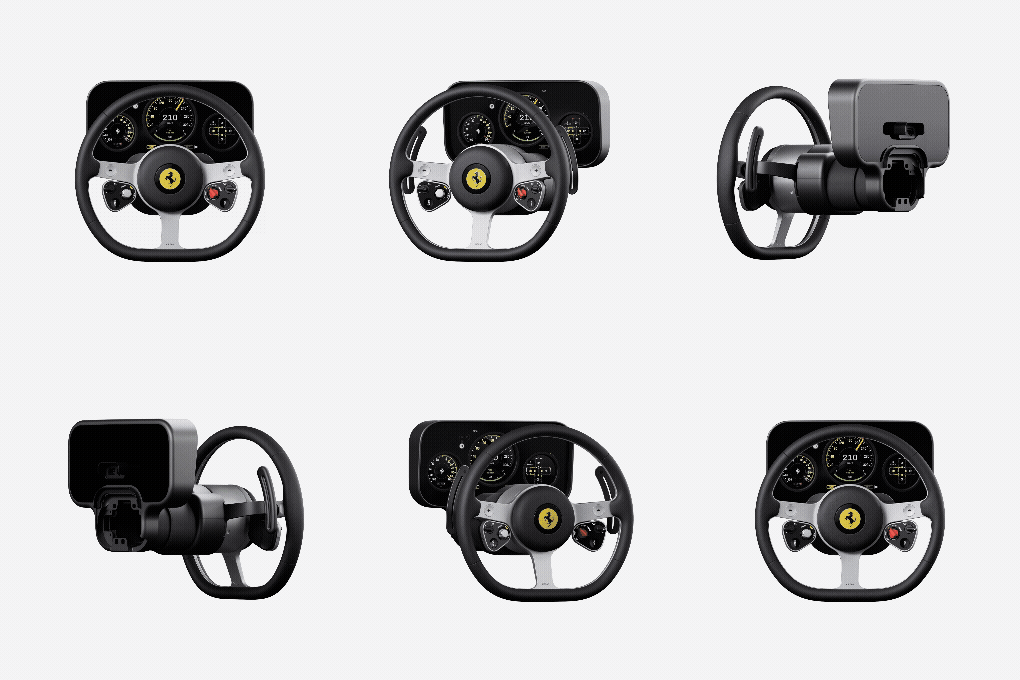
The Luce steering assembly is designed to be seen from all angles
Despite all this tactile delight there’s still no indication of what the Luce will actually look like. All we know is that it is a large four-door, four-seat GT, along the lines of Ferrari’s Purosangue SUV. The Elettrica EV platform, revealed late last year, will put out around 1,000bhp through no less than four electric motors, be powered by a sizeable 122kWh battery and have a target range of over 300 miles.
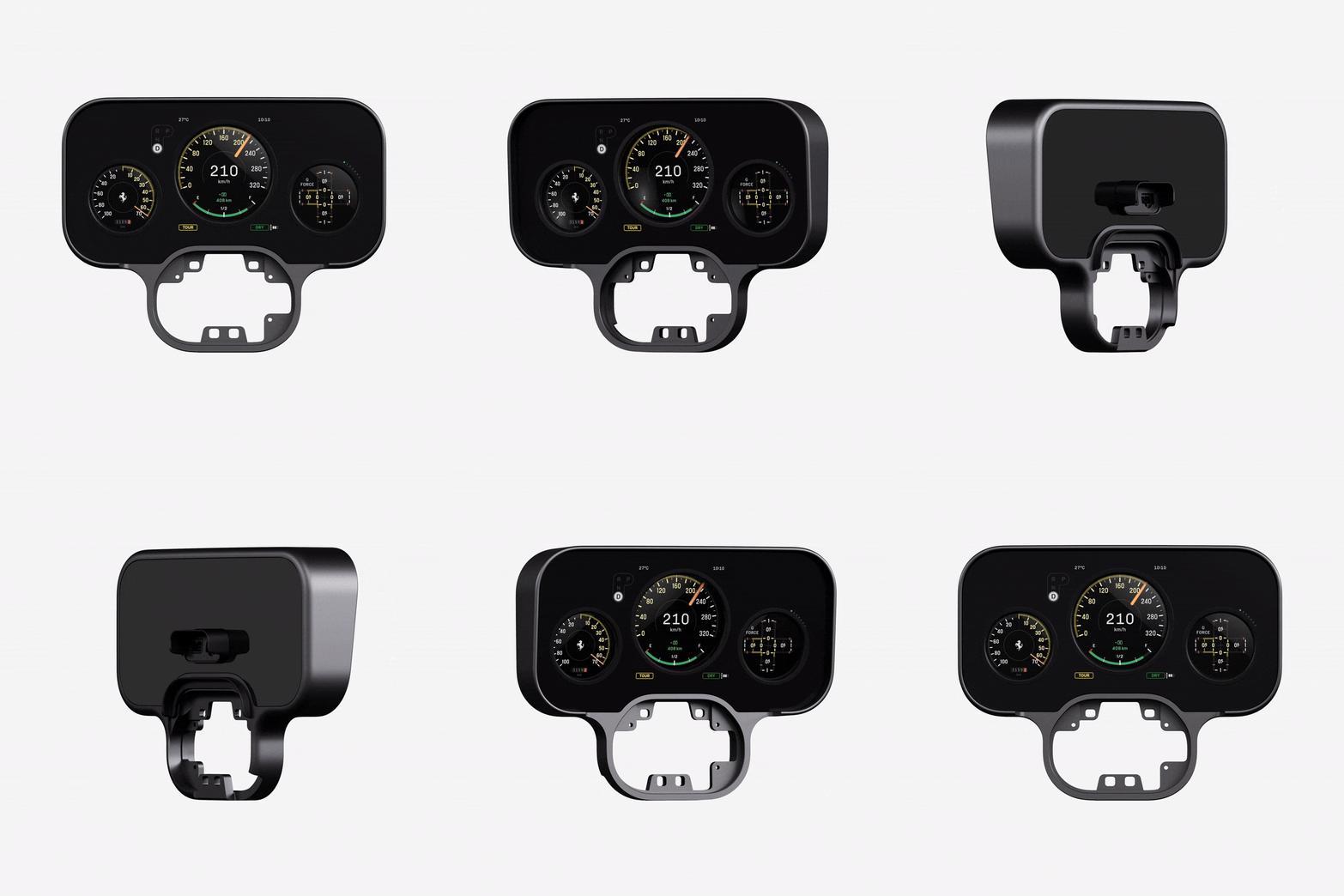
An animation of the Ferrari Luce instrument binnacle
There will be no artificial engine noise, but instead a soundtrack generated by the electrically amplified noise of the mechanical components, tuned by a noise cancelling system to exclude unwanted frequencies and capable of running completely silently when required. Handling will be bolstered by active suspension, a development of the system onboard the Purosangue, that makes use of the four individual at-wheel motors to enhance the dynamic experience. In the absence of combustion, feedback, drama and sensation will be created in other ways.
Thus far, design predictions have shown an evolution of current Ferrari design language. Clean sheet briefs are truly rare things to find in the world of car design. We think – and hope – Ive and Newson have gone much further. Will the Luce take on the crisp wedgy profile of the 1973 308 GT4, the poised muscularity of the 1966 275 GTB4 or the fluid sci-fi drama of Pininfarina’s 512S Modulo concept from 1970 (just three examples of the cornucopia of iconic car design in the Ferrari annals)? It could be a synthesis of all three and more or a deliberate avoidance of everything.

A spread from Taschen's Ferrari monograph showing the output of the marque
These historic cars - and many more – were lovingly dissected and redrawn as handsome vignettes by the LoveFrom team, part of the lavish four volume set of bound research findings and recommendations created in the first six months of the project. ‘You can’t work across disciplines without an insatiable curiosity to learn,’ says Ive, explaining how this research phase is crucial to any LoveFrom project. ‘It demonstrated our deep interest in the culture of Ferrari, both as an automotive brand and from an Italian cultural perspective,’ Newson adds, ‘you really have to get into character.’
The two men have a 30-year friendship, and a love of cars is a shared preoccupation. Often seen at the world’s great concours – Villa d’Este, Pebble Beach, Goodwood, etc., both are noted collectors of classic machines (Newson’s 1934 Bugatti Type 59 won Best of Show at the 2025 International Concours of Elegance in St Moritz). This project is in many ways the culmination of a long personal and professional association.

Newson's Bugatti Type 59 at The Ice, St Moritz, 2025
According to Manzoni, the LoveFrom collaboration has ‘really enriched our approach.’ The Sardinian-born designer, who joined Ferrari as CDO in 2010, describes the Luce as being ‘independent of the design strategies of the [Ferrari] range… this is unico.’ ‘The rest of the range is evolution,’ he continues, ‘we’ve learned a lot, especially in HMI, but we want to keep this car unique.’ Manzoni – nor anyone else – will be drawn on the Luce’s exterior aesthetics. ‘You can imagine the approach [LoveFrom] have used on the exterior,’ he teases, ‘the formal philosophy is the same – very rigorous and very pure.’

A detail of the multi-functional clock on the central screen: LoveFrom's horological experience is in evidence in every dial and digit
The Luce’s interior is fascinating for what it omits as much as much as what it includes. Ive is uncharacteristically blunt in one assessment, telling us that ‘touch doesn’t belong in cars.’ There is touch input, of course, but it’s definitely secondary to the analogue experience. The interior is a defining example of that horrid portmanteau ‘phygital’ (a word which is conspicuously and thankfully absent from any of today’s discussions), a fact that’s all the more interesting coming as it does from one of the preeminent architects of our modern digital lives.
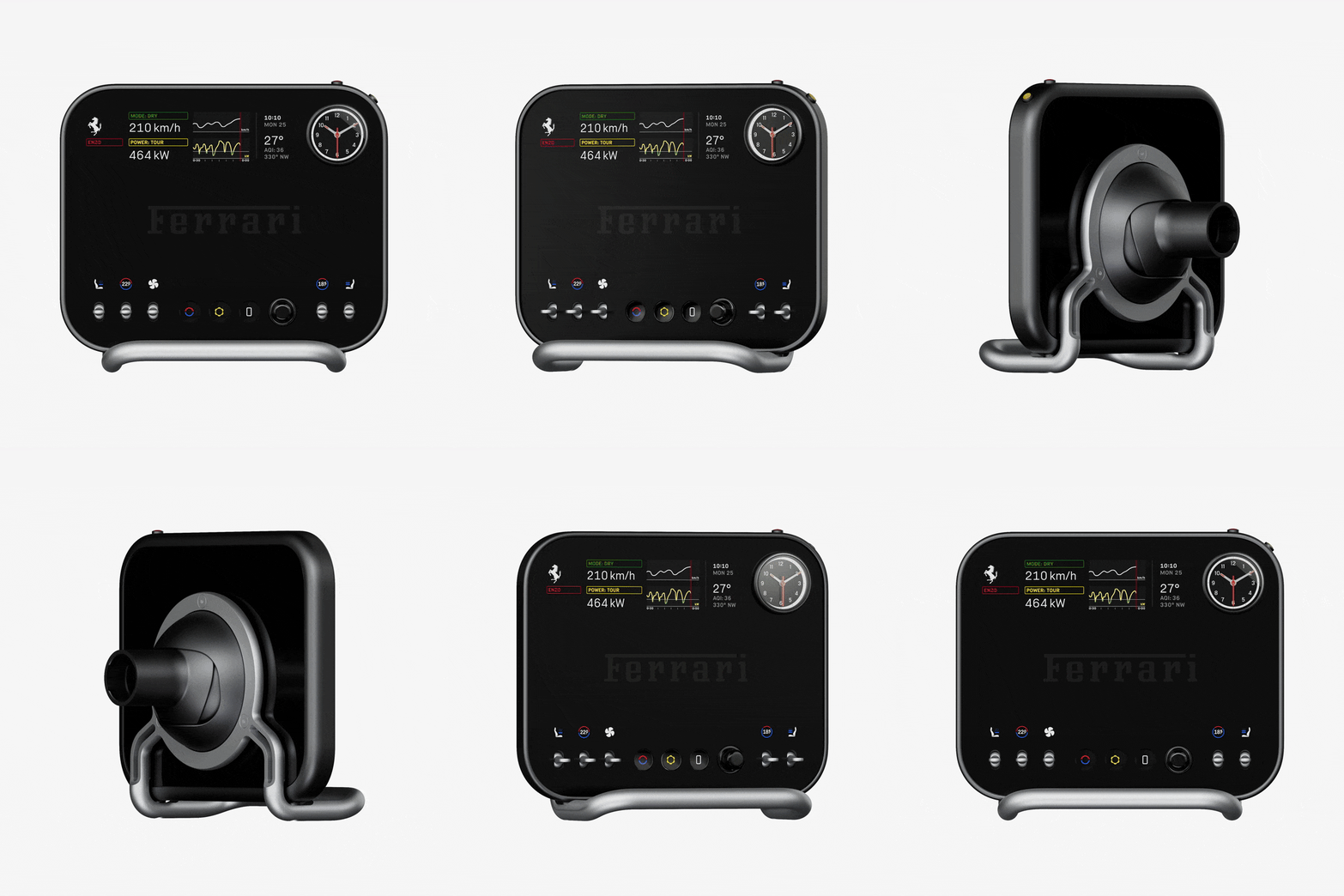
Ferrari Luce control panel animation
Ive maintains that the distraction-free cockpit of the Luce will ‘save lives’, and it’s hard not to imagine Ferrari’s rivals taking copious notes once they lay eyes on the LoveFrom design. Ferrari itself describes the cabin’s forms and displays as being ‘simplified and rationalised in the service of driving'; it's worth noting that they’re quite a long way from the company’s current interior ethos.

LoveFrom have created an automotive timepiece for the ages
There are some caveats to this blanket anti-screen statement, not least the auto industry’s billion-dollar push towards autonomy. San Francisco is the home of Waymo and the company's LiDAR-encrusted Jaguar I-Paces are a common sight on its streets. It’s one area where the distraction of more screens might be welcome, although a self-driving Ferrari is perhaps even more heretical than an electric one.

Chalk and cheese? Exploded view of the 1999 Ford 021C Concept Car by Marc Newson
Flavio Manzoni acknowledges that the Luce is not designed for traditional Ferrari customers, rather those who are new to the brand and perhaps more taken with the tech and luxury backgrounds of Ive and Newson than with Ferrari’s 79-year history of sports car manufacturing. It could even be more appealing to women, traditionally underrepresented in Ferrari’s customer base (although younger markets like China have a more equitable female/male ratio than the West).
The Luce interior has a clarity of execution and function that few other car companies can currently muster, if they ever could. By avoiding the overt reliance on giant touchscreens and by amplifying the importance of touch and feel, the Luce is taking its own path, parlaying the importance of a true analogue physicality to the spirit and emotion of driving.

Detail of the Ferrari Luce seat
Stage two of the Luce reveal certainly corroborates Elkann’s intention to avoid the industry’s existing dogma. As Newson says, ‘we were approached as an outside entity, so our approach was going to be different – that was the whole point of the exercise. The fact that it was an EV was an interesting starting point and a welcome and exciting level of newness.’

The Marc Newson-designed stand holding Ferrari's 50th anniversary monograph, released by Taschen in 2018
From the initial research to the final interior, the Luce project is a showcase for LoveFrom’s obsessive, intensive and unashamedly multidisciplinary approach. ‘If you don’t have a very strong philosophy and discipline, it just won’t work,’ Ive says of the project’s vast complexity, working hand in hand with Ferrari’s engineering team, its suppliers, production partners and the reams of legislation that bind the auto industry.
Newson still enthuses that ‘Ferrari are by far and away the best partner we could have,’ strongly implying that the realisation of this detailed and comprehensive brief would simply not be possible anywhere else.

Ferrari Luce steering assembly
Read our May 2026 report from the full Ferrari Luce reveal in Rome