A closer look at the stage design of Bad Bunny’s sensational Super Bowl 2026 performance
Wallpaper* speaks with production designer Julio Himede of Yellow Studio about the epic sets. 'These little stories are very much part of Puerto Rican life, but also part of Benito’s life.’

When Bad Bunny was announced as the headliner of the 2026 Super Bowl halftime show, he made a promise: ‘The world will dance.’
The Puerto Rican superstar certainly delivered on that pledge with his sizzling show at Levi’s Stadium in Santa Clara, California. But it wasn’t just hits like ‘Tití Me Preguntó’, guest appearances from Lady Gaga and Ricky Martin, and the musician’s signature hip thrusts that sent the crowd wild — the multi-faceted stage design allowed Bad Bunny create a powerful portrait of Latinx culture.

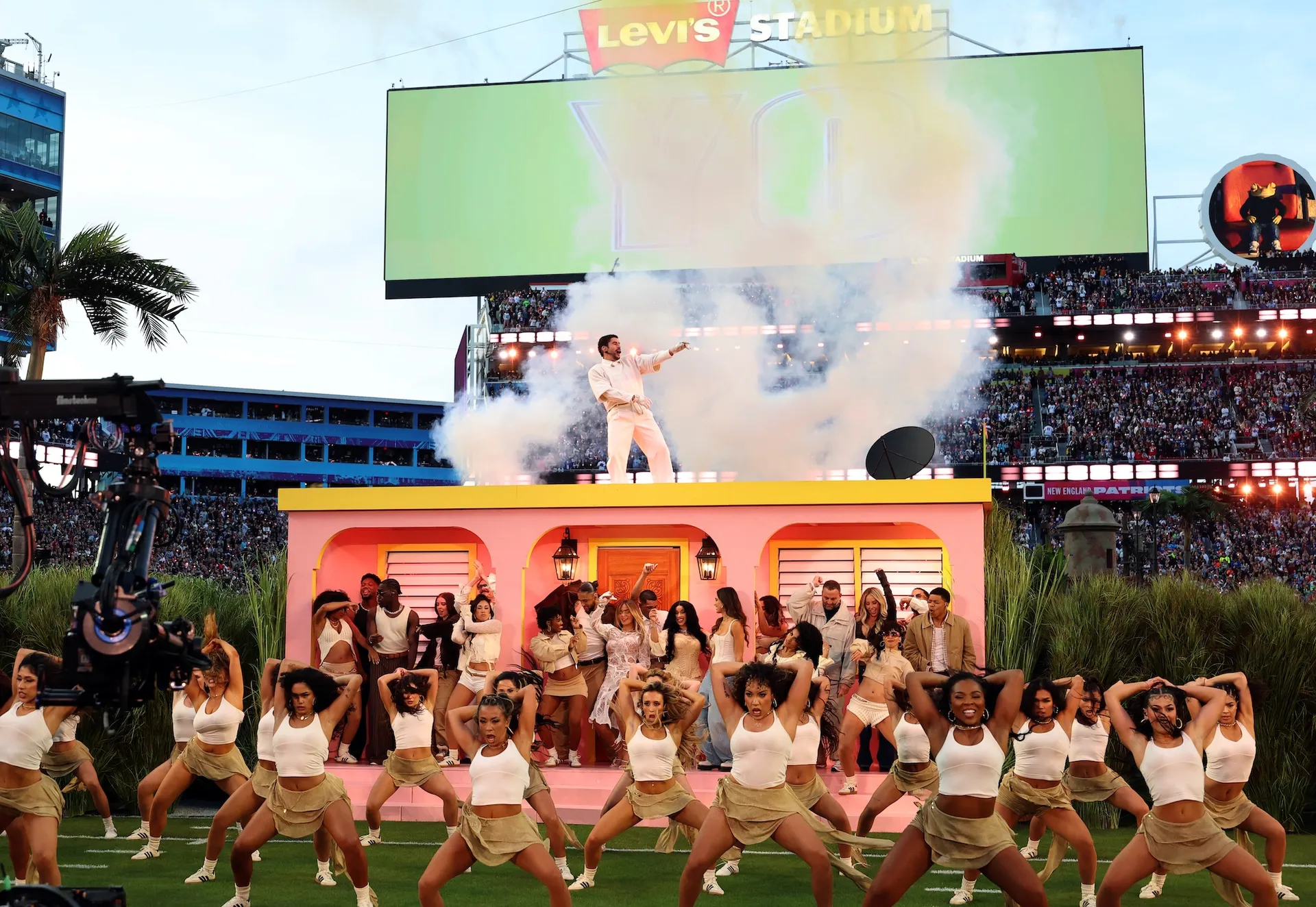
Bad Bunny danced atop a bright pink casita
That was evident from the first moments of the performance, which began with the words: Que rico ser latino — how lovely it is to be Latino. From there, Bad Bunny wandered through a maze-like sugarcane field that had been erected, encountering scenes of Latin American life along the way, from grandfathers playing dominos to a vendor selling piraguas, a traditional Puerto Rican shaved ice treat.

According to Julio Himede, founder of New York and London-based production design company Yellow Studio, the expanse of grass not only helped define the performance visually, but became what Bad Bunny, who was born Benito Antonio Martínez Ocasio, and creative director Harriet Cuddeford referred to as a ‘field of dreams.’
‘It became the big brushstroke of our idea,’ Himede tells Wallpaper*. ‘Benito himself wanted to make sure that we celebrated and highlighted everyday Latin culture through these vignettes. These little stories are very much part of Puerto Rican life, but also part of Benito’s life.’

Bunches of plants formed the perimeter of the on-field performance area, a simple move that helped define vignettes .
The field contained a series of structures that hosted scenes within the show, notably, a bright pink casita in which Bad Bunny quite literally crashed a house party. The casita is a fixture on Bad Bunny’s stages, but for the Super Bowl, the production designers needed to translate to both a television and stadium audience. Notably, the musician crashes through the ceiling, where the audience was treated to a domestic scene. ‘The interior happens to be a very traditional interior from maybe your uncle or your grandmother in Puerto Rico,’ Himede, who has Salvadoran heritage explains.
Outside, dancers and partygoers (including Karol G, Cardi B and Pedro Pascal) crowd a porch with bright yellow trim and white shutters.

Ricky Martin performed alongside two plastic monoblock chairs.
A joyous (and real) wedding scene unfolded on a brick terrace flanked with parapettes reminiscent of 18th-century castillos in San Juan, details that Himede and Cuddeford took in on research trips to Puerto Rico. A mini streetscape during a rendition of ‘Nuevayol’, meanwhile, featured a detailed replica of a Brooklyn bar. ‘Benito wanted to be authentic and true to himself, to his people. So every detail that we did of that wedding plaza or the New York scene were very, very accurate,’ Himede explains — that even included bringing the bar’s legendary owner, María Antonia ‘Toñita’ Cay, along to serve Bad Bunny a shot.

The artist fell off a miniature streetscape that resembled New York
Other elements helped lend varying degrees of scale to the performance, like a lush grove that hosted a plantain tree, a pair of white monobloc chairs (which grace Bad Bunny’s Grammy-winning album, Debí Tirar Más Fotos) and Ricky Martin. A powerful performance of 'El Apagón' (‘The blackout’) unfolded across a cluster of powerlines, a reference to frequent power outages experienced not only in Puerto Rico, but across Latin America. ‘We took hundreds of photos of all these telephone poles full of cables,’ Himede says, ‘If you go to Guatemala, if you go to Mexico, you're going to see very similar power lines. It's a symbol of those communities coming together.’

The performance was a historic one — it marked the first Super Bowl halftime show to be performed almost entirely in Spanish. It also provided a counterpoint to immigration crackdowns sweeping the United States, which Bad Bunny has publicly condemned. That was reflected in the halftime show’s finale, when, amid an explosion of fireworks and a swirl of flags from across Latin America, a Jumbotron projected the phrase: ‘The only thing more powerful than hate is love.’
‘I just want people to have fun. It’s gonna be a huge party,’ Bad Bunny said during a pre-show press conference. ‘I want to bring that to the stage, a lot of my culture.’

Still, the performance proved polarising. President Trump, in a post on Truth Social, said that the show was ‘absolutely terrible, one of the worst EVER.’
Ultimately, though, the show’s creators hoped they sparked a conversation about togetherness, rather than division. ‘We are very proud to be celebrating authenticity and communities together — that is the biggest message about unity and America. I think it’s a wonderful message and it was clear from the very beginning in our brief and we carried it through visually,’ Himede says.
‘I think we gave quite a few moments that will go down in history,’ he adds.
