
At last Sunday's Grammy Awards (1 February 2026), Bad Bunny took home Album of the Year for Debí Tirar Más Fotos, released in January 2025. The album was also nominated for the first-ever Best Album Cover award, though that prize ultimately went to Tyler, The Creator’s Chromakopia. For the design enthusiasts at Wallpaper*, however, the Puerto Rican rapper’s album art holds special significance.
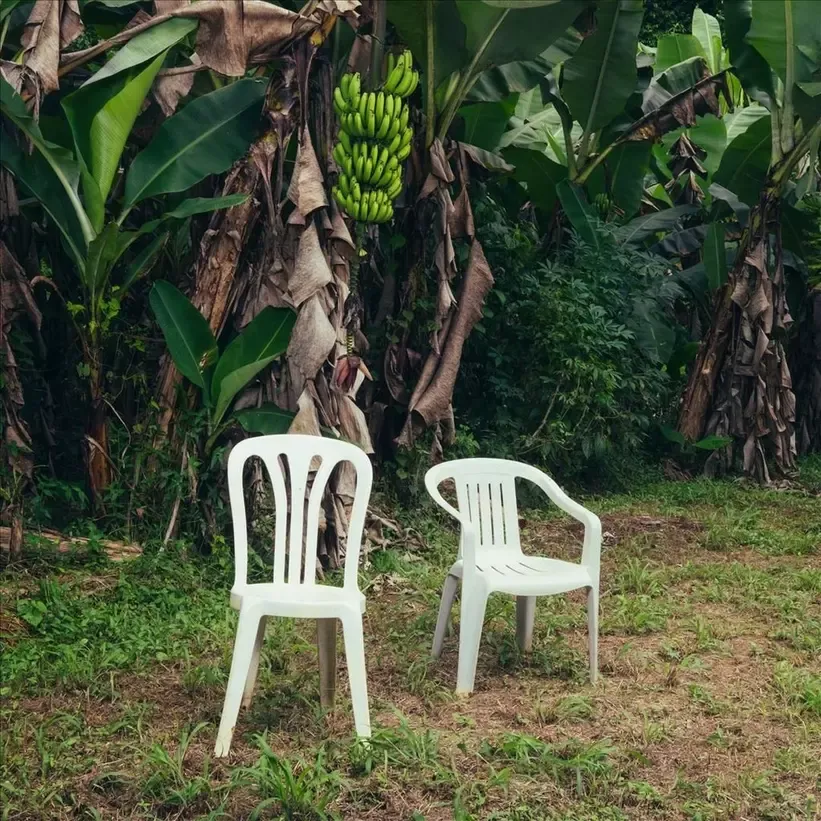
The image is deceptively simple: two white plastic chairs on a grassy lawn. They are the familiar stackable plastic kind you’ve seen a thousand times before – in gardens, on the street, in schools or other public buildings. These are ‘monobloc’ chairs – so named because they are molded from a single, continuous block of plastic – and they are arguably the most ubiquitous design object on the planet.
In the hands of Bad Bunny and Eric Rojas, the photographer behind the album cover, the monobloc chair becomes more than furniture: it is cultural shorthand, laden with memory and emotion. In Puerto Rico, these chairs are everywhere, drawn into circles by family, friends and neighbours to talk, laugh and share stories – becoming a symbol of community and identity. This is reinforced by the album’s back cover dedication – ‘to all Puerto Ricans around the world’.
Read alongside the album’s title, which translates to ‘I should have taken more photos’, the chairs take on a poignant register. They are empty, perhaps standing in for those no longer there: elders who have died, family members who have emigrated, a way of life slowly disappearing. All of this meaning is carried, improbably, by two plastic chairs. Herein lies the cover’s genius.
That said, what makes the monobloc so compelling is that it is both culturally specific and broadly nonspecific. Widely regarded as the most commonly used piece of furniture globally – found in cafes, markets, backyards, schools and festivals from Sweden to Sudan – it is the ultimate ‘everychair’.
During a talk in New York accompanying the Museum of Modern Art’s 2025 exhibition Pirouette: Turningpoints in Design, design critic Alice Rawsthorn argued that ‘few objects are as truly quotidian as the monobloc, which conforms to the dictionary definition of the word by being unalloyedly ‘ordinary’, ‘commonplace’ and ‘everyday’’.
Its success is rooted in its simplicity. The monobloc is produced in a single step, from a single material, typically polypropylene. It is lightweight, durable, weather-resistant, stackable and extremely cheap to manufacture. In a video accompanying Pirouette, head of architecture and design at MoMA, Paola Antonelli, describes the monobloc as ‘the culmination of a long standing desire among designers to create the perfect industrially manufactured chair’.

Prior to the mid-twentieth century, the idea of a chair with no screws of assembly required was virtually inconceivable. Advances in thermoplastics in the late-1950s made it possible to heat plastic pellets, liquefy them and inject them into a mold to produce a single, seamless form. In the 1960s, Danish designer Verner Panton, along with Italian designers Joe Colombo and Vico Magistretti and German architect Helmut Bätzner, developed the concept. The monobloc chair only entered true mass production, however, after 1972, when French engineer Henry Massonnet introduced the Fauteuil 300 through his company Stamp. His model reduced production time to under two minutes.
To Rawsthorn’s mind, the design leap occasioned by the monobloc echoes that of one of the earliest mass-manufactured chairs: the No. 14, developed in the mid-1800s by German cabinetmaker Michael Thonet – ‘the first chair designed to sell for the same price as a cheap bottle of wine, making it the first chair to seat modestly paid teachers as well as aristocrats’.
Crucially, Massonnet never patented the Fauteuil 300. As a result, it was freely copied by manufacturers around the world, incrementally modified again and again. By the early 1980s, polypropylene injection molding had been widely mastered, leading to billions of monobloc chairs sold over the following decades.

Verner Panton's monobloc Panton Chair (1959)
The monobloc is something of an industrial design holy grail, representing the purest expression of its ambition: a complete object, made in one process from a single material, and accessible to almost everyone as a result. But for some, that ubiquity has become a problem. Its critics condemn it as a symbol of throwaway culture, environmental harm and cheap consumerism. So common as to feel anonymous, the monobloc often seems disposable – an object with a short life and a long afterlife in landfill. From 2008 to 2017, authorities in Basel, Switzerland, even banned monobloc plastic chairs from public spaces, arguing that they detracted from the city’s appearance.
‘Not all turning points in design are wholly positive, as the monobloc illustrates by being a force for good in some respects and for bad in others. The monobloc’s dangers… stem from what was once its principal asset: that it’s made from plastic,’ Rawsthorn acknowledged, adding that it’s almost impossible to repair the chair when the plastic breaks, making it a poor candidate for circular economy practices.
‘[This] puts it on the lengthening list of innovations which were widely considered to be successful for much of the last century thanks to their functional benefits and technical sophistication, only to be condemned as ecological nightmares in this one,’ she continued. ‘What the monobloc – and every other once-celebrated design project facing the same dilemma – needs, is a radically redesigned successor.’
Whether you see the monobloc as a design icon or ‘ecological nightmare’ and eyesore, few objects have been more referenced and repurposed across art, fashion, film, memes and political protest, or come to represent so much – from globalisation and modernity to ordinariness and resistance. On the cover of Debí Tirar Más Fotos, the monobloc is rooted in Puerto Rican life, but it is a universal visual cue. Not bad for a chair.