Back to the '90s: Edward Enninful and Juergen Teller remember the decade's freedom, chaos and creativity
To mark the Tate’s celebration of the art and fashion that defined 1990s Britain, exhibition curator Edward Enninful and photographer Juergen Teller reminisce on an eventful decade
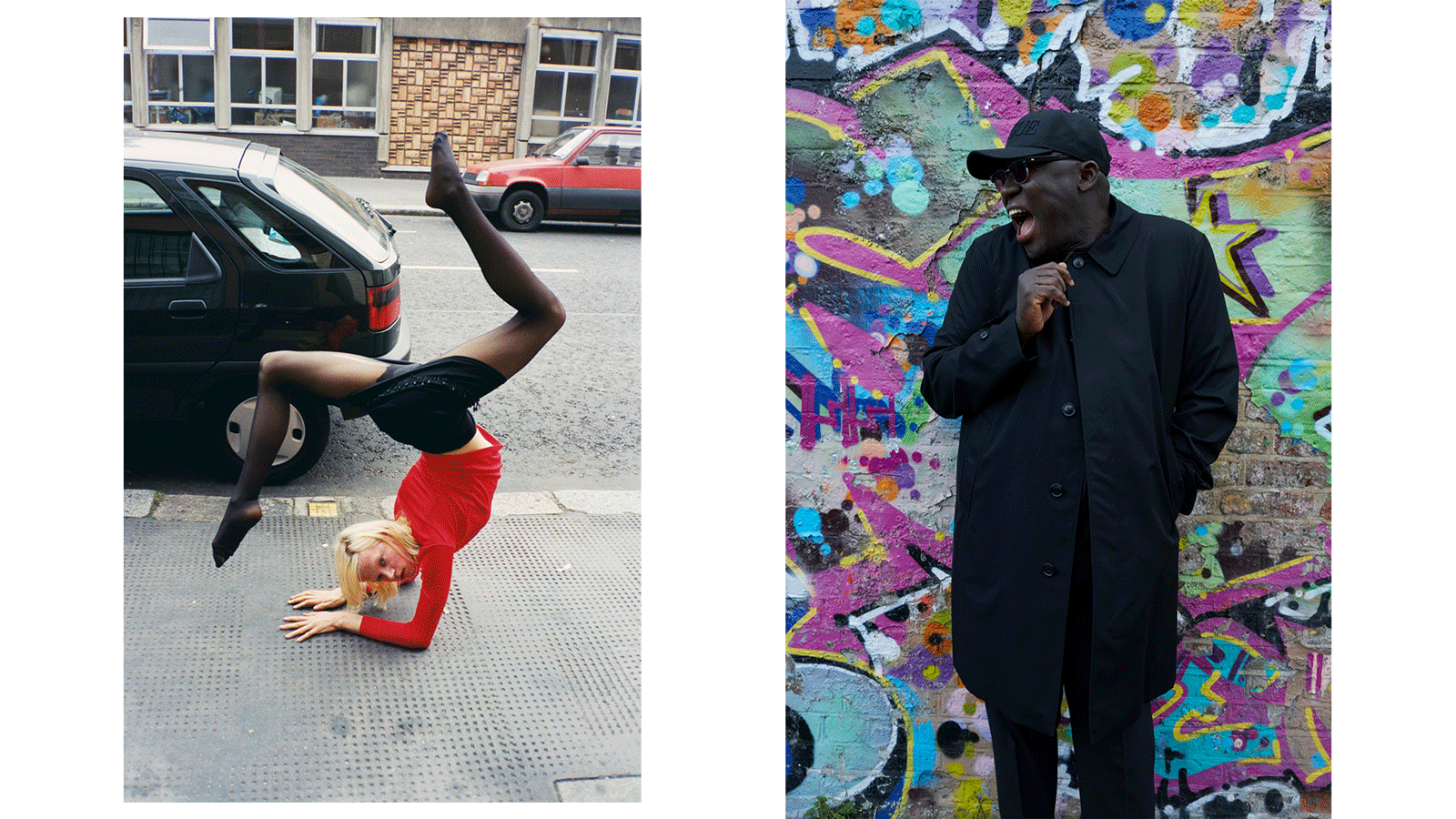
Juergen Teller: When did we meet, Edward, around 1993, working at i-D? How old were you, 15 or 16?
Edward Enninful: I was 18. I remember you took me to Cornwall.
JT: You were so scared of the countryside! There were sheep!
EE: I was very urban.
JT: It was hilarious. I remember it – there was a hill, and we were lying down on the grass, looking at the sky.
EE: And I'd never been to the countryside before! I remember first meeting you, Juergen. You came to the office, you had your striped pyjamas, and your camera, and the whole office thought, ‘Oh my God, he's so good looking.’ You’ve m always been so talented. It was really an honour to meet you, you were just full of life and energy - the same as now.
JT: We became friends. We were hanging out in London doing things, and then also working together too.
EE: You’re such a good friend, Juergen, so it never feels like work. And no two jobs are ever the same with you. What I love about working with you is you see things that the normal human eye doesn't see. We can both be looking at the same space, and you will see it from an angle that I've never seen before. So that's always really exciting. And if you’re really into an idea, you know in two seconds. But when you say, ‘Let me think about it,’ you're like, ‘Nah, it's not going to happen.’ And now we’re working together again.

Closed Contact #4, 1995-96, by Jenny Saville and Glen Luchford
JT: I was a bit shocked when I heard about this exhibition. I thought, oh my God, the Nineties, that was just yesterday. It felt so far away, but at the same time not so far at all, somehow. I had to get my head around it because I'm completely in a different headspace now. And I'm not nostalgic at all. I don't think it was such a great time, in a way. In a certain way it was, but it was really tough and really hard.
EE: Very hard.
JT: The establishment - it took ages to knock on doors and for them to open up. The outlet was very little. There were a couple of magazines, hardly anything in the world. And now there are thousands1000s of them, literally, and there were very few art directors and stylists who inspired me, and who I inspired in return. It was a very small circle. And it took six months to think about an idea, and weeks to shoot.
EE: A picture a day sometimes!
JT: For me, the beautiful thing about the 90s, or the late 80s, was that I felt really proud. When I did have a chance to make some money, it was an honest way to make a living, like when a musician or a band asked me to do their record cover, back when they were proper record sleeves. I grew up with the visual language of how the graphics sit with a photograph, or whether there's a border around it. So my visual language was really from TV and music. Then I photographed Sinead O’Connor and the single, Nothing Compares 2 U, became number one.

Pauline Bunny, 1997, by Sarah Lucas
EE: And you know the video is in the exhibition?
JT: Yes! And I photographed Courtney Love and Kurt Cobain. Is this a portrait? Is this a reportage, or is it actually a fashion photograph? Through these portraits of these musicians, from punk to new wave to grunge, to all these different movements - fashion picked up all that stuff later, and they inspired fashion. So I was interested in music and doing portraits of these things and that's how I got to know these zeitgeist magazines, like the Face and i-D magazine where there's suddenly these fashion pages. I come from the forest, in the countryside. I didn’t have much of an idea of fashion at all, but it felt very natural to me.
EE: We just wanted to create. We were all living in Notting Hill, kind of broke. I was thrown into i-D at such a young age. I had to sink or swim. But it was just fun hanging out, going clubbing. I was always out. You know, go clubbing, go straight to work.
JT: There was a beautiful, honest naivety. It was a really pure time of wanting to explore. A time before phones and the internet. You had to go to a record store. You had to go to see things happen - it was so much more difficult to find something, so it meant more.
'Suddenly, you’re on Concorde flying to New York and you’re in front of these supermodels, like Linda Evangelista. I was so shy, I couldn’t say a word to Linda.’
Juergen Teller
EE: I remember spending hours in libraries, doing research, trying to get images from the 70s. It was like you said Juergen, the last time before cell phones, before online. So we were able to really experiment, really make mistakes and learn from them. It's rose-coloured now, but it wasn't the easiest of times either. I was probably the only Black person I remember, apart from maybe Pat [McGrath] and Naomi [Campbell]. We had to negotiate and find our way.
JT: And I'm German! Being in that environment in London was very tough for me. But all these ideas from that time are found in Young Pink Kate [the lead image for the exhibition]. She looks so beautiful, and it was a time where we felt really free. There was no, you can't do this, or you have to put on an outfit head to toe, and you have to have that handbag in it. With this photograph, it was just Kate. She went to a fashion show in Milan for Gianni Versace, and they coloured her hair pink. She flew back to London the next day and called me up. She said, ‘I'm going to change my hair color back to normal, but before that, Juergen, come over to my house and photograph me, because that could be something.’ That was it, and we had a nice time. There was no other reason other than we both wanted to do this picture. It wasn't even for a magazine or anything.
Nobody wanted money or publicity, we wanted to do it creatively. We wanted to play. What also really works is the photograph of her turning round on the cover of Wallpaper*. It's like turning round into the 90s kind of thing, and it feels so innocent as well. It's this real sense of freedom.

Alexander McQueen, photographed by Sean Ellis and styled by Isabella Blow, for The Dark Knight Returns story in the August 1998 issue of The Face
EE: I was lucky to be at i-D at the best time. I would be able to style, commission, see the incredible work that came in, the incredible people, and just be right there. That was very, very special.
JT: I remember in i-D and The Face there used to be cigarette advertising.
EE: Yes! We had to go to the clubs to sell the ads to the record company people. You know the little back page ad? Go and sell it! We were young, we had the energy.
JT: And you didn't need much money to survive. Every single penny I earned, I put back in because photography was expensive back in the day. You had to have film, to have it processed, to go to the lab, to have them printed or print them yourself. You had to be very careful of how much you shoot and how much you spend on things like that.
EE: We were all just growing up, and your tastes change, and the times were changing. We saw so many iterations of what the '90s meant, from pure minimalism, to when Juergen was shooting with flash. The changes during the 90s result from age and experience, don’t you think, Juergen?

Images from Nigel Shafran’s 1990 Teenage Precinct Shoppers series

Images from Nigel Shafran’s 1990 Teenage Precinct Shoppers series
JT: Yes, I became successful, and recognised as a fashion photographer, and American Vogue asked me to work for them. Suddenly, you’re on a Concorde flying to New York, and then you’re in front of these supermodels, like Linda Evangelista and Stephanie Seymour. I remember sitting on a park bench, I was so shy I couldn't even say a word to Linda.
EE: And she was so excited to work with you!
JT: And it was really good. But very quickly, I felt frustrated with the commercial constraints of a big, commercial fashion magazine, and I thought, instead of me flying to New York or around the world, I want to be in my studio. And then all these model agencies called me up, and I thought oh, this is actually interesting. It was at a time when we grew up with Kate Moss and Kate, she became so successful - this quirky, small, super energetic and interesting young woman. Everyone was trying to find a new supermodel like Kate, but there isn't any of course, but it opened up the door for so many other things. I thought, instead of me trying to find another so-called new supermodel, I want to photograph all of them, and put it in a book [Go-Sees, 1998-9]. I wanted to be democratic and I wanted to be able to do a good portrait of anyone. I tried my hardest to do the best positive portrait I could of that person. It became very successful and I learned a lot from that. That was an important project for me - to step back from the hyper commercialised fashion photography to, hang on a minute. In a way that was my first conceptual artwork.
EE: For the Tate, Go-Sees was a game changer. I remember when I saw it - wow, this is something new.
JT: And I never had any kind of a stereotype. For me, it's like, whoever that person is, is great. It doesn't matter where they come from or what they do, it could be anyone who I find interesting. So that was very important for me, and it was also a bit of a critique on the fashion industry of how that whole thing gets handled, and it is tough for the models.

Juergen Teller, Young Pink Kate London 1998
EE: It was such a work of art. That's why it's got its own world, essentially, in the exhibition. And what was key when thinking about this exhibition is, obviously, it is at the Tate. It's not the V&A or the National Portrait Gallery. Art has to power every room. Art has to be at the centre of it, and that has been really great. Even when it came to selecting the pieces, it was amazing calling the people in the show because it didn't even feel like work. So that was the first thing. And the second part is, this is not a nostalgic, let's look back, it’s recognising the decade established conditions that are still with us.
And the artists are a combination I really like, many who didn't go to the best schools or weren’t in the right gang, but whose work was amazing at the time. It’s not just, here's a YBA show. And then, of course, how do you show fashion in an exhibition with such great artists? So that was another interesting approach, where we thought, let's make each fashion piece almost like an artwork that can stand on its own, and that was the focus. But this is by no means a comprehensive guide to the '90s. It's just my view of the '90s, with my friends, great artists that I was lucky enough to grow up with and be around, have a couple of drinks with. So it was really a pleasure, working with people who were so great at what they did, and redefined a whole decade - like Juergen.
Wallpaper*: I’m so glad we get to mark it with our incredible cover from Juergen.
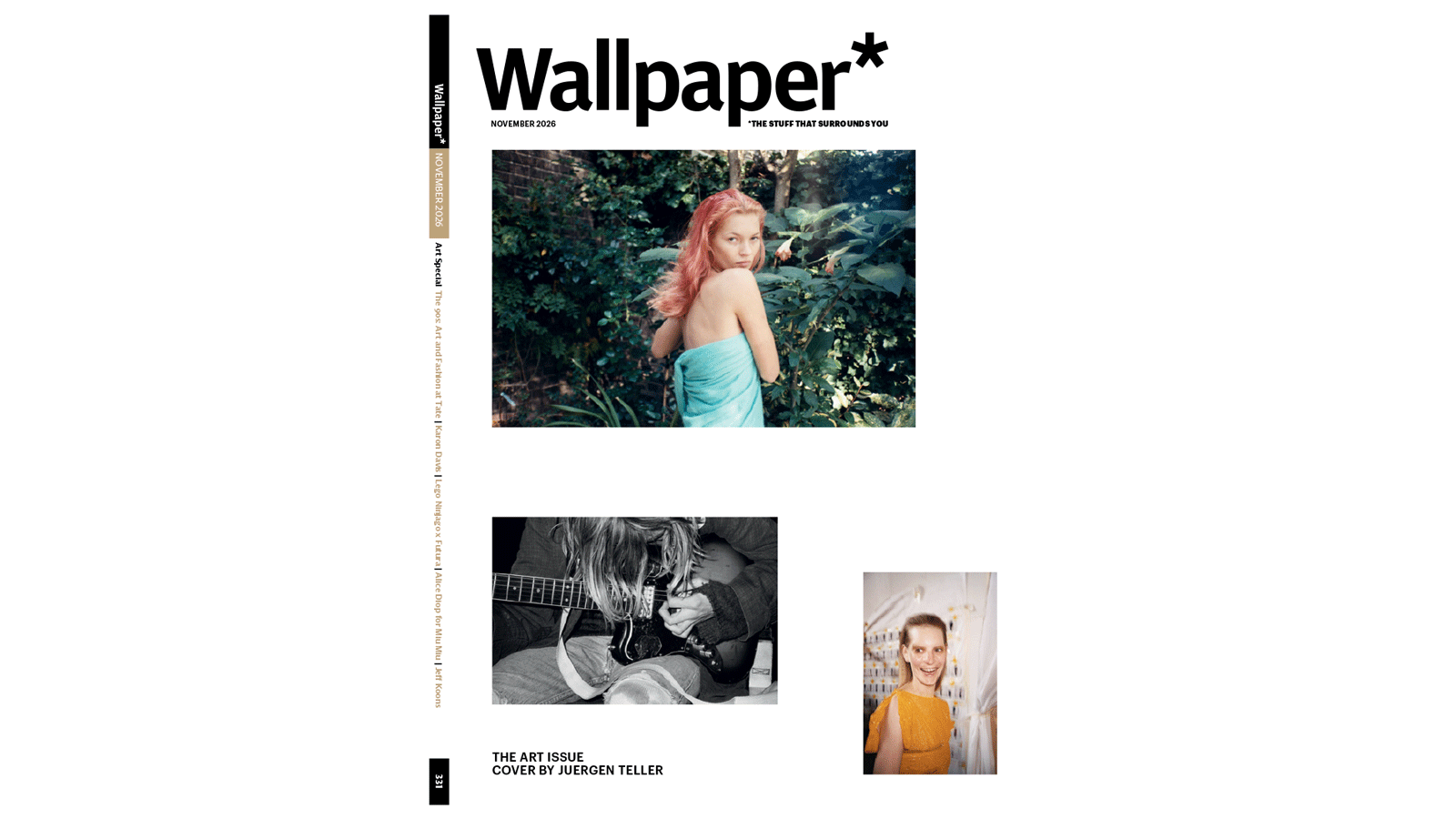
The Wallpaper* November Art issue, on sale 8 October
EE: Your cover is so amazing! And let me tell you something about Juergen Teller. He calls me, he kept calling me. When Juergen has something on his mind, he will call you nonstop. And he was getting on a plane, on top of everything he has to do that week - you were in New York, you went everywhere that week.
JT: Yes!
EE: He called to say, I have the incredible cover for Wallpaper*, and that's what I love about Juergen, his focus. Every job is so important to him. When I saw it I was like, oh my god, this is amazing! He thinks about it all the time. I love this cover so much.
JT: Excellent. Me too!
A version of this article will appear in the November 2026 Art Issue of Wallpaper*, available from 8 October in print on newsstands, on the Wallpaper* app on Apple iOS, and to subscribers of Apple News +. Subscribe to Wallpaper* today
'The 90s: Art and Fashion’, curated by Edward Enninful, is on show until 14 February at Tate Britain, London SW1