
It’s a Torqued Ellipse! It’s a Torqued Spiral! It’s…the Oval Office?! Just days after former President Barack Obama likened the Trump-era White House to a Cheesecake Factory opened by Saddam Hussein, the people have spoken, the political tide has turned, and the Oval Office has been stripped of its ersatz ormolu and transformed into a serene volume of Cor-Ten steel. Starting today, you can step inside.
This Oval Office, all 36 handsomely weathered tonnes of it, is the work of Elmgreen & Dragset, fresh from rectifying another presidential design blunder with the installation of their meticulously crafted, cyan-bottomed pool in the Hirshhorn Museum’s revitalized sculpture garden. From Washington, DC, the Danish-Norwegian artist duo headed to Manhattan to put the finishing touches on ‘TRANSITION,’ an impeccably timed new exhibition at Pace Gallery that evolves the 'Powerless Structures' series of finely calibrated reconfigurations they began in 1997.

‘We discovered that the Oval Office is actually not very big, even though it’s torturing your social feed every morning and puts you in a very bad mood,’ said Elmgreen at a preview of the show. ‘So, we thought, why don’t we turn that entity into a sculpture? Why don’t we try to take away its power symbols, all its decorations, all its authoritarian structure, and see what it becomes if it’s pure volume?’
The Richard-Serra-meets-the-West-Wing result is at once monumental and enveloping, austere and cozy. Fabricated in north German steel country by Serra’s metal-formers of choice, the two-part structure is just shy of actual size and aerated by lattices of would-be windowpanes and a door – all placed to match those of the actual Oval Office.
Passing into the bracketed void, the artists provided further orientation. ‘You’re walking through the Resolute desk,’ noted Dragset, while Elmgreen pointed out a pair of imaginary couches and the space where the press would scrum. ‘It fills up very easily,’ he said. ‘Journalists are aligned along this wall.’
The choice of Cor-Ten steel not only connects the installation with the formal language of Minimalism (most notably Serra, with a side of Gordon Matta-Clark’s decisive cuts and apertures) but also imbues it with vitality – a robust and earthy contrast with what Obama described as ‘supergluing gold medallions to the mantel.’

‘We can’t take credit for the incredible surface,’ said Dragset, eyeing the variegated russet tones blooming on the curved walls. ‘It was transported by sea in an open crate, and exposure to the elements created this painterly quality. It’s a surface of constant transformation.’
The rugged, traversable oval sculpture is paired with an adjoining room of six large wall-mounted circular works. This is the Balcony Series, in which Elmgreen & Dragset have altered photographs of assorted heads of state waving from on high. ‘The balcony is another architectural power centre, supporting and elevating the head of state who is standing above people’s heads and waving down,’ said Elmgreen. ‘Images of royals and presidents are cut out of the image. The important part for us is the balcony – it’s the guilty architecture.’
Silkscreened in black and white onto stainless steel plates polished to a fine gleam, familiar figures are disappeared into mirrored silhouettes, reflecting onto the floor as human shadows. Eye-level placement means that the viewer encounters his or her own visage where the missing leader’s should be.

The Balcony Series, by Elmgreen & Dragset
Is it a despot? A beloved monarch? A slick alum of Sciences Po? The identities and locations are not disclosed, but the Buckingham Palace scene is unmistakable, and architectural detectives will delight in mining the other balconies for clues. Those delicate decorative accents that carry the fizz of Danish Rococo suggest Margrethe II, who Elmgreen recalls waving a little flag for in 1972, when she was proclaimed queen (on the balcony of a different Copenhagen palace). Over at the Casa Rosada (disguised in greyscale), the legacy of Evita is carried on by the distinctively coiffed present-day president of Argentina, Javier Milei.
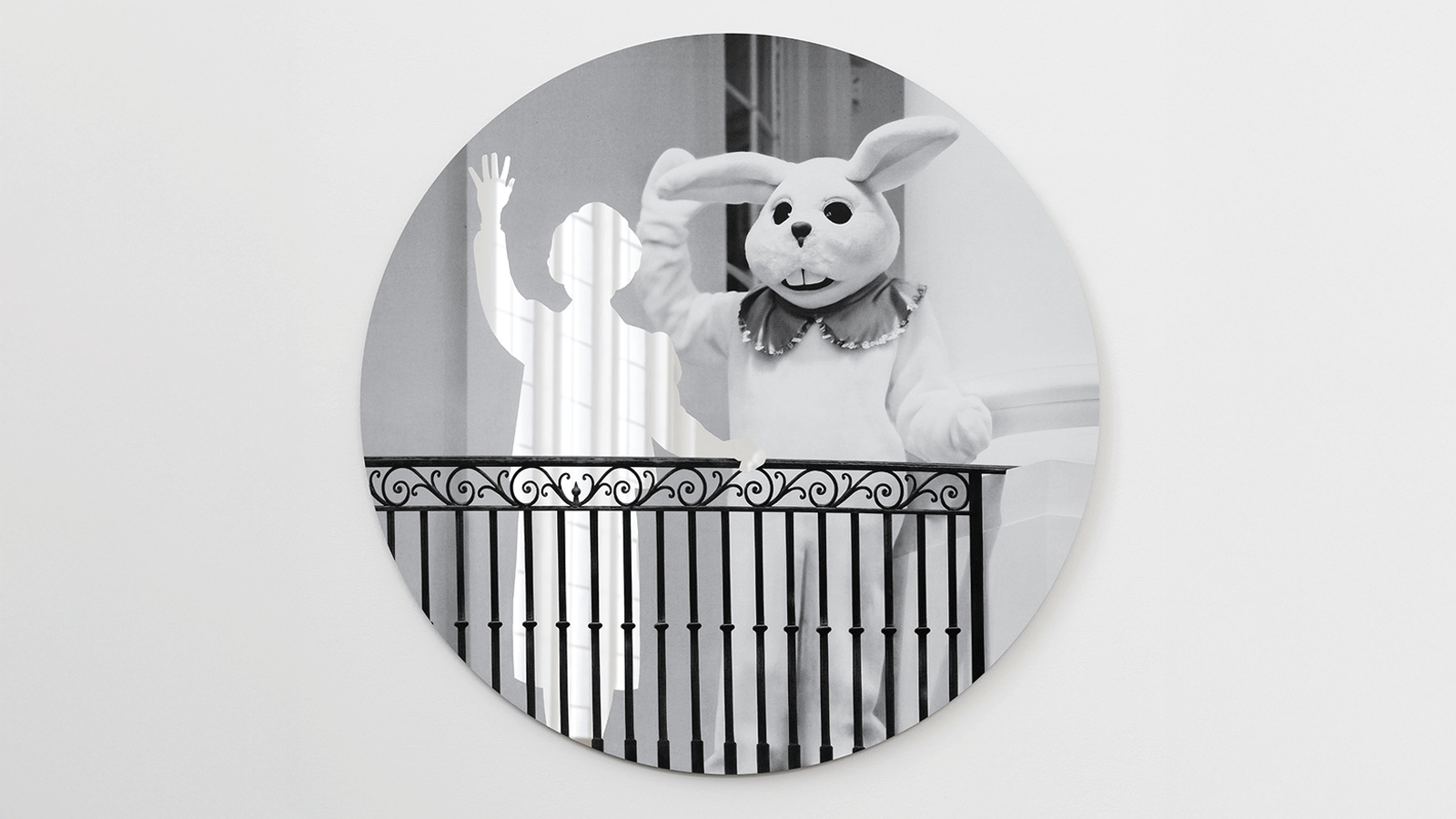
In one work that gets a wall to itself, the silhouette of former First Lady of the United States Nancy Reagan is joined on the White House balcony by a figure in an Easter bunny costume. Where some will see whimsy, others, including Elmgreen & Dragset, discern a figure synonymous with her deadly silence during the AIDS epidemic of the 1980s.
Yet as the last several days have demonstrated, change – transitional, transformational, even triumphant – is possible. ‘These works are the ultimate in adaptability. Due to their mirror-polished surface, they will change according to where they hang,’ said Elmgreen. ‘They will suck in the surroundings and tell a different story. Think of it, this one, reflecting a blue sky, you would suddenly turn it into a Magritte!’
‘TRANSITION’ is on view at Pace Gallery until 16 January 2027