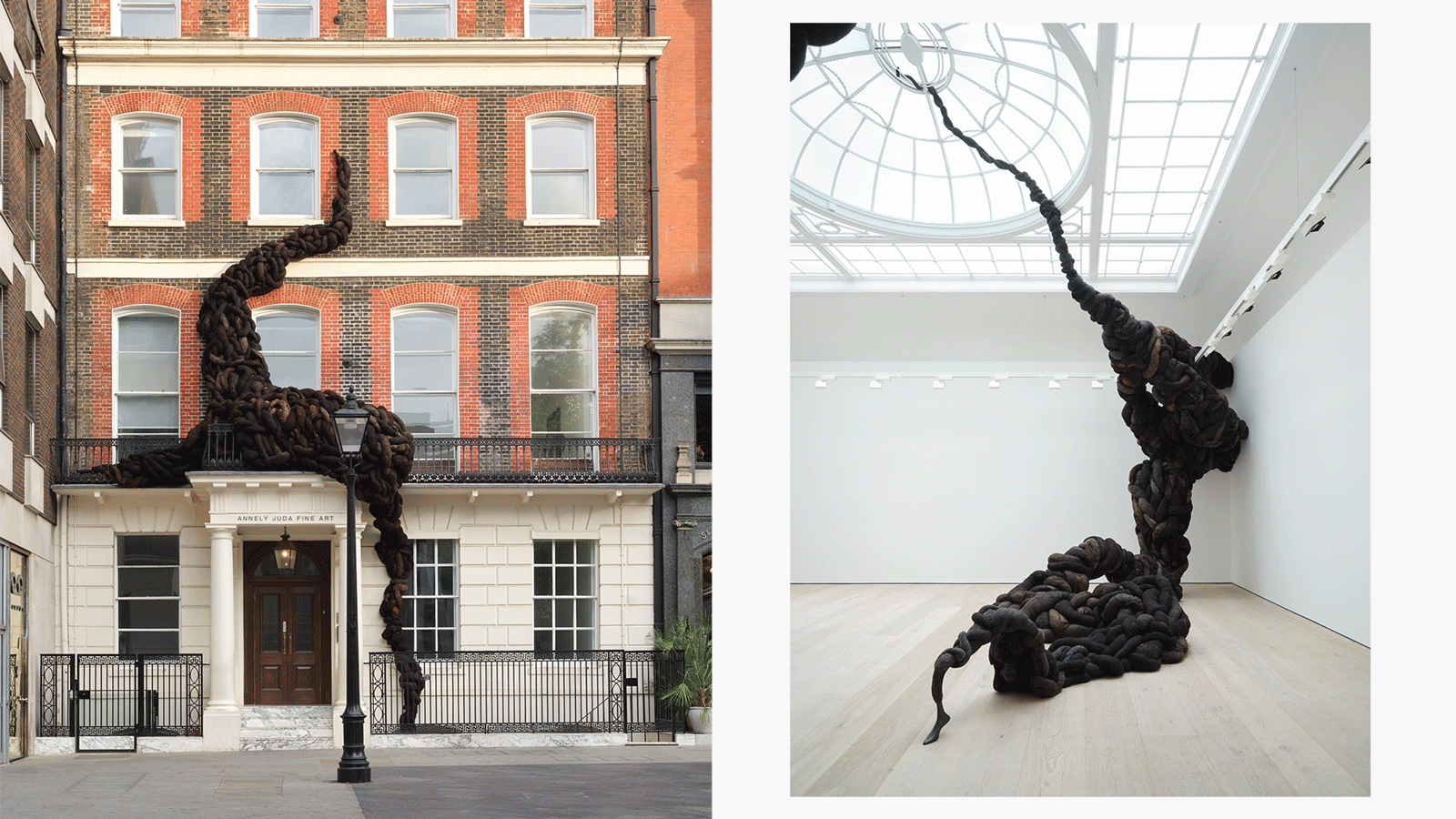
Nicola Turner’s expansive sculptures reach deep into the unconscious. The British artist creates repurposed horsehair installations which creep and tumble across gallery walls, floors and façades. ‘I Tear Secrets from Your Yielding Flesh’, her new exhibition at Annely Juda, sees giant dark tendrils crawling from the windows of the gallery’s Grade II-listed Georgian townhouse on Hanover Square. Inside, a series of smaller works leads up to a giant sculpture in the back room that hangs from an antique glass ceiling lantern.
The work is as emotionally confronting as it is beguiling, open enough for the viewer to project their own discomfort or intrigue onto its creeping forms. ‘I really try to let myself respond to the space while I’m there,’ she said, reflecting on the ambitious installation. ‘It is almost like a fight or a battle with my material. Then it sits and settles. I’m interested in the weight of the material, how it pulls, how it hangs and how it holds on. All of that helps to give an emotion to the piece.'

Numerous sculptures appear like living figures who teeter on pointed blades and shears. The artist describes herself as a ‘very anxious person’. The sharp points mirror her feeling that ‘I can’t let myself be held by the ground… like the tension is always in my shoulders’. Previous surgeries and medical interventions are reflected in the cutting and stitching of her work. Multiple women have contacted her after visiting her shows to share their own experiences of PTSD. ‘I don’t purposefully make work about female shame; however, the shapes that emerge morph into that,’ she says. ‘In putting material together, somehow the emotion from me or my tensions are encased in that material.’
The gutlike nature of the work calls to mind the body’s ‘second brain’, which contains a well of feeling. ‘Neuroscientists are now realising they have to go below the neck,’ she says. ‘Trauma can be passed through the gut into the next generation. I find [the latest research into this] completely fascinating.’ Turner encourages a physical, and not just thinking response to the work. ‘I’m interested in that unsettling feeling.’

The show also riffs on the building’s history. The Royal College of Chemistry rented the space from 1845, using the downstairs as a laboratory. A student working there discovered that a purple solution could be extracted from coal tar, before patenting the first aniline dye. ‘It revolutionised fashion,’ she says, as purple became available as a clothing colour for everyone, not just an expensive luxury for royalty. The building was later used by Reville and Rossiter, a couture house and dressmaker for the royal court. When Edward VII died in 1910, they dyed all of their stock black using a version of the aniline dye to accommodate the overwhelming public mourning.
Reville and Rossiter also made Bloomsbury writer Vita Sackville-West’s wedding dress. In 1918, five years after her marriage, Sackville-West penned an erotic poem to her lover Violet Trefusis. Turner used a passionate line from the poem as the show’s title, reflecting the stigma and covert nature of Sackville-West’s same sex relationship. She sees the building’s rich history and different narratives as encapsulating the secrets of both chemistry and couture, while also drawing upon the idea of shame.

Dress makers' scissors, vintage stockings and pins repeat in the work, inspired by the building’s history. ‘I gathered all this and then gave myself the freedom to just make,’ she says. ‘I reflected afterwards about how that relates to the history I had researched.’ The horsehair mattresses that are frequently reformed in her work are also embedded with the memory of their time on animals’ bodies and then as domestic furniture. There is a ‘slight whiff on the larger pieces’, she says, ‘a really visceral smell that you feel in your gut’.

The show seems to so adeptly express how it feels to suppress a trauma that can’t help but erupt. In a world that encourages us to push down and repress painful feelings, there is a sense of relief and liberation that comes with this. ‘I have this roar in my stomach,’ she says. ‘I feel like I’ve let it out a little bit.’
Nicola Turner at Annely Juda until 7 November 2026