The early aughts were a time of technological friction. The World Wide Web was becoming part of everyday life, and people – now ‘users’ – were entering the greatest masquerade ball of the modern age. Meanwhile, reality shows were turning living-room televisions into a social panopticon.
Television presenter Chris Hansen occupied this awkward intersection. His To Catch a Predator segments, which began on NBC’s Dateline in 2004, turned anxieties surrounding internet chatrooms into compulsive viewing. Adults posing as children online invited suspected predators to suburban houses, where hidden cameras recorded their arrival, and Hansen then emerged to confront them. The programme combined investigative reporting with the suspense of a hidden-camera show, making its presenter a celebrity. (The show ended in 2007 amid legal and ethical fallout following a suspect’s suicide)
A new film seeks to portray Hansen at the height of To Catch a Predator's popularity. Set in 2006, Primetime casts a bleary-eyed Robert Pattinson as Hansen, alongside Merritt Wever, Skyler Gisondo, Phoebe Bridgers, Matthew Maher and Bokeem Woodbine. It marks the first narrative feature from Lance Oppenheim, who has also co-directed the acclaimed Elizabeth Holmes documentary You Can See Everything (2026), co-directed with Nathan Fielder.
Bad taste makes good cinema in ‘Primetime’

Written by Ajon Singh and inspired by true events, the A24 thriller follows Hansen as his journalistic ambitions become entangled with the demands of entertainment. It offers a disquieting portrait of a showman struggling to reconcile his public image, ego and increasingly distorted sense of morality.
Much of the film takes place in the suburban houses where Hansen and his crew stage their encounters. On the original programme, these were real homes temporarily fitted with hidden cameras, with adjoining rooms given over to producers watching the monitors. Visitors arrived expecting to meet someone they had spoken to online, while Hansen waited out of sight.


Recreating these borrowed interiors fell to production designer Alex DiGerlando, whose credits include Love Story (2026) and True Detective (2014-2015). He studied the original episodes, noting the furnishings left by homeowners and the awkward adjustments made for filming. ‘You can’t kind of lure a guy into a soundstage,’ he tells Wallpaper*.
The houses needed to remain convincing, even with a television operation installed inside them. His instruction to the art department welcomed their decorative peculiarities: ‘We should not be afraid of the ugly. We should embrace it.’
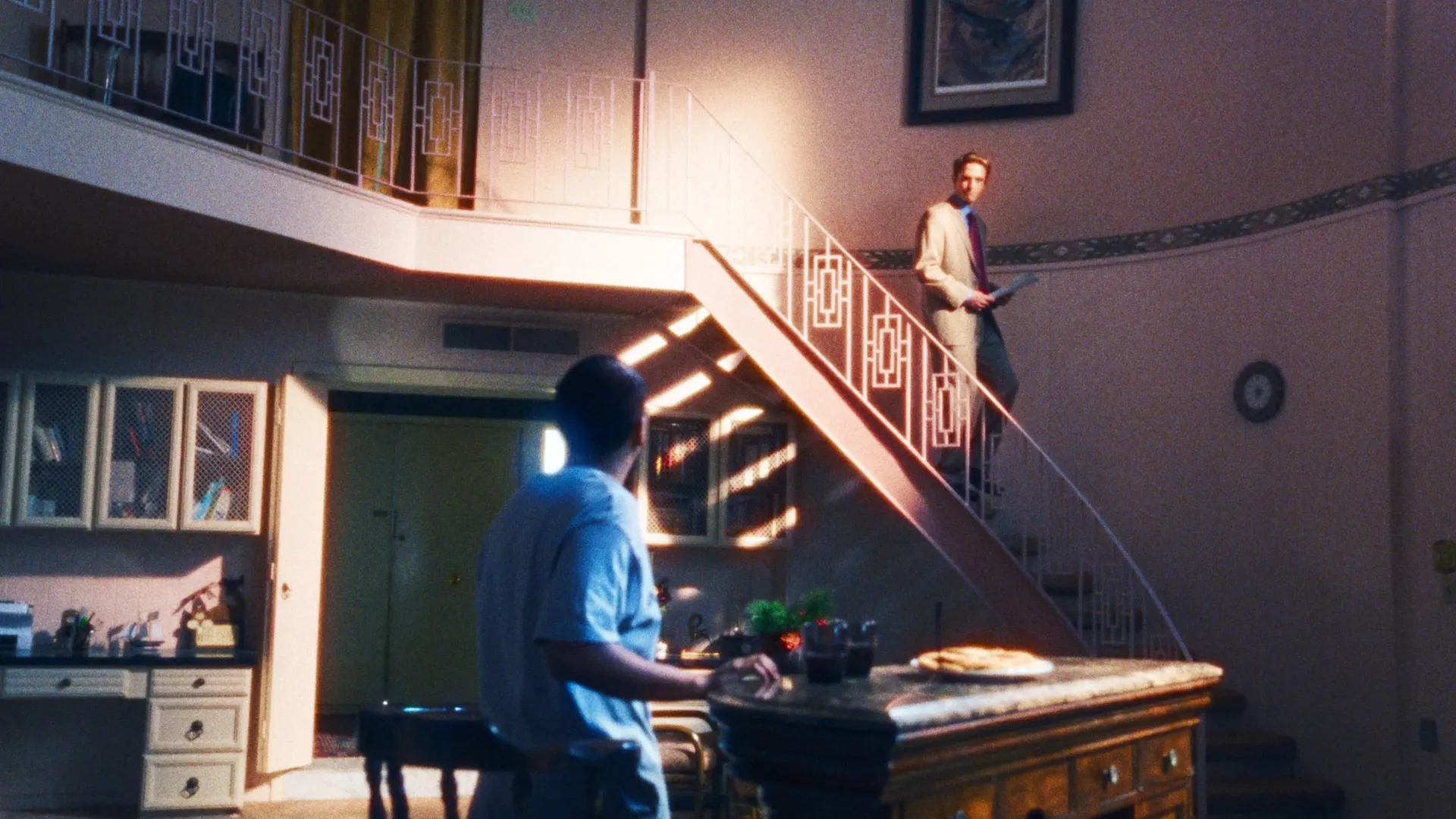
Working around New Orleans, the team found properties to stand in for California, Florida, Texas and the American northeast. DiGerlando asked location manager Tyler Holman to look for homes belonging to older residents, whose renovations might date from when their children were young. Original appliances spared the department the trouble of finding replacements, while wallpaper, shag carpet and architectural eccentricities supplied the texture and imperfection the team sought. ‘The Internet has sort of homogenised people’s tastes, and algorithms funnel everybody to the same places,’ he says.


Among those architectural discoveries was the grand staircase in the opening sting house, where the filmmakers imagined Hansen descending like Bela Lugosi’s Dracula (1931), an entrance absent from the script but consistent with their discussions of vampire lore and invitations across thresholds. ‘Chris is a vampire in his own way,’ DiGerlando says. ‘These things are his lifeblood.’
Larry Sultan’s 2004 photo series The Valley, which photographs adult-film productions at work in San Fernando Valley homes, offered DiGerlando, Oppenheim and cinematographer David Bolen another useful reference for the sting houses, where a television crew’s equipment had to coexist with the owners’ furnishings. ‘Both To Catch a Predator and adult films […] would move into a location that was chosen for whatever reason, and then would do slight modifications,’ says DiGerlando. Sultan’s photographs helped the team consider how much of a household would remain visible once a production had rearranged its rooms.


As he watched the original television episodes in preparation for the film, DiGerlando noticed that family photographs had been removed from the houses while ornaments and artworks remained, revealing something of the owners’ tastes without identifying them. ‘They do tell you a lot about the person who lives there,’ he says, recalling how he wondered whether seeing his own belongings amid ‘the kind of darkness that had been let in’ would change his feelings about his home. The team selected objects that suggested these absent occupants and borrowed details from the programme, including a ‘live, laugh, love’ mural above one kitchen.
Furniture rearranged for filming and an unusual abundance of lamps hinted at the television operation installed among these household possessions. The lamps illuminated the encounters without bringing conventional film lights into view. ‘We purposely would put too many lamps in a place,’ says DiGerlando, explaining that a visitor might notice the odd arrangement before recognising its purpose: ‘He’s not yet tipped into what’s going on.’
He also insisted that cables remain visible across the floors, observing that in most films, ‘all the cables that would make that work miraculously don’t exist’.


Bedrooms and dining rooms became control rooms, with banks of monitors occupying increasing amounts of space as the television operation grew. Recreating the stings required several cameras to record simultaneously, sometimes following an encounter through the house and outside to an arrest in a single take, which left few places for the film crew to hide. ‘Typically on a normal movie, the crew could just be in the next room over,’ DiGerlando says, but here the action could pass through that room too, so the team surveyed each property and mapped out areas where they could remain unseen.
For the motels where Hansen and his colleagues stayed between stings, the team drew on Alec Soth’s 2006 monograph Niagara, whose photographs of rooms around Niagara Falls offered a record of the period’s décor. Recreating it sometimes meant undoing recent renovations, as at the motel used for the Florida scenes, where photographs supplied by the manager helped the team restore earlier colours and patterns. Soth, an admirer of Oppenheim’s documentaries, later visited one of the sets to take photographs of his own.


The rooms’ period character also depended on the cameras recording them, with Oppenheim and Bolen using over ten formats, including digital video and hidden cameras associated with the original programme. DiGerlando remembers early digital photography being regarded as ‘both exciting, but ugly’, its imperfections now helping to evoke the era alongside the furnishings. Working with colourist Damien Vandercruyssen, the filmmakers also transferred digital cinema footage to 16mm and back, adding grain to the film’s varied image textures.
‘It didn’t seem like something that people would fetishise ever,’ DiGerlando says of early digital photography, whose glitches now strike him as ‘comforting or cosy in a weird way’.
He adds, ‘Nostalgia is a powerful force.’

‘Primetime’ opens in UK cinemas on 30 October 2026