Who are Prune Nourry’s plaster-cast figures inside the Petit Palais?
As part of her ‘Visionaries’ exhibition, the French artist is bringing female sculptors to Paris, at all scales

Gathered in the light-filled spaces of the Petit Palais in Paris, blending into the museum’s permanent collection of work, from antiquity to present day, are 18 figures, visionary women cast in plaster. They are a new addition, courtesy of Paris-born artist Prune Nourry, who is looking to redress a balance that currently sees only 4 per cent of the Petit Palais’ collection created by female artists.

Working in plaster was a conscious choice for Nourry, who was invited by the Petit Palais to include her works as part of her ‘Visionaries’ exhibition. Surprisingly, almost 70 per cent of the works in the museum are ‘studio plasters’, works that were never intended to be displayed, but have survived the decades, unlike their bronze counterparts, which were originally destined for posterity.
It is a fitting analogy for the works themselves. Nourry has populated the Petit Palais with the figures of lesser-known female sculptors, a generous addition to the four female sculptors who are already included in the museum’s collections. As a subject, however, women are prolific.
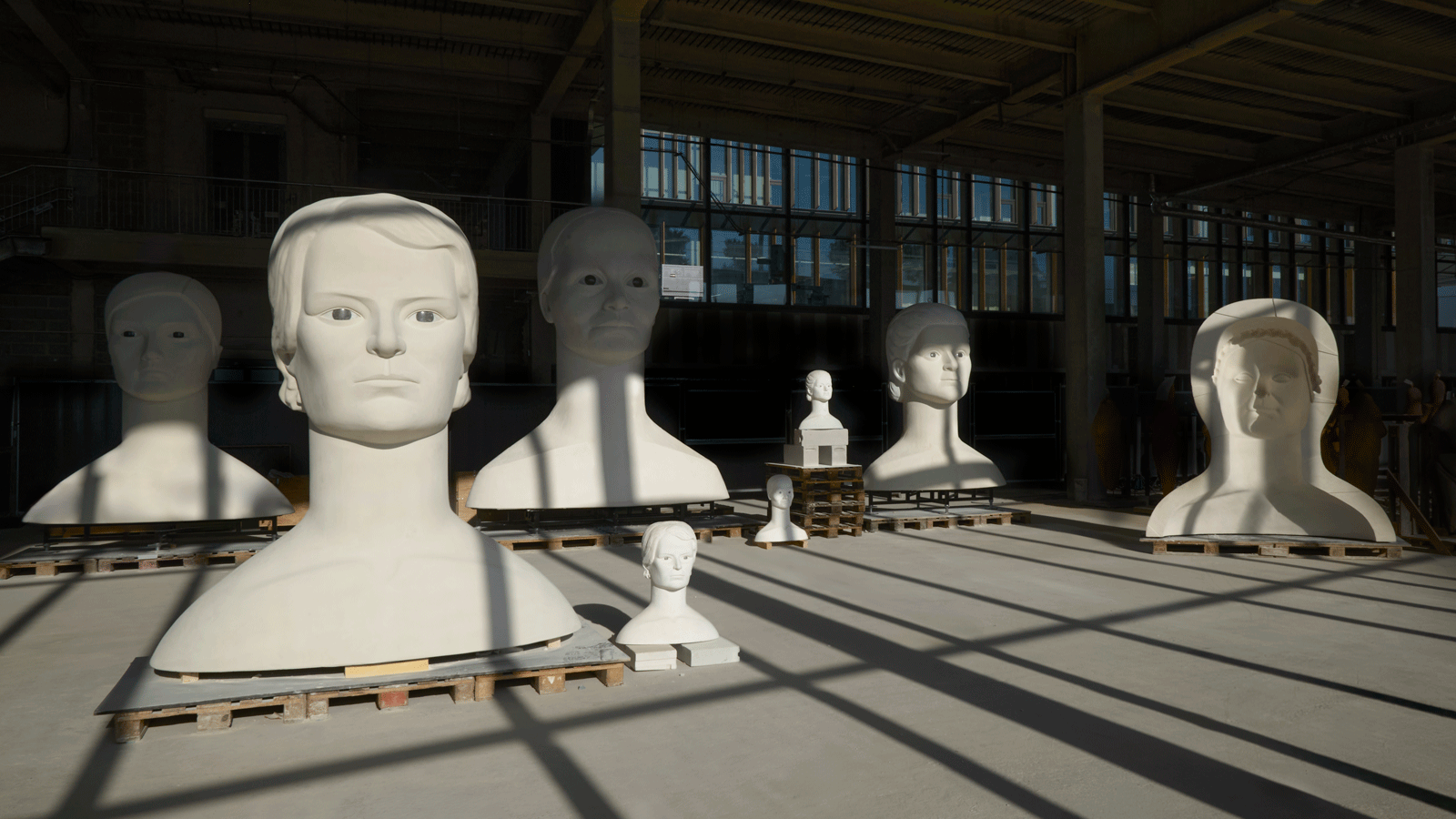
View of the workshop at the Saint-Denis Pleyel station
Upon discovering this, Nourry began to work with three art historians, researching female sculptors in the late 19th and early 20th centuries, collecting their writings and portraits in order to gain a sense of who they were. Featured sculptors, including Käthe Kollwitz, Nancy Elizabeth Prophet, Hélène Bertaux, Jane Poupelet, Consuelo de Saint-Exupéry, Selma Hortense Burke, Daria Gamsaragan, and Sarah Bernhardt, share a strong aesthetic identity to which Nourry was drawn.

Prune Nourry, Jane Poupelet
Nourry enjoyed the process of creating their representation in plaster – but it was stressful, she adds. ‘Very stressful. Obviously it's an interpretation of them and their portraits, because sometimes on the archive images I have of them, you only have the front, or the profile. If you have different images, they don't look like the same woman – they are from different parts of their life. I had to accept that interpretation was a huge part of this, and I hope that they forgive me.’

Prune Nourry sculpting in her studio
Sculpture is an instinctive process for Nourry, the sensuality of which she began to appreciate after being diagnosed with cancer in 2016, at the age of 31. ‘Sculpture is where I discovered the connection between my eyes and my hands – when I went through chemo, I lost the touch within my fingers,’ she says. ‘After that, I started a project where I would be blindfolded and sculpted only with my hands to make them work even more. Because I had the fear of losing them, I focused only on them. Sculpting is what moves me.’

Works for the exhibition ‘Visionnaires’, in the studio at the Gare de Saint-Denis Pleyel – Grand Paris Express
The works here are led by the character of the women themselves, or what Nourry learnt about their character through scrupulous research. While they share arresting marble eyes, in line with the Petit Palais’ sculptures, the busts on show play with scale, a thoughtful consideration of the space a woman can require.

Prune Nourry sculpting Jane Poupelet
‘I could have done very different styles according to each of their work, but I chose not to,’ says Nourry. ‘The portraits I have are from that time in the 19th century, when you went to the photographer who would arrange you in a certain posture. You wouldn't smile, and you would be quite front-on to the camera. That posture is what you feel in the portraits.’
She wanted the busts to go beyond the concept of the body itself, Nourry adds. ‘I wanted it to be about them as human beings. I did very different sizes, also to show that sculpture can be in very different sizes, and it is not a hierarchy here. It was just based on whose pictures I got first, and I would then start to sculpt first – they would be big because, in terms of the process, this is the timing you have to respect.’

Prune Nourry, Wang Jingyuan
Ultimately, it has been a labour of love for Nourry, and an essential expression of her role as an artist. ‘Sculpture is like my spine,’ she says. ‘It's what keeps me straight.’
‘Prune Nourry: Visionaries’, from 20 October 2026 – 24 January 2027 at Petit Palais; prunenourry.com