
Dramatic and futuristic-looking, High Tech architecture is one of the best-recognised movements of the 20th century. It also helped propel its key proponents – many of them British – to starchitect status as it emerged, and their bold, wildly different take on their era's status quo became internationally acknowledged. Widely recognised as an architecture genre born in the UK, because of this – a 'development in British modernist architecture from the late 1960s’, as RIBA explains on its website – it was also a genre seminal in bringing new technologies and engineering solutions into the mainstream and helped define how we build today.

Norman Foster's Millennium Bridge
High Tech architecture – a guide
High Tech architecture, or Structural Expressionism, emerged first in the British architecture scene in the 1970s. The movement emphasised the visible expression of structural and mechanical systems in the body of a building, which freed internal spaces to adhere to an 'omniplatz' (this meant they could be flexible and adaptable to different uses and flows) and cater to a range of functions.
What is High Tech architecture?
Reyner Banham coined the moniker 'High Tech' in his 1966 book The New Brutalism, describing a new techno-functionalist architecture genre, where the buildings treated technological components as ornamental. By commandeering an almost utilitarian, industrial material palette, the movement borrows from the language of mass production, hinting at a corresponding populism.

HSBC Main Building (1985), Hong Kong, by Norman Foster
Its central tenet is the building as an object whose aesthetics are born of its engineering, rendering it a powerful demonstration of functionalist ideals. It also nods to Victorian industrial nostalgia, interpreted here as futurism, making this movement distinctly postmodern.
What makes a building High Tech? Key characteristics include the use of modularity in construction, making the most of technology in materials and manufacturing, visible systems (such as mechanical and electrical), and an inside-out approach, where functional elements of a building, such as elevators and ducts, become central in the aesthetic, visible and defining of the final architectural form.
The precursor: London’s Crystal Palace
Perhaps High Tech architecture’s most direct ancestor is gardener Joseph Paxton’s famous Crystal Palace. The prefabricated cast-iron and glass exhibition hall in Hyde Park was built for the Great Exhibition of 1851 in London. The 564m-long, 39m-high building displayed pioneering, for its time, Industrial Revolution era technology, demonstrating that architecture could be led by structural systems.

Crystal Palace, archive image from 1888
Key proponents
British architects Norman Foster, Richard Rogers, Nicholas Grimshaw, and Michael and Patty Hopkins are among the movement's key pioneers, alongside Italian architect Renzo Piano. They all operated from the 1960s and 1970s, testing new ground in both design and construction, fusing the two in the end result in a way that was more legible on a building than ever before.

Frei Otto's ultra-light designs used tensile structures – here, he is seen with a model for the roofing of the Olympic Park’s swimming hall, Munich, c. 1970
American architect Minoru Yamasaki (who designed the original World Trade Center in New York City), German architect and engineer Frei Otto, and Spanish Santiago Calatrava are also considered part of the movement – which spurred myriad followers across the globe. However, the movement's origins are widely considered unmistakably British.
Women and High Tech architecture
Women's role in High Tech is woefully under-recognised, despite foundational contributions by key representatives. Team 4, who built the Reliance Controls Factory, considered the first High Tech building, comprised Su Brumwell, Wendy Cheesman, Norman Foster and Richard Rogers.

Hopkins House, where the Hopkins lived; the architect died in 2023
When Team 4 disbanded in 1967, Cheesman co-founded Foster Associates, and Brumwell co-founded what became the Rogers Partnership. Patty Hopkins co-founded Hopkins Architects. yet none of them achieved the same recognition as their male counterparts.
High Tech architecture into the future
Despite this, High Tech has become the dominant legacy of the 20th century, aided by the longevity of the practices that spearheaded it. With the recent deaths of Richard Rogers (2021), Michael Hopkins (2023), and Nicholas Grimshaw (2025), the foundational generation has only just passed. Modular design, lightweight cladding panels and prefabrication, all principles that High Tech developed, have become synonymous with how we build today.
Reyner Banham warned in Theory and Design in the First Machine Age that architects who resisted technology risked irrelevance in a world driven by innovation. As the built environment turns its attention to survival, that observation has aged better than almost anything else associated with High Tech architecture.
9 key examples of High Tech architecture
Hopkins House, Hampstead

When: 1976
Architecture: Patty & Michael Hopkins
Hopkins House is the only residential building on this list, completed in 1976, Patty and Michael Hopkins built it as their own home in Hampstead: a two-storey lightweight steel and glass structure with almost no fixed internal partitions. It became a manifesto for the practice, demonstrating that High Tech's logic of flexibility and exposed structure could work at the most intimate scale.
Centre Pompidou, Paris
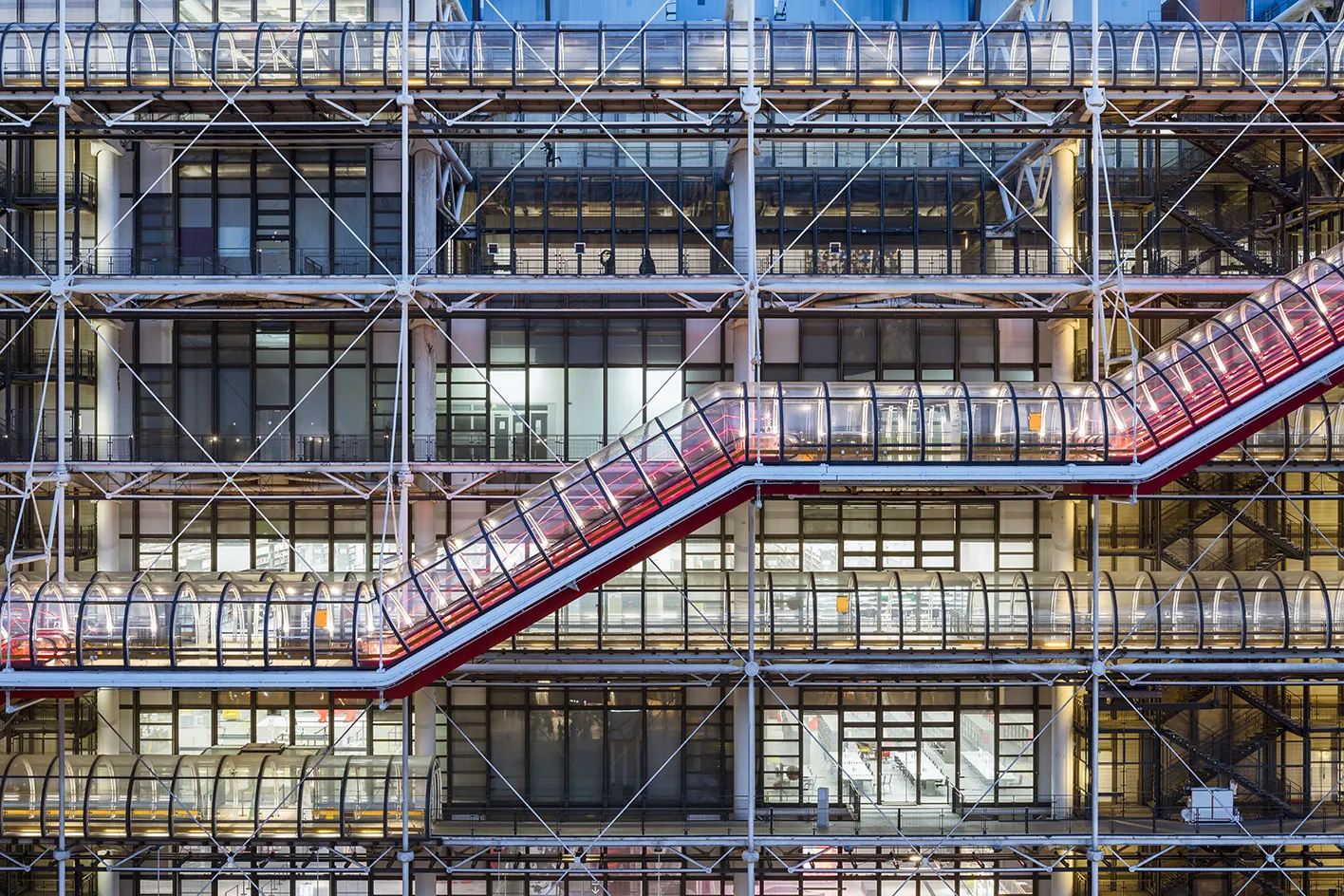
The Centre Pompidou is now closed for major restoration works
When: 1977
Architect: Rogers & Piano
The building that announced the movement to the world was the Pompidou. By externalising all structure, circulation and service tubing it liberated the six-storey building’s interior to display art unimpeded. Rogers and Piano won the international competition with a proposal to build on half the site and leave the other as public space. Colour adorns the different service elements likening it to diagrams akin to Archigram’s.
Lloyd’s of London, London

When: 1986
Architect: Richard Rogers Partnership
It was initially described as a monstrosity, but as with the Pompidou, negative responses were short-lived. The 14-storey building, Housing Lloyd’s of London, was built as three towers, each with their own service towers, surrounding a central 60m-high naturally lit atrium. It was the youngest building to receive Grade I listing, just 25 years post-completion, described by Historic England as ‘one of the key buildings of the modern epoch’.
HSBC Headquarters, Hong Kong

HSBC Hong Kong, a key example of Norman Foster's architecture
When: 1986
Architect: Foster + Associates
Completed the same year as Lloyd’s, the brief was to create the best headquarters in the world. At completion, it was the most expensive building ever built. The commission was won just ten years after Wendy and Norman Foster set up Foster Associates and was their first project outside of the UK. The 99,000 sq m skyscraper was their first tower; built from a kit of parts, the exoskeleton suspends five clusters of column-free floors accessed by zig-zagging escalators that scale a ten-storey atrium. An arrangement that suited HSBC's trading floors – radical architects and bankers had become unlikely bedfellows.
Kansai International Airport, Osaka

When: 1994
Architect: Renzo Piano
Built on a human-made island in Osaka Bay, Kansai is a reminder that High Tech is not just British eccentricity. The terminal's mile-long, undulating roof’s form is derived entirely from engineering logic. High Tech architecture is often successfully applied to transport infrastructure adapted to different locales, substantiating the international style.
Reichstag Dome, Berlin

When: 1996
Architect: Foster + Partners
The Reichstag is a project in which Foster + Partners added a public walk-in glass dome above the plenary chamber of the parliament building, severely damaged by a fire in 1933. It is a rare example of a retrofit in which a new intervention makes a damaged heritage building functional again.
Millennium Dome, London

When: 1999
Architect: Richard Rogers and Partners
The Millennium Dome, built to mark the dawn of the 21st century, was built in 15 months from standardised components and under budget at £43m, and is a clear example of the movement’s optimism for the future. Twelve 100m masts, commemorative of the role of Greenwich Mean Time, and the clock face, anchor steel cabling supporting the Teflon-coated glass-fibre tensile roof spanning 80,000 sq m, creating a 52m high dome. Despite the optimism, it was criticised as a symbol of government waste. The structure, now the O2 Arena, has outlasted the controversy.
Eden Project, Cornwall

When: 2000
Architect: Grimshaw Architects
Grimshaw's two biomes in a reclaimed china clay pit are the clearest statement of what the movement's technology was ultimately for. Hexagonal ETFE triple-layered cushion panels supported by geodesic tubular steel domes create climate-controlled ecosystems housing plants from the humid tropics and the Mediterranean. The engineering serves the ecology, not the other way around.
30 St Mary Axe, London

Part of our guide to Norman Foster's architecture, 30 St Mary Axe
When: 2003
Architect: Foster + Partners
30 St Mary Axe, nicknamed the Gherkin, is a 40-storey diagrid building whose profile is now a defining element of London’s skyline. Built on the former Baltic Exchange site, no High Tech building has done more to demonstrate that a single building can reframe the image of the city.