
One can scarcely imagine how a car company could be more controversial than Ferrari in 2026. The new Ferrari Luce is a triumph of unconventional thinking and devil-may-care dial-shifting. It’s the company’s first pure EV – unnecessary for some, heretical to many – and what’s more, it’s been designed and shaped on the West Coast of the USA by no less than Sir Jony Ive and Marc Newson of LoveFrom.
When the Luce’s luxuriously minimal interior broke cover earlier this year, many Ferraristi were frothing. If they’re still upset, then the company would do well to leave them far behind, for the Luce is unlike almost any Ferrari that’s gone before. The launch of this car has been impeccably mediated from the outset, ever since powertrain details were revealed last autumn and the interior components shown at an event in LoveFrom’s home city of San Francisco.

The Luce is only Ferrari's second ever four-door model
Now we’re in Rome to see the whole car at an event shrouded in secrecy. Legions of security personnel check everyone’s multi-stickered camera phones at every opportunity. To the frustration of content creators, faced with a beautifully curated architectural interior, exterior and lovingly produced displays, the highly symbolic launch was off-limits to private photography.

The launch venue, Vela di Calatrava, Rome
The event took place at Rome’s Città dello Sport, designed by Santiago Calatrava and opened just last year. It’s a spectacular but troubled sports complex known as ‘Calatrava’s Sail’ (Vela di Calatrava), 16 years late and reportedly costing around €740m. Ferrari overlooked this inauspicious contemporary white elephant and chose instead to highlight the city’s association with its heritage – today (25 May 2026) is precisely 79 years since the marque won its first race victory, when the Ferrari 125 S of Franco Cortese triumphed at the Baths of Caracalla circuit in the 1947 Gran Premio di Roma.

Ferrari Luce
The Luce inside and out
The secrecy clearly worked. As the plethora of online speculation – and outright outrage – indicated, the Luce was so eagerly awaited that any leaks would surely have surfaced. Spy shots proved useless, leaving the many predictive renderings far off the mark. So far, in fact, that Ferrari must be congratulating itself on the leftfield choice of LoveFrom as a way of utterly befuddling normally perceptive industry watchers. So what exactly has Ive, Newson and their team done to upend the company’s traditional aesthetic?

The Ferrari Luce is launched in Rome
‘Jony and I are car enthusiasts, obsessives even – I’ve done the Mille Miglia 14 times’
Marc Newson
In some respects, one could argue, tradition has actually been slavishly adhered to, with every fact, facet and anecdotal datapoint from the Ferrari mythos carefully chronicled and dissected in order to achieve a greater meaning. This is evidenced by LoveFrom’s hefty tomes of research – dated spring 2022, to give you some idea of this car’s gestation period. They demonstrate a thoroughness of thought and a desire for knowledge, as well as total mastery of their subject. As Newson later confirms, ‘Jony and I are car enthusiasts, obsessives even – I’ve done the Mille Miglia 14 times.’


The end result, if you can believe it, is probably the most practical, everyday Ferrari ever made. Sure, there have been four-doors before – the Purosangue (and the aforementioned one-off Pinin, as well as a few off-book specials) – as well as many more four seaters (including the epic 612 Scaglietti, the FF, GTC4Lusso, Mondial, 412, and 365 GT/4 2+2), but none to date have offered four doors and five seats, let alone a hatchback-style boot.
It’s also massive, the biggest, heaviest car Ferrari has ever made, but only just: at over 5m long, 2m wide (without mirrors) and 1.54m high, the Luce is longer but fractionally narrower and lower than the Purosangue. The kerb weight of 2,260kg is roughly equivalent to the ICE car’s 2,170 kg. Rear-wheel steering tightens the dynamics, as does the use of no fewer than four electric-traction engines with electrically controlled active suspension (a system first used on the Ferrari F80).

Ferrari Luce front end: the 'bonnet' is an aero component
Yet these are obviously not the accolades Ferrari is gunning for. Try these facts instead: the Luce is the fastest four-door, the fastest five-seater, the most luxurious, and the most spacious, as well as the most aerodynamic production Ferrari ever made. Purists who eschew all these metrics in favour of their misguided ideals will therefore be missing out. But let’s not offload the company’s bravery onto its customers. Anyone who thinks the typical UHNWI consumer needs a pat on the back for going electric when the offering is as plainly desirable and accomplished as this is as deluded as the Ferrari fanboy who thinks the brand has desecrated itself.

The Luce's rear lights are a return to a classic Ferrari configuration
It’s true that the rich are notoriously competitive and self-conscious, but most arguments we’ve heard against the Luce’s credentials are that it doesn’t offer the sonorous drama, ergonomic awkwardness and sheer impracticality that defines a supercar or hypercar. The latter’s emotional magnetism also comes with emotional baggage, as well as scant opportunities for real-world use, hence the over-supply of low-mileage examples of practically every hypercar ever built.
Just as playing a vinyl record on a £50,000 Linn Sondek LP12-50 turntable induces an addictive level of friction and inconvenience in the quest for sonic perfection, so the byproducts of inefficiency have come to define combustion-powered performance – engine and exhaust noise, heat, friction, smell. These are inconveniences many have come to passionately adore, shaped into a soundtrack that defines lives and loves. There are those who feel that a supercar will always be the antithesis of what an EV has to offer, precisely because of this perceptible friction. As a result, how can the Luce qualify as a ‘true’ Ferrari?

The purity of the Luce's glass house is set against the sculpted bodywork
As will become apparent, the newest Ferrari ticks all the checkboxes of a luxury EV – comfort, convenience, performance and sophistication – and then some. Having thoroughly explored the car in the metal (first drives won’t be until later in the year), Wallpaper* can categorically state that the worriers and naysayers underestimated LoveFrom from the outset.
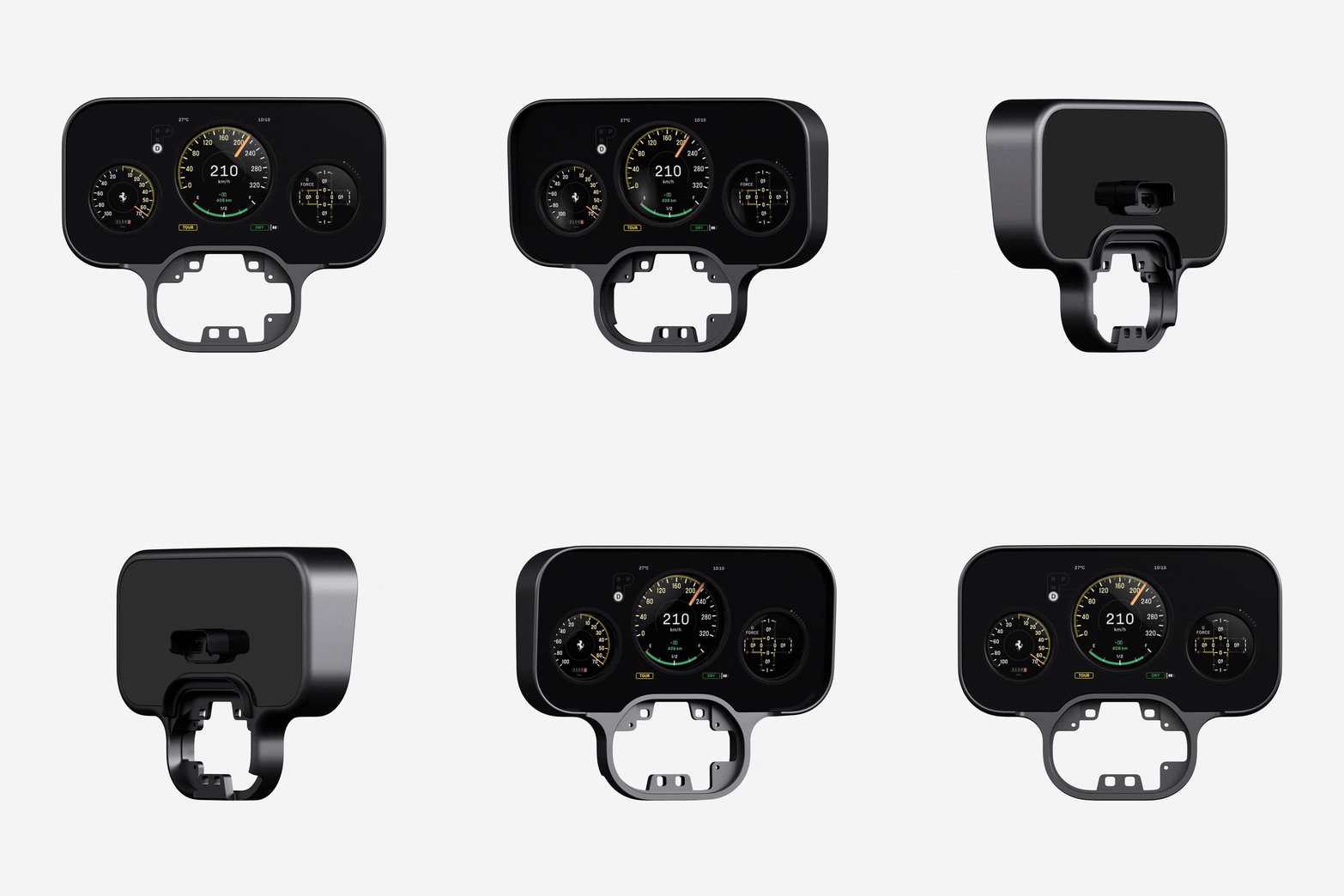
An animation of the Ferrari Luce instrument binnacle
The design collective is not a loose assemblage of earnest but talented dilettantes, but one of the most sophisticated industrial design agencies in the world. Working with Ferrari has meant complete immersion in the world of Maranello. ‘We’ve been hand in glove with Ferrari for six or seven years, completely embedded in the organisation,’ Marc Newson begins, adding that ‘what’s interesting and pertinent to this project is the integration of the interior, exterior and UI – in a way that’s not typical in the car industry.’
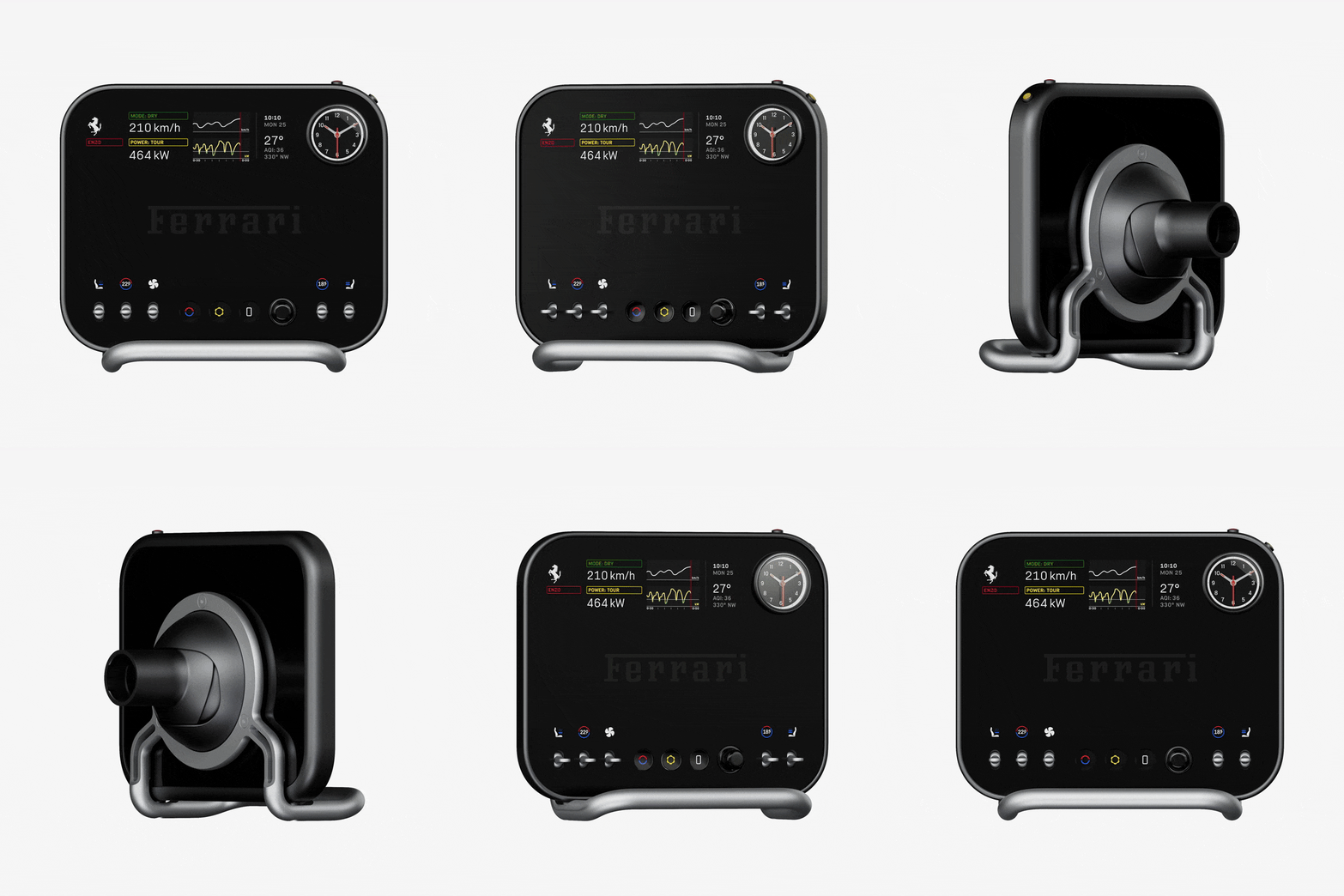
The LoveFrom team considered every angle of every component
Both Newson and Ive and their colleagues know a thing or two about holistic design experiences. From iPhones to superyachts, theirs is a world of meticulously intended consequences; things look the way they do because is the best way for them to function. ‘[As a result] we couldn’t disassociate the interior from the exterior,’ Newson continues. ‘As industrial designers, the way we’ve approached this project is a collection of around 500 individual design products. I can’t remember a car where someone has spent time designing the aluminium seat rails. Everything is completely new from the ground up.’
‘Each component is a self-contained object,’ confirms LoveFrom’s interior leader Jeremy Bataillou. ‘This enables new thinking – they would still be beautiful objects if you took them out of the car.’


‘There was clearly a desire on Ferrari’s behalf to have fresh eyes and look beyond their comfort zone’
Marc Newson
Electrification – not 100 per cent confirmed when the project began – gave the project team the impetus it needed to push back on traditional car design strictures, thanks to that painstaking research into the company’s design history. ‘I’m not sure [if being outsiders] gave us any more licence, but there was clearly a desire on Ferrari’s behalf to have fresh eyes and look beyond their comfort zone,’ Newson explains.
New thinking abounds, from the way the windscreen wipers dock alongside the A-pillars, leaving a near-seamless front surface descending from windscreen down to bumper, to the electric platform's enabling of the fifth seat, a space usually given over to the transmission tunnel. At the same time, there are visual elements that evoke classics from the range, like the rear halo lights, seen on everything from the 360 Modena and the 458 Italia to the 365 GTB/4 Daytona.

The new Ferrari Luce
Aerodynamics helped dictate the form, from the purist glass house, integral aero elements and active grilles that divert airflow for cooling without compromising drag, to the ride height that lowers subtly at speed. The near-seamless glazing sits above unifying bodywork that wraps around it, further defining its form, with the whole ensemble a careful exercise in scale reduction thanks to a clever mix of painted panels with black sills and lower structure to elongate the relatively tall four-door crossover form. The five launch colours – Azzurro la Plata, Giallo Luce, Rosso Dino, Bianco Artico, and Rosso Fiammante – include classic takes on Ferrari red and yellow, along with a tasty blue, and technical-looking grey and orange.


The massive 24-inch wheels at the rear and 23-inch at the front, as well as the sleek rear window, further edge the Luce towards a sleek saloon silhouette – we’re reminded of the 1980 Ferrari Pinin concept. The wheels come in two designs, a more classic open five-spoke pattern and an aerodynamically optimised and closed-off turbine design that can be specified with body-coloured details. At the front, a pure aero form dives beneath a body-coloured ‘bonnet’, while the rear doors, which open up coach-style at the push of a button, give access to a spacious and impeccably trimmed cabin.

The dashboard of the new Ferrari Luce
The Luce’s interior is beyond reproach, from the slick action of every single switch and dial through to the clarity of the graphics and the smoothness of the animations. Once you’ve hurdled the apparent irony of one of the primary progenitors of our screen-focused, highly scrollable reality doing away with touch-centric car interiors, what is left makes undeniable sense.
‘Touchscreens and capacitive switches are completely inappropriate for cars’
Jeremy Bataillou
According to Newson, ‘a return to physical buttons seemed obvious to us. [Jony and myself] have owned old Ferraris. We like being able to access things in a spontaneous way.’ Newson quotes Ive as saying that ‘just because a vehicle is electric doesn’t mean you have to get carried away with the electronics’.
‘Touchscreens and capacitive switches are completely inappropriate for cars,’ Bataillou says with conviction.
‘Ferrari were very receptive to this idea from the get-go,’ Newson continues, ‘although this simplicity has a lot of complexity behind it.’

The rear compartment of the Luce – Ferrari's first-ever five seater
The ribbed leather seats and door cards, glass-faced consoles, and highly detailed recycled aluminium controls and accessories (just check that rear ceiling-mounted grab handle) speak to the timeworn simplicity of classic interiors and implements. Even the multifunctional dials and digital displays developed with Samsung Display, fuse the satisfying exactness of a vintage watch face with modern information demands, including mapping from both Google and Apple. A 21-speaker audio system with 3,000W of amplification channels Ferrari’s new Audio Signature, more of which later.
‘The interface work followed the initial vision from the very first meeting,’ says LoveFrom’s HMI team leader Christopher Wilson. ‘But there was also constant evolution with the test drivers and in simulations. We iterated and iterated.’ In terms of legibility and precision, the binnacle evokes the necessary simplicity of aircraft. ‘There’s quite a lot of aviation design in there,’ Newson admits, ‘particularly helicopter references. It’s the rationality of how things are designed in that sector.’

Pictures can't convey the tactile delight, but this is perhaps the most desirable car interior of the 21st century
A true Ferrari?
So is the design and engineering acumen on display true to the Ferrari ethos? In our polarised era, the Luce must still straddle two opposing world views. Naturally, the company describes the car as a pure Ferrari, a sports car ‘designed for deeper engagement and performance, with a unique and recognisable character.’ In keeping all the engineering – right down to the battery packs – in-house, the Luce project has included 60 new patents.
As already noted, stellar performance is often a by-product of electrification, rather than its primary raison d'être, so here at least the Luce’s capabilities are most definitely on brand. The cited figures include a 0 to 100 km/h time of 2.5 seconds (thanks to that roof-mounted launch control – a future social media staple, we predict) with 200km/h reached in 6.8 seconds.

Ferrari Luce steering wheel references three spoke designs from Ferrari's past
The top speed will be somewhere in excess of 310 km/h. It’s also worth noting that while a Purosangue delivers a range of around 578km on a full tank of fuel, the Luce’s maximum range is a not dissimilar 530km. More to the point, you won’t feel short-changed by having to haul around a barely stressed V12.
Unlike the ersatz combustion sound favoured by companies as diverse as AMG, Abarth and Dodge, Ferrari has developed a system that works a little bit like an electric guitar pick-up, with an accelerometer on the axle picking up the ‘dynamic texture and vibration of the rotating components’. This signal is then filtered and amplified, depending on the drive mode, and can be heard inside and outside the car, with the interior system providing a bit more detail and grain depending on throttle response and driving mode.
Radical luxury on four wheels

Ferrari Luce seat on show in the Transamerica Pyramid in February 2026
There is quite literally nothing that Ferrari could have done to forestall the inevitable deluge of dismissive snark that will come their way from some quarters. The internet is going to hate it, but then the internet hates everything. Instead, let’s not just celebrate Ferrari’s bravery but also acknowledge its quiet mastery of luxury design, edging the brand into a realm that hitherto has only been associated with names like Rolls-Royce and Bentley.
At 550,000 euros, or about £440k (exact pricing TBC), the Luce is twice as much as the Merc-AMG and the Jaguar Type 01 and probably punches well above the Bentley Barnato and even the Spectre. Arguably, the Luce is more technologically sophisticated and finely resolved than all of the above.

The Luce rides on traditional five-spoke wheels (shown above) as well as a new turbine design
Yet the price is irrelevant. To a certain extent, the badge is too, for this is a car for people less concerned with what a Ferrari was than what a Ferrari can be for them. The prancing horse might carry with it an inescapable gut punch of emotion, especially in Italy and markets with a more slavish devotion to heritage, but there’s a new generation of wealthy buyers who are simply committed to acquiring the best, regardless of brand.
These people are happiest when collaging their consumption from a patchwork of obscure heritage brands, luxury suppliers, tried and tested mainstream products and brand-new start-ups. Hence the success of Tesla as a status symbol amongst early adopters in Silicon Valley, a mantle subsequently passed to Rivian and Lucid. There aren’t decades of heritage to kowtow to, simply the understanding that – at the time – these were the companies doing the best work at the cutting edge.
In the auto industry, it’s taken legacy brands the best part of 15 years to catch up and recognise electrification as an opportunity to convey innovation first and heritage second. In fact, having the latter inform the former is a habit that some companies still can’t kick – witness Mercedes-AMG’s penchant for concocting emotion from memory and cultural meaning, from angry V8 sounds to vibrating seats. Equally, Jaguar’s brave Year Zero approach started off as all tone and no substance, triggering a reputational catastrophe.

The new Ferrari Luce in Azzurro la Plata
At the other end of the scale, Rolls and Bentley swathe their EVs with traditional forms and materials, while the lack of publicly affirmed action from Lamborghini, McLaren and Aston Martin implies they have neither the cultural nor financial capital to take either path just yet.
Ultimately, what emerges strongest from the Luce is a new definition of luxury. Ferrari expects 80 per cent of production will go to buyers who are new to the brand and therefore don't know or care about the complex emotions conjured up by combusted hydrocarbons. For them, the Luce has more in common with a Birkin bag or a Leica M6 than an F1 car. It’s a superyacht for the road, with every cleat, catch, switch and hinge made to measure, money no object. Thanks to LoveFrom’s obsessiveness, the Luce is a far more bespoke object than any amount of marquetry or stitching can create.

The new Ferrari Luce
The look is clean, the lines are calm, the image is tasteful; the Luce is no outrageous four-wheeled flex, even though stats suggest it can more than keep up with the best of the rest. It might not be cheaper to buy but it’ll certainly be a great deal cheaper to run than the anxiety-inducing complexity of the over-fettled hypercar (Ferrari promises support for electrical components, including batteries, equal to that provided to its ICE cars).
On top of that, the packaging makes it more practical for daily life than almost every other luxury EV. In terms of look, feel, package and performance, the Luce could just be the most radical Ferrari of all time.
Ferrari Luce, from c€550,000, Ferrari.com, @Ferrari, LoveFrom.com