
We’re just a few days away from one of the most iconic luxury brands on the planet taking a bold step into the unknown. The full unveiling of the Ferrari Luce – only the interior control surfaces and seats have been revealed at time of writing – will truly set the cat amongst the pigeons as the progenitor of the luxury sports car sector ventures into pure electric propulsion for the very first time.
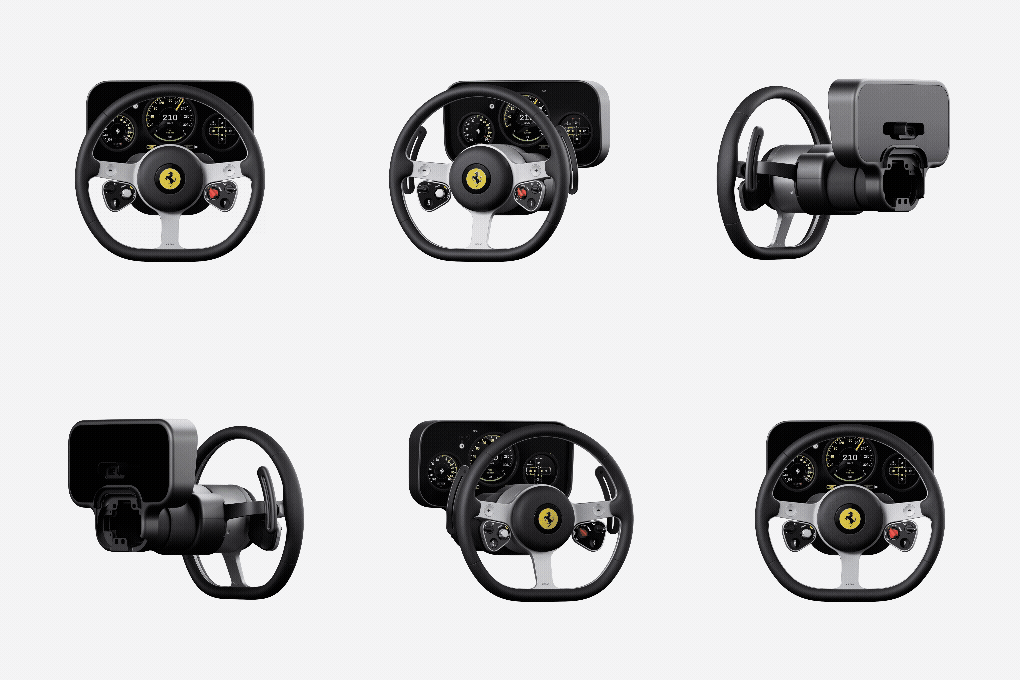
The Luce steering assembly is designed to be seen from all angles
When even the unveiling of the Luce’s dashboard – usually not a subject to trigger controversy and provocation – spawned endless amounts of comment and opinion, it became clear that the combination of electrification and deviation from a pre-conceived norm could not fail to be anything but rage bait.

The Jaguar Type 00 concept at the 2025 Festival of Speed; the production version will be known at the Jaguar Type 01
Wallpaper* can confidently predict the rage-bait churn will get another hearty stir – not because of any aesthetic shortcomings, but because sports cars have been sucked into the culture wars. We’re pretty sure that wasn’t Ferrari’s intention when it signed up LoveFrom and its car-mad directors, Sir Jony Ive and Marc Newson, to steward the aesthetic of Ferrari’s first EV, working closely with Maranello’s engineering team to create the ultimate expression of luxury electric mobility.

Jaguar Type 01: all we've seen so far
You might well ask why a car maker going electric is even remotely controversial in 2026. To answer that, one must strap in to experience a perfect storm of misplaced idealism, a layer of wishy-washy governance, a vociferous fandom who have become vocal gatekeepers, and the endless but near mythical search for the true soul of a machine.

Pininfarina Battista: a pure electric £2m hypercar overlooked by moneyed enthusiasts
Thirty years ago, the latter Grail Quest would have been considered fully done and dusted, with the glorious mechanical symphony that is the V12 engine placed upon a pedestal in the eternal temple and henceforth worshipped forevermore.
To the fury of the temple gatekeepers, that’s not what happened. The inconvenient truth of mobility’s fossil fuel addiction was no longer possible to ignore, except to the most steadfast denialists and exceptionalists. Unfortunately, it’s this contingent who rule the roost in the small but high-profile world of luxury sports automotive.

Maserati abandoned plans to release the MC20 Folgore EV alongside the ICE version
So what’s the true status of electrified performance? One of the side effects of electrification has been that hitherto unattainable levels of performance are now handed on a plate to drivers of ‘everyday’ machinery; in its most powerful form, the humble Volvo EX30 will hit 62mph in 3.6 seconds. That’s quicker than the limited production 1995 Ferrari F50, now comfortably commanding upwards of £3.5m.

Is this an electric sports car? The Volvo EX30
In divorcing the thrill of out-and-out performance from the exclusivity of extortionate prices, the luxury performance market is having to push the boundaries of design, materiality and technology to retain its edge. The new inclusivity of electrification effectively divorces the emotive qualities of performance. And perhaps more than any other carmaker, Ferrari once considered itself the be-all and end-all of emotional machinery.

The Luce interior will focus on quiet luxury
That’s why the Luce is not a two-seater, but a grand tourer, perhaps the last bastion of romance on four-wheels. But even this sanctified typology – with its evocation of great journeys, open roads and a life of leisure – hasn’t quite cracked the apparently tainted image of electric luxury.

Jaguar Type 00 Concept: don't expect the Type 01 to follow this minimalist approach
Will the Luce change this? It’ll certainly help shift the dial. This year also sees the release of Jaguar’s new Type 01, the production iteration of the car revealed as the no-less controversial Type 00 Concept. The first all-electric Bentley is also on the way, previewed by the EXP 15 Concept last year, while Rolls-Royce has been quietly operating in this electric realm for several years, first with the Spectre and more recently with the coachbuilt Project Nightingale.

The 2025 Bentley EXP 15 previews the upcoming Bentley EV, possibly called the Barnato
Porsche, Maserati and Lotus have all performed screeching U-turns on their pure EV strategies
So are all these companies doubling down on an unchangeable course they might conceivably come to regret? That’s certainly the takeaway from the more performance-focused slice of the luxury market. Porsche, Maserati and Lotus have all performed screeching U-turns on their pure EV strategies.

The Lotus Theory 1 was an electric design study...
Maserati scrapped a near-completed electric variant of the MC20 supercar, while Porsche has delayed its Boxster replacement, despite engineering a fully electric variant, in order to accommodate ICE power as well – not on the original spec sheet. Meanwhile, Lotus has just announced the Type 135, a hybridised V8 supercar that’s a world away from the electric-only Evija hypercar and Theory 1 concept, reversing plans to make the brand electric only.

... which might influence the hybrid V8 Type 135
Meanwhile, Lamborghini, McLaren and Aston Martin are blocking their ears and pretending their customers have a perfect right to carry on polluting and they have a perfect right to carry on allowing them to do so. The reason? There’s no demand for EVs amongst buyers who favour V8s and V12s, the pop of unburnt fuel crackling in the exhaust pipe and the roar of mechanical combustion.

The 2023 Lamborghini Lanzador Concept EV has been quietly forgotten
Despite technical agreements (McLaren with Nio, Aston Martin with Lucid and Lamborghini as part of the VW Group), the fruits of these labours are still shrouded in their respective design studios, waiting for positive customer clinics and enthusiasm from dealers. The 2023 Lamborghini Lanzador concept now looks like a dead end.

Yangwang U9
Like so many manufacturing and technology sectors, the luxury car industry is in danger of being left behind by China. Right now, the only thing the country doesn’t have is the lustre and leverage of a heritage automotive brand. Otherwise, Chinese EVs are attaining new levels of luxury and performance. The extraordinary 300mph Yangwang U9 Xtreme (parented by BYD) is just a foretaste of what’s to come. The country’s fleet of luxury EV GTs is even stronger, from the Xpeng P7+ to the Zeekr 001 FR and Ferrari-aping Denza Z9 GT.

Denza Z9 GT
The viability of ICE is increasingly running counter to social norms
So is the customer always right, or can they be swayed by new brands without the accumulated centuries of heritage that still shapes our understanding and perception of cars? Companies might cry that ‘our customers don't want an EV!’ but the viability of ICE is increasingly running counter to social norms. No one would welcome fumes in a smoke-free space just because the smoker could afford a pricey cigar. So why would an expensive but outlandishly noisy exhaust be a socially acceptable thing to inflict on a city?

Xpeng P7
Perhaps it’s the beginning of the end for the traditional supercar and hypercar, their unfeasible abilities hamstrung by social norms and legal restrictions. Genuine enthusiasts know that power isn’t everything, let alone price, and that the best driving thrills don’t necessarily even need speed. A beautifully balanced small sports car will always triumph over a bloated, oversized performance machine.

All hail the Renault 5 Turbo 3E

A pint-sized hypercar: the forthcoming Renault 5 Turbo 3E
There’s a veritable stable of smallish, sporty electric cars either here or on the way
There are signs that EVs are starting to head in this direction. Consider the return of the ‘hot hatchback’, once a mainstay of affordable ICE performance, now reborn for the electric era. There’s a veritable stable of smallish, sporty electric cars either here or on the way, from the Alpine A290 to the Hyundai Ioniq 5N, as well as the Vauxhall Corsa GSE, Peugeot e-208 GTi, Cupra Raval VZ, and the Volkswagen Polo GTI, even the supercar-baiting Renault 5 Turbo 3E. These run the gamut from affordable to outrageous, but all pack a dynamic punch that more than matches up to ICE equivalents. Zero emissions, more space, less sound and more reliability are all added bonuses.

The upcoming VW ID Polo GTI
Those with more patience might want to hold out for the Caterham Project V, due to be revealed in 2027 (when there might also be an electrified successor to the Audi TT to talk about), while fellow small manufacturer Morgan has also dabbled in electric concepts (including the riotous XP-1) and could still be a contender in this defiantly niche market.

Caterham Project V EV
The pressure on the traditional sports car is technological, cultural and economic, threatening to squeeze this once highly desirable form factor into obsolescence, afforded only by a tiny coterie of confused collectors unsure as to what they’re even signifying. As it stands, China has almost all the cards when comes to the premium electrified GT (despite Porsche and Audi’s valiant resistance). Will Ferrari’s top-tier competitors respond to the boldness of the Luce, or will they simply wait and see how it all pans out?

Morgan XP-1 Prototype
Lest we forget, the very first EV of the modern era, the Tesla Roadster, was a sports car (engineered by Lotus, no less). It was a simpler machine from a simpler age but still retains some charm. Nearly 20 years later, a true successor is nowhere to be found. Whoever can convincingly splice electrification with true driver engagement could still come up with a winner.