Adam Pendleton on Black Dada and ‘breaking the rules’ as his new show opens at Amsterdam’s Stedelijk Museum
The artist presents 11 paintings and eight large drawings – work that sits at the intersection of the avant-garde, abstraction and Blackness – in a new exhibition
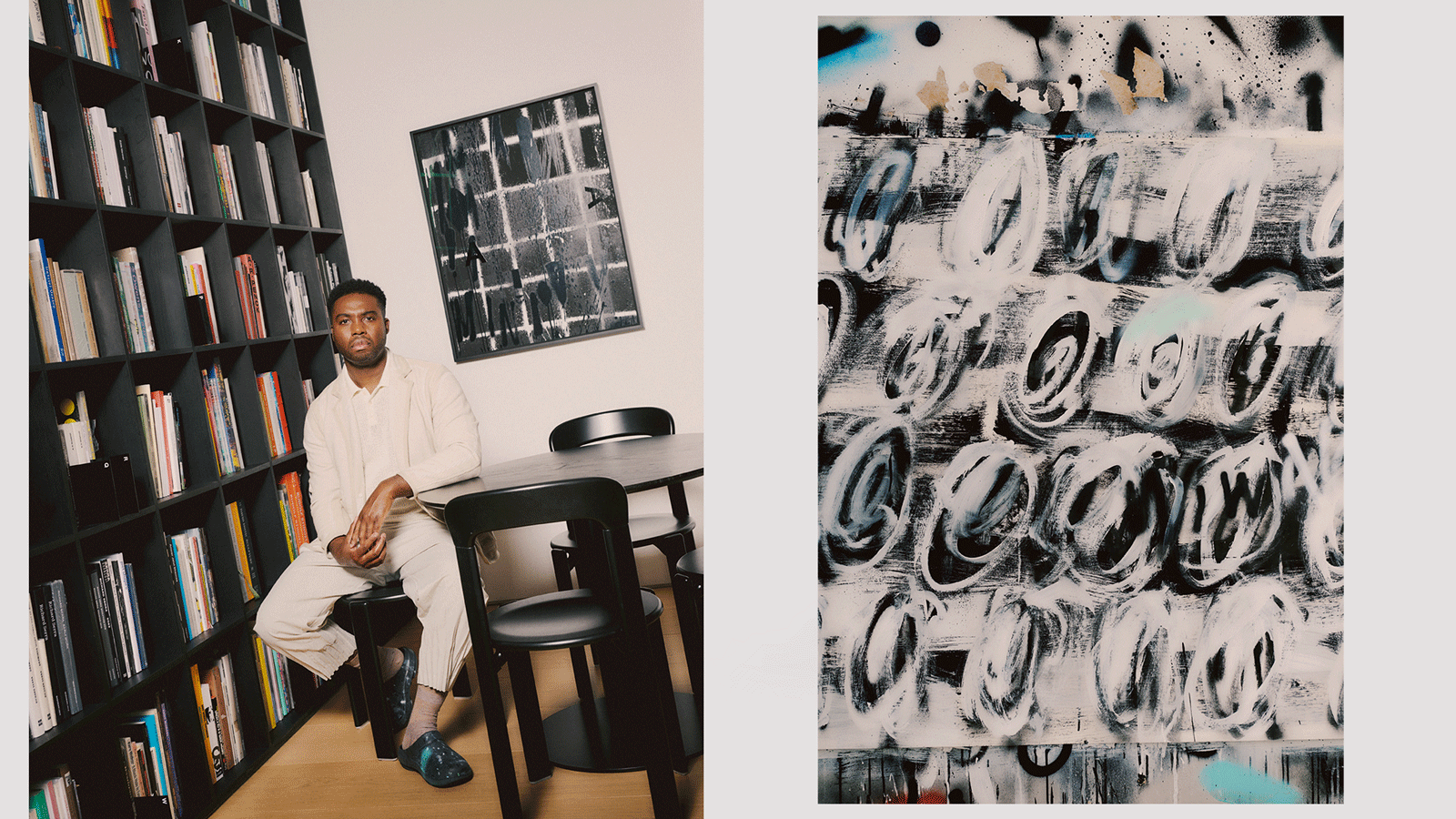
For Adam Pendleton, abstraction is a medium with no rules. Throughout his career, the artist has resisted being caged in by the term, instead creating his own way of working, which has led to solo exhibitions at institutions including the Museum of Modern Art, New York, and the Montreal Museum of Fine Arts.
Born in Richmond, Virginia, Pendleton began to shape a new way of working in 2008, creating a framework, Black Dada, which sits at the intersection of the avant-garde, abstraction and Blackness. The resulting works are a visually rich juxtaposition of cultures and history, the works themselves a cumulation of layers beginning with mark-making on paper, which is then photographed by Pendleton before being layered onto canvas using screen printing.

Detail of Pendleton’s Untitled (Basis), 2026, a work in four parts in gold ink on black paper
‘I became an artist because I have never been particularly interested in rules or norms,' says Pendleton. We are speaking over Zoom on the eve of his major new show at Stedelijk Museum Amsterdam – ‘Some Wild Kind of Language’, 10 October 2026 – 17 January 2027 – where he will present 11 paintings and eight large drawings. ‘When I look back, I realise I was always looking for means and mechanisms that could allow me to tap into that which is different or other.'

Detail of a work from the Basis series, 2026
Pendleton cites reading as a major influence for him growing up, an act that became bigger than simply experiencing the words on the page. ‘To see words, but you don't just see them, you feel them,' he says. ‘Imagine them taking space in the world around you, to the extent that you could almost taste them. Over time, I started to realise that these words were ideas. By organising the words on the page, by giving them form, they began to take up space within the context of the world. I believe what happened is that I realised you can basically imagine or construct an alternative to that which you experience every day – whether it's going to the grocery store or picking up your kids. There's an infinite number of alternatives that can be made real, and for me, that is the job of an artist.'
It's an apt philosophy for an artist who moves so seamlessly between mediums, rejecting a distinction between them in his embrace of painting, photography, film, text and installation. ‘I am a painter, but I am a painter that is preoccupied with how ideas exist in the world,' Pendleton clarifies. For him, the other mediums find their way into his primary work.

Work in progress in the artist’s studio
Pendleton is adept at finding connections between these ideas – the primary driver behind the Black Dada movement, which takes a closer look at how things are related. ‘Black Dada is very much my way of establishing and breaking the rules, and it's been very interesting from a critical standpoint. We've been talking about Black Dada publicly since about 2008, and this very interesting thing happened where people started saying back to me what Black Dada was. They were trying to take something that was about perpetual discovery, and they were saying what it is – that's the opposite of what it is.'

A work in progress in the artist’s studio
His works resist easy classification because Black Dada finds meaning in the unfixed; as the rules are not established, there are endless new discoveries available. ‘Someone would say, “Oh, these paintings aren't very Black, or they don't represent Blackness.” And I'd be so perplexed. How can you say that? These things are defined and take shape in real time, and they're also defined and take shape in the relationship with the individual that puts them forward.'
His uniting of seemingly disparate strands is integral to the works themselves. Composed of fragments pulling from language and geometry, they take shape in physical layers of paint, spray paint, ink and watercolour, interspersed with graffiti-like marks, snippets of text and stencilled forms. And when placed in the context of the Stedelijk Museum Amsterdam, a historic 19th-century building, they become imbued with new meanings again.

A model of the Stedelijk Museum’s central staircase, where Pendleton has painted the walls black, and where the artist will present eight Basis drawings – his largest pieces to date
Fittingly, Pendleton's paintings will be displayed in the museum's IMC Gallery, also known as the Gallery of Honour, which has previously showcased works championing minimalism, conceptual art and abstraction by artists including Barnett Newman, Morris Louis, Robert Ryman and Willem de Kooning, who themselves grappled with their own mastery of the medium. The other key space is the museum's central staircase and walls, famously painted bright white in the mid-20th century by its then director Willem Sandberg, thus establishing one of the earliest ‘white cubes'.
In Pendleton's takeover, the staircase becomes black. ‘I think my desire to break the rules is on full display here,' he says. ‘It's very intentional.' The staircase is an evocative background from which he showcases eight Basis drawings, his largest pieces to date. The works speak to Pendleton's process of revision and repetition, and are led by the endless possibilities of the materials themselves, and the many tools he uses in his works. His process affects his results – for example, ‘with the spray paint, it is very fast and fluid. But then sometimes I'll slow the spray paint down. I use a simple mono printing technique in the studio while I'm working, spraying it firstly on a sheet of paper, instead of it going directly on the paper that, in this case, will become a drawing.
‘You can imagine or construct an alternative to that which you experience every day. There’s an infinite number of alternatives that can be made real, and for me, that is the job of an artist’
Adam Pendleton
‘Then I'm pressing the paint into the paper. So there's this very physical act of making, and also this very physical and tangible relationship to time,' he says. ‘There's also a kind of athleticism at play. A tennis player uses her instincts to navigate the court and her relationship to her opponent, but her instincts are informed by years of training, and that is the same with painting. While I am working, I am also training. I'm training my body, my eye, and my mind.'
Presenting his works in a space steeped in cultural and architectural history, paradoxically, becomes freeing for Pendleton. The immersion he creates in this context goes far deeper than the feeling of experiencing a single work. ‘As human beings, and in the way culture functions, we often become unproductively tethered to fixed notions of what things are and what they aren't,' he says. ‘I'm an evangelist for a concept like Black Dada as it allows for one to become untethered – or productively unhinged.'
'Adam Pendleton – Some Wild Kind of Language' is on show from 10 October 2026 – 17 January 2027 at Stedelijk
A version of this article appears in the November 2026 Art Issue of Wallpaper*, available from 8 October in print on newsstands, on the Wallpaper* app on Apple iOS, and to subscribers of Apple News +. Subscribe to Wallpaper* today