
Textile designer, weaver, writer and graphic artist, Anni Albers (1899-1994) was a pioneer of 20th-century modernism. Her work prompted a reconsideration of textiles as an art form – both in their functional roles and as wall hangings – and pushed the processes of printmaking into new territory. Like many of the 20th century’s most influential female designers, her work long existed in the shadow of her husband, the painter and colour theorist Josef Albers, but in recent years has come into sharper focus.

Nicholas Fox Weber and Anni Albers, 1981
That renewed attention is reflected in the publication of her first major biography, written by cultural historian Nicholas Fox Weber, who knew the Alberses personally and has served as executive director of the Josef and Anni Albers Foundation for four decades. Drawing on extensive archival research and decades of personal contact, the book revisits Albers’ life and work, tracing how a material long associated with function became a vehicle for some of the 20th century’s most rigorous artistic thinking.

The first major biography on Anni Albers traces the complex personality and influential artistic career of the groundbreaking modern artist.
Rethinking weaving

Annelies (Anni) and Lotte Fleischmann, c. 1908
Born Annelise Elsa Frieda Fleischmann in Berlin in 1899, Albers grew up in a cultured and affluent household. Her father ran a successful furniture business, while her maternal grandfather founded Ullstein Verlag, then one of Europe’s largest publishing houses. Even as a teenager, Fox Weber notes, she was 'more curious and adventurous than most people…open to rebellion, to confronting the unexpected, and to living originally.'

Albers weaving
She arrived at the Bauhaus in 1922, part of a generation seeking new forms of expression in the unsettled years following the First World War. Like many women at the school, she was directed towards the weaving workshop. What followed was less an acceptance of constraint than a redefinition of it. Working with cotton, linen and jute, as well as metallic threads and horsehair, she approached weaving as a system – one grounded in logic, repetition and variation.

Wall Hanging by Anni Albers, wool, silk, chenille, and bouclé, 1925
Her compositions, built from repeated lines and subtle shifts in tone, rejected representation in favour of abstraction, yet retained a physical immediacy. These were objects to be handled as much as seen. In doing so, Albers helped collapse the boundary between art and design, positioning textiles as a site of experimentation rather than decoration.
From the Bauhaus to Black Mountain

Joseph and Anni Albers, Asheville, North Carolina, c. 1935
In 1925, she married Josef Albers, whom she had met at the Bauhaus. When the school closed under pressure from the Nazi regime in 1933 – faced with demands to abandon what it deemed 'degenerate' art – the pair were left without work. As conditions in Germany became increasingly precarious, particularly for Anni as a Jewish artist, an opportunity emerged through Philip Johnson, whom she had met during his visit to the Bauhaus. After a chance meeting in Berlin, Johnson returned to the United States and soon sent a telegram inviting the couple to join the newly established Black Mountain College in North Carolina. They arrived in New York in November 1933.

Wassily Kandinsky, Anni Albers, and Nina Kandinsky on the terrace of Villa Henning in Berlin. Photograph by Josef Albers, June 1933

Josef and Anni Albers arrive into New York aboard the SS Europa on November 25, 1933
The move marked a dramatic shift in circumstances. Having lived comfortably in Berlin, the couple found themselves in modest conditions, supported by the college with accommodation and meals. Yet the environment proved formative. At Black Mountain, where they remained until 1949, Albers developed both her practice and her pedagogy. Her philosophy – grounded in clarity, discipline and responsiveness to material – was later set out in her book On Weaving (1965) and would go on to shape a generation of artists; later figures such as Sheila Hicks and Ruth Asawa have cited her as an influence.

Expanding the field

Black-White-Red by Anni Albers, cotton and silk, 1926/1964
Albers’ circle extended across disciplines – from John Cage to Buckminster Fuller, as well as Bauhaus figures including Walter Gropius and Paul Klee – reflecting the cross-pollination that defined midcentury modernism. Her work drew on observation as much as theory, from Berlin interiors to the textures and colours of Mexico, which became a lasting influence.
During her time at Black Mountain, she also developed an experimental series of ‘hardware’ jewellery with student Alex Reed, using utilitarian materials such as paper clips, screws and sink fittings. Created in part in response to the loss of her family’s possessions during exile – her parents fled Germany in 1939 with little to their name, their jewellery either confiscated by Nazis or used to secure safe passage – the pieces challenged conventional notions of value and ornament. Though initially met with scepticism, they embodied a principle that ran through her wider practice: that meaning lies not in material worth, but in invention and perception.

Necklace, by Anni Albers, eye hooks and pearl beads on thread. Reconstruction of the original by Mary Emma Harris
In the transcript from a talk she gave to students in March 1942, she wrote: ‘To our surprise we found that though we used such common materials as bobby-pins or washers or stopper chains for our necklaces, they sometimes looked quite beautiful and even precious. To our greater surprise still, we found that other people liked them too. But our greatest surprise was that others, like ourselves, did not care about the value or lack of value of the materials we used, but enjoyed, instead of material value, that of surprise and inventiveness – a spiritual value.’

Pasture, Anni Albers, cotton, 1958
Her designs are now held in major collections including the Museum of Modern Art in New York, which played a pivotal role in her recognition. In 1945, the museum staged a small exhibition of modern textiles that included her work. Though modest in scale, it marked an important moment, signalling the growing significance of textiles within modern art. Four years later, in 1949, Albers was given a landmark solo exhibition – the institution’s first dedicated show for a textile artist, and only the second afforded to a woman.

Installation view of ‘Anni Albers Textiles’ at the Museum of Modern Art, New York, 14 September – 6 November 1949
Conceived with Philip Johnson and initiated by Edgar Kaufmann Jr, the exhibition presented woven works, room dividers and material studies that prioritised structure, tactility and invention over decoration. Installed with unusual clarity – floating furniture, suspended screens and rhythmic partitions – it emphasised the inherent qualities of materials, from raffia and cellophane to metal threads. A review in The New York Times described her as 'a fabric engineer', underscoring her position as both artist and innovator. Though understated at the time, the exhibition marked a turning point, helping to establish textiles as a serious medium within modern art.
New Haven and beyond

Anni Albers in her kitchen at 8 North Forest Circle, New Haven, Connecticut, 1958
In 1950, Anni and Josef Albers moved to New Haven, Connecticut, where Josef took up a teaching position at Yale University, becoming chair of the Department of Design. The move marked a shift from the experimental environment of Black Mountain College to a more established academic setting, while providing a stable base from which both could develop their work.
For Anni, this was a period of increasing independence. Her reputation continued to grow through the 1950s, with exhibitions across the United States, including a major touring show organised by MIT. At the same time, she expanded her practice beyond weaving, turning to printmaking in the early 1960s.

Intersecting by Anni Albers, cotton and rayon, 1962
Her prints translated the logic of weaving into a new medium. Working across lithography, screenprinting and embossing, she developed compositions built from repeated lines, grids and subtle tonal variation. As in her textiles, structure remained central: image emerged through process rather than gesture, reinforcing her position as an artist for whom material and method were inseparable.
Legacy

Six Prayers by Anni Albers, cotton, linen, bast, and silver thread, 1965-66
Anni and Josef Albers worked well into the 1970s, remaining restless and curious throughout their later years. After Josef died in 1976, Anni devoted her attention to the stewardship of his legacy as well as her own practice – continuing her printmaking with Gemini G.E.L. and overseeing exhibitions of her work.

The Alberses’ house at 808 Birchwood Drive, Orange, Connecticut, 1994
She died in 1994, yet her influence has only grown more visible in recent years, as contemporary designers and artists return to questions of material, process and the value of making. Retrospectives at the Gugggenheim Bilbao in 2017 and Tate Modern in 2018 put her work firmly into the spotlight once more. Another show at Blanton Museum in Austin, Texas followed in 2024, while just last year, Dedar launched five fabrics based on Albers' weavings with showcases in Milan and New York. If modernism often privileged the monumental and the industrial, her work offers another perspective, one that starts with a simple thread and works outward.
'Anni Albers: A Life' is released in the US on 28 April 2026 and in the UK on 23 June 2026.
Shop Anni Albers

‘We investigate and worry and analyse and forget that the new comes about through exuberance and not through a defined deficiency.’ —Anni Albers, ‘One Aspect of Art Work’, in Selected Writings on Design
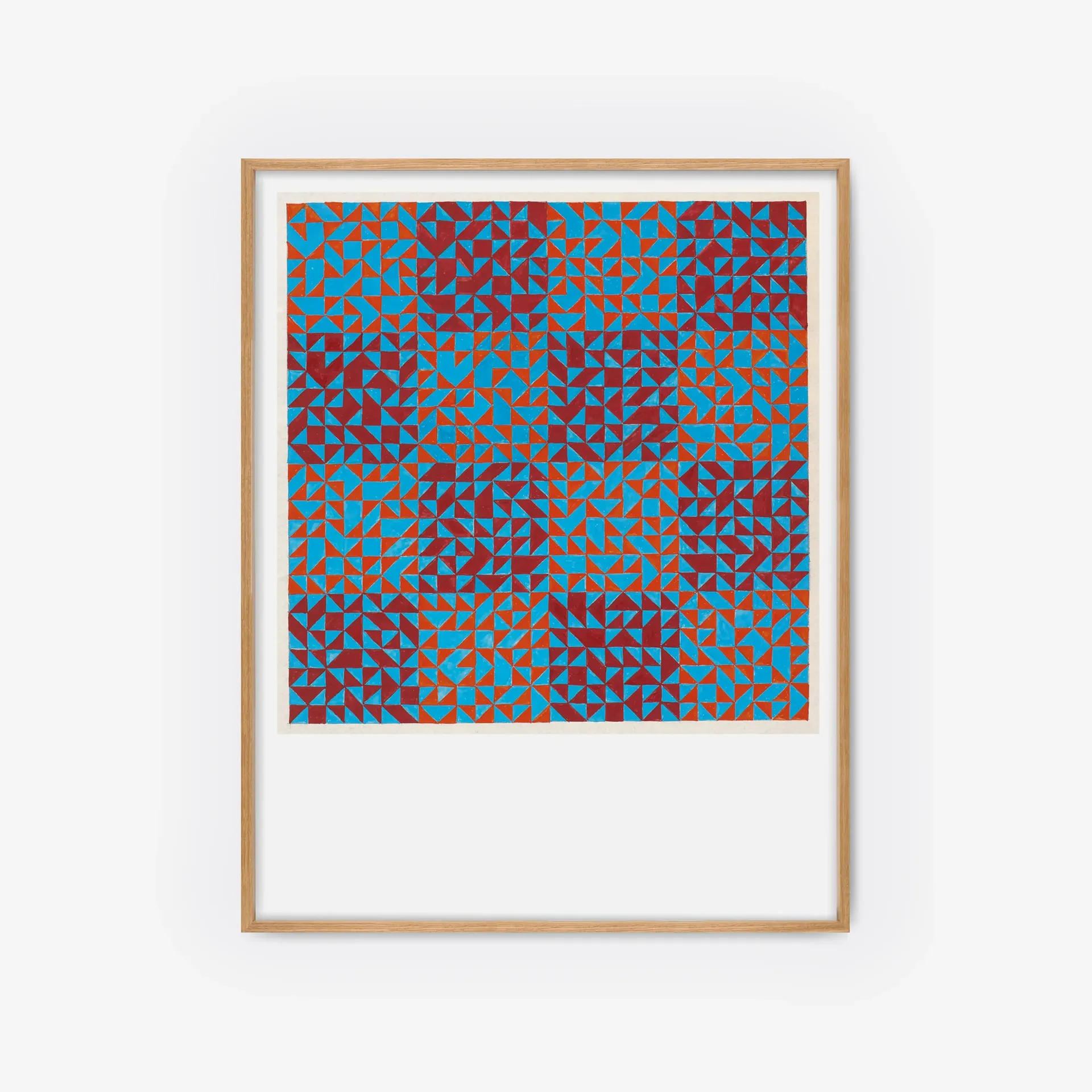
This 1970 colour study by Anni Albers was designed for a print that was never realised. Triangular motifs reflect the tension between order and chaos in nature’s crystalline structures, as well as Anni’s interest in Mexican culture. Inspired by her many visits to Mexico and her fascination with Mesoamerican forms, she also collected pre-Columbian artefacts and textiles.
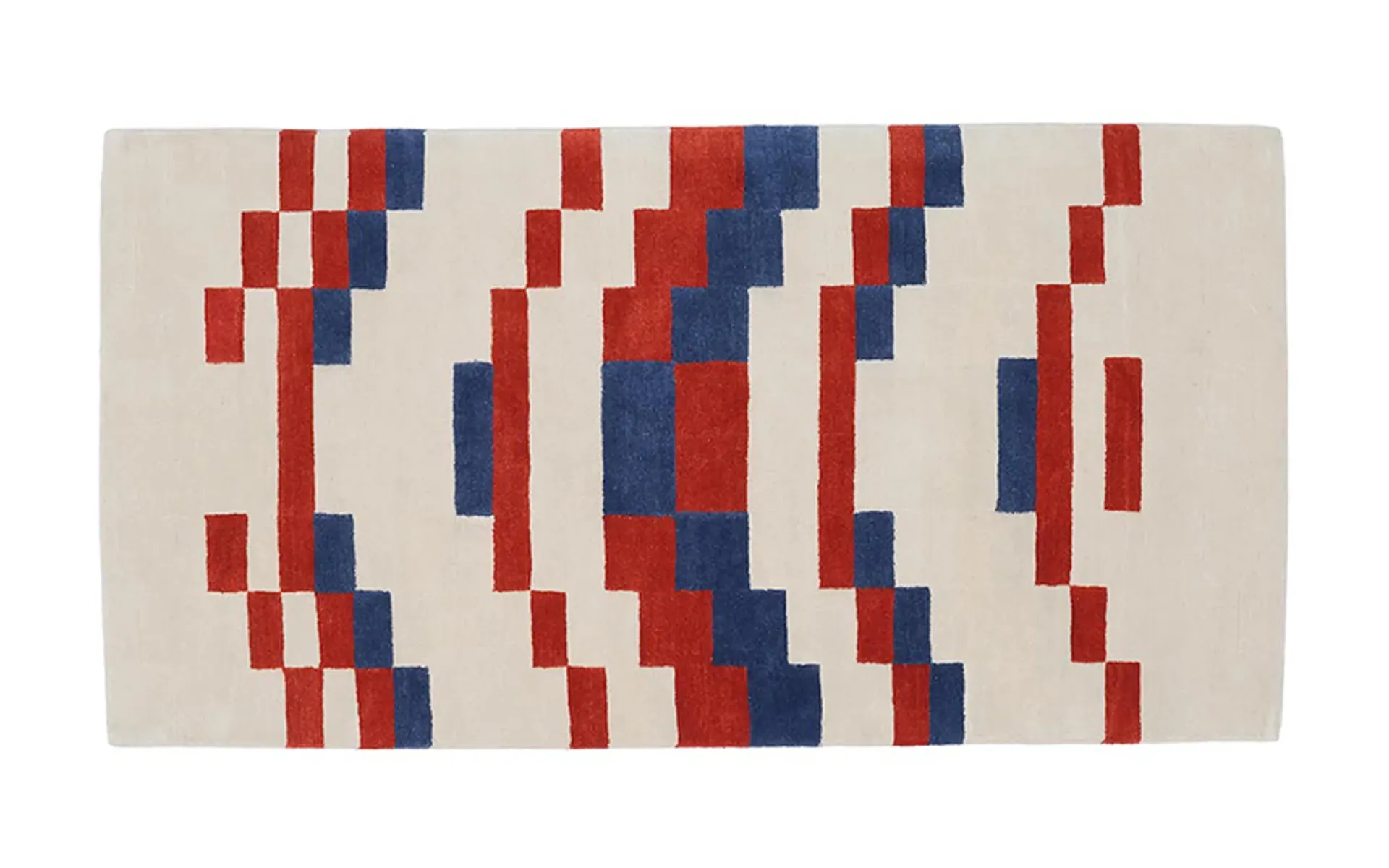
Part of Christopher Farr Editions, a collection of collaborative rugs from some of the world’s most interesting and iconic artists and designers, both past and present. The Temple Berry rug has been produced in association with the Josef and Anni Albers Foundation, to ensure that the end result is as faithful to the original work as possible.

An 'aimlessly meandering' line, to quote Albers, on a jacquard fabric consisting of a composite mingling of yarns, weaves, and colours. The wool thread improvises its trajectory over a cotton satin fabric and jute weft threads, to trace a pattern poised somewhere between calligraphy and a leisurely stroll. The thick ondé wool yarn woven with the fil coupé technique, along with the lively colour palette and an artful technique confer three-dimensionality to an image that may be interpreted as a painting. The pronounced textural aspect recalls the charm of hand weaving. Ideal for curtains, panels, upholstery and decorative applications. In collaboration with The Josef and Anni Albers Foundation.