
At Wallpaper*, showcasing exceptional homes from across the world is our raison d'être. That's why we've launched a monthly series, The Architecture Edit, dedicated to highlighting the diversity of contemporary residential architecture. Every edition rounds up the houses that caught our eye that month – projects defined by thoughtful design, inventive construction and outstanding craftsmanship.
This time around, our journey takes us to a brutalist complex in Paris and a Canadian lakeside, the Tuscan coast and the suburbs of south London. Come along as we explore the standout houses of June 2026.
A subterranean South London home

Stylus Architects tucked Green Lodge into an awkward plot behind a Victorian house in Roehampton, London. To keep the street façade single-storey and ease planning approval, the architects dug down, placing living spaces on the ground floor and three bedrooms below, with light coming from sunken courtyards and a stairwell roof-light. Exposed concrete, oak joinery and larch cladding define the interiors, while photovoltaics and an air source heat pump make this a notably low-energy home.
A Parisian brutalist duplex

This month, a 55.6 sqm duplex that sits atop the Marat building within Renée Gailhoustet and Jean Renaudie's celebrated 1975 brutalist complex came to market. Built between 1971 and 1981, the stepped, ziggurat-style scheme is known for the way it integrates green urbanism into mass housing. The apartment includes two small sleeping areas, a study on a half-landing and main living spaces reached by a sculptural staircase, as well as a private terrace with mature trees.
A curved Canadian retreat

Designed by Bryan Young of Young Projects, this concrete, wood and stone holiday retreat in the Canadian Rocky Mountains takes an intriguing, curved ‘cut-out’ form, which ‘embraces’ an entrance inspired by a boulder retained on site. A butterfly roof, meanwhile, defines the silhouette across the adjacent lake. Inside, an open-plan living, kitchen, dining and study area occupies the main level, with a primary suite and three guest bedrooms tucked into the slope below.
A sculptural concrete house

Architect Carlos Maia of Tetro Arquitetura describes Xingu House as a sculptural statement merging landscape, structural ambition and Brazilian modernist heritage. It crowns a forested hilltop in Nova Lima, Brazil, pinwheeling around a central axis on six faceted concrete pillars. One cantilevered wing houses the primary suite; two others meet the ground at the site's old stone terraces, now reimagined with reflecting ponds and a pool. The interior, meanwhile, pairs raw concrete with sculptural art, including a piece by artist Túlio Pinto.
A Québec lake house

Yh2 architecture's Counter-Slope House embeds into a sloping site on Québec's Lake Memphremagog, leading the architects to describe the result as ‘an architecture of subtraction that reveals more than it imposes’. Here, cedar cladding and white oak joinery age naturally with the site. The open-plan ground floor comprises stone, timber and floor-to-ceiling glazing, while the entrance level, reached via a bridge, houses three bedrooms beneath a butterfly roof, as well as a rooftop ‘belvedere’ for contemplating the lake.
A 16th-century Medici watchtower

Perched on Tuscany's Romito Coast, this 16th-century Medici watchtower later became Baron Sidney Sonnino’s seaside residence before standing empty for years. Architecture studio Tono has now restored it, preserving the stone, lime and travertine façade as well as the original Venetian terrazzo and marble flooring. Inside, a lapis lazuli-toned palette echoes the sea, which is visible from every room, and is paired with antiques and bespoke furniture.
A Costa Rican patio house

Mexican architect Manuel Cervantes designed this patio house around a central courtyard and pool, drawing on a Roman impluvium as inspiration. Four pavilion-like wings – two living spaces and two bedroom blocks – surround the courtyard, encouraging movement through thresholds rather than corridors. The house uses local materials and craft traditions, built from Pacific cedar, Nicaraguan brick and chukum plaster, while two sculptural pyramid forms rise from the pool.
A mixed-reference Australian home

Coy Yiontis Architects designed Glenblaith as a ‘forever home’ for a retiring couple in Manifold Heights, Australia, mixing brutalist and modernist references within a suburban streetscape. A moveable timber screen reveals an introverted courtyard core anchored by a 4.8m oculus that nods to John Lautner’s Hope Residence. Monolithic concrete columns frame an atrium with a lily pond, dividing the home into separate wings for living and entertaining. Unexpected details, like a barricaded brick window, add moments of unexpected charm.
A national park-inspired home
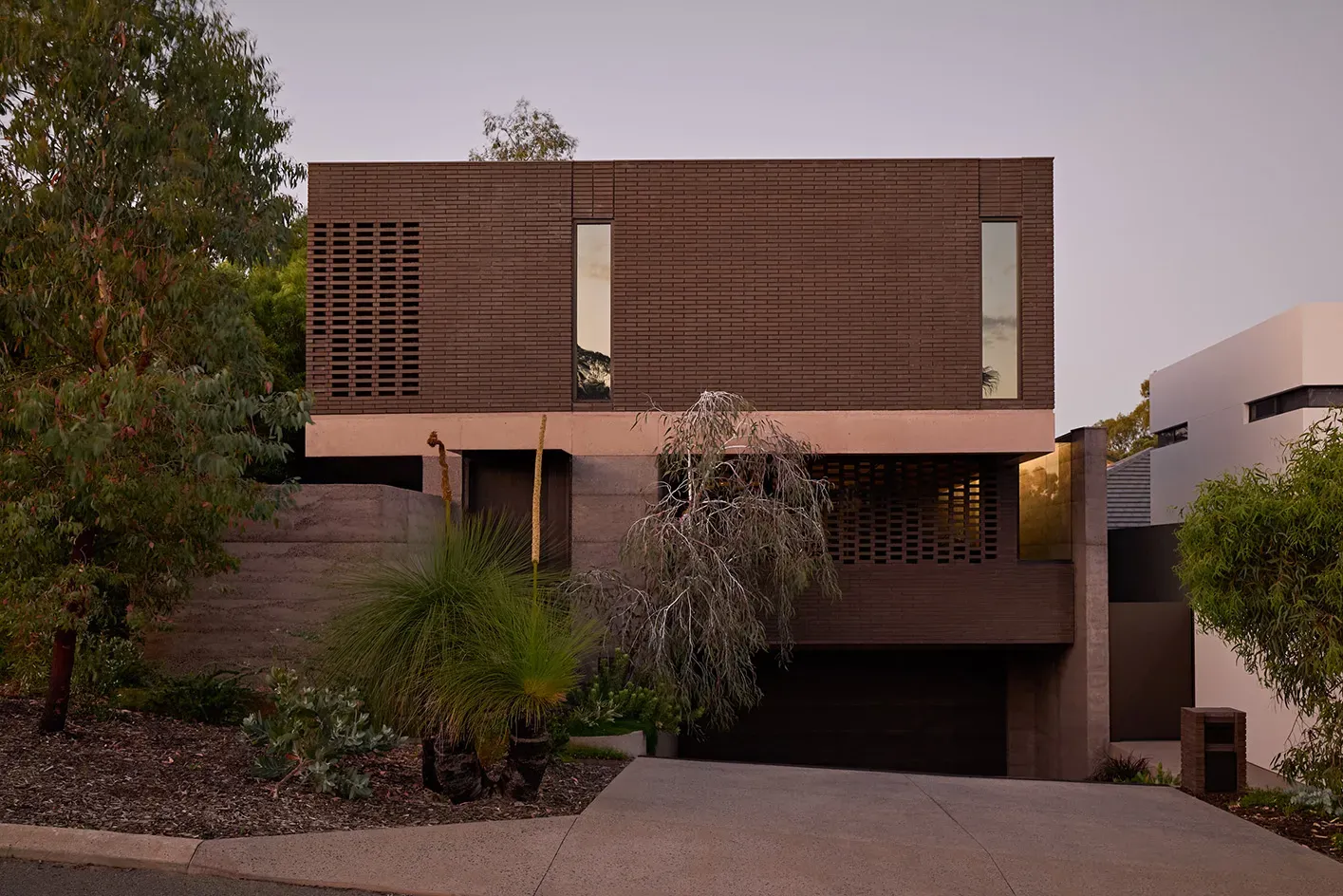
Designed by Tenille Teakle of Studio Gritt, this 409 sq m home in Perth's Wembley Downs draws on the textures of Karijini National Park. Seven-metre rammed-earth walls and weathered face brick echo the gorge rockfaces, while burnished concrete floors recall blackened sand. Upstairs, lighter hemp render mimics the experience of climbing out of a gorge into daylight. The design also incorporates recycled concrete, repurposed materials and native planting, creating a calm, cocoon-like sanctuary.
A dwelling within a barn

In order to leave the host structure unaltered, Prague-based Facha Architekti simply inserted a compact, self-contained timber dwelling into an old agricultural barn. Clad in black asphalt, the box sits slightly elevated above the barn’s original floor, with a concrete threshold joining interior and exterior. Inside, birch plywood dominates, and a single black-dyed MDF block consolidates the kitchen, bathroom and storage. Underfloor heating keeps things warm, while the barn itself acts as a passive buffer against summer heat and winter cold.