You are now subscribed
Your newsletter sign-up was successful
Want to add more newsletters?

Daily (Mon-Sun)
Daily Digest
Sign up for global news and reviews, a Wallpaper* take on architecture, design, art & culture, fashion & beauty, travel, tech, watches & jewellery and more.

Monthly, coming soon
The Rundown
A design-minded take on the world of style from Wallpaper* fashion features editor Jack Moss, from global runway shows to insider news and emerging trends.

Monthly, coming soon
The Design File
A closer look at the people and places shaping design, from inspiring interiors to exceptional products, in an expert edit by Wallpaper* global design director Hugo Macdonald.
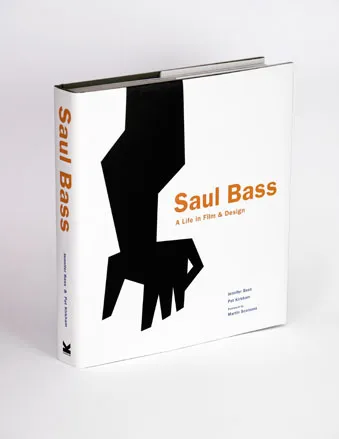
There is no single word to sum up the work of graphic designer Saul Bass, who so succinctly defined entire movies with just one image. Luckily, there are now 440 pages to do the talking in Laurence King's long-awaited book, Saul Bass: A Life in Film & Design.
Of course, this new tome has its fair share of images too, more than a thousand of them, in fact: old photographs, product labels and movie posters in that unmistakably jerky style. Equally resonant are the stills of Bass's now mythical film title sequences. Remember the fruit machines at the start of Ocean's Eleven, illustrated with hundreds of dots like Vegas neon? Ever see Anatomy of a Murder, with that staccato Duke Ellington score synched to graphic body fragments on the pavement? Classic Saul Bass. As is, perhaps, his most famous work, from Vertigo (a sequence unambiguously referenced in 2007, when the TV series Mad Men debuted its titles, featuring another faceless, falling man).
You see tributes to the graphic designer everywhere. Yet this book is the definitive homage, discerningly and lovingly edited by his daughter Jennifer Bass, now a designer herself, with a foreword by Martin Scorsese, who collaborated with him on Goodfellas, Cape Fear and other films. Just thinking of those titles makes you want to hide beneath the covers. Such was the power of Bass's visuals. Perhaps you could call him the Man with the Golden Arm, after the Otto Preminger film whose titles he designed. After all, nearly everything he touched turned to cinema gold.

Poster for The Man With The Golden Arm, directed by Otto Preminger, 1955

Tone Poems of Color album cover, 1956

Poster for Saint Joan, directed by Otto Preminger, 1957

Poster for 'Vertigo', directed by Alfred Hitchcock, 1958

A spread from the chapter on Anatomy of a Murder, directed by Otto Preminger, 1958

The symbol of the male figure became so synonymous with the film that it was possible to remove the text for programmes and invitations altogether

A spread from the chapter on Bonjour Tristesse, directed by Otto Preminger, 1958

A spread from the chapter on Exodus, directed by Otto Preminger, 1960

A spread showing the scorched invitations to the Exodus premier

A spread from the chapter on Spartacus, directed by Stanley Kubrick & Anthony Mann, 1960

A spread showing Bass as a 'bill poster' for an article in Show Business Illustrated, 1962

A spread with the poster and idea sketches from the chapter on Seconds, directed by John Frankenheimer, 1966

A spread from the chapter on Lawry's Seasoning & Food Company, Saul's first major identity campaign, 1950s and 1960s

A spread from the chapter on Hunt Foods after it took over W.P. Fuller & Company and asked Saul to devise a new logo, 1960s

A spread on a selection of designs for Ohio Blue Tip Matches - a division of Hunt Foods, c. 1963-65

Saul with some of the work produced during the identity design process of Celanese Corporation of America, 1965

Saul in his office, 1970s

A spread of from the chapter on United Airlines advertisements, 1989