The brightest stars in the constellation of progressive Los Angeles architects are Frank Gehry and Morphosis, but Franklin Israel (1945-1996) might have rivalled their brilliance had he not died at age 50, just as his career was beginning to flower. Had Gehry passed that early he would be remembered only for his houses and a few humble projects, mere hints of the Bilbao Guggenheim, Walt Disney Concert Hall and other masterpieces to come. Gehry was a mentor to Israel and paid tribute at his memorial, asking 'Was he a great architect? He was becoming one. We won’t see the peak.'
Franklin Israel's architectural legacy and potential is explored in a new book

Even during his two decades of creativity in LA, there was little public awareness of Israel. Many of the residential commissions were hidden from the street. He shaped colourful, interior villages for cutting-edge companies, including Propaganda Films, Virgin Records and Limelight Productions, while transforming the former Eames Studio in Venice for the branding company Bright and Associates. Each shares a common language of folded and tilted planes, exposed members, luscious colours and daring manipulations of space.
Deconstruction is an overworked and often misapplied term, but it’s an apt description of these fragmented environments. All were concealed within generic warehouses and only one – for the Tisch-Avnet film company – remains intact.

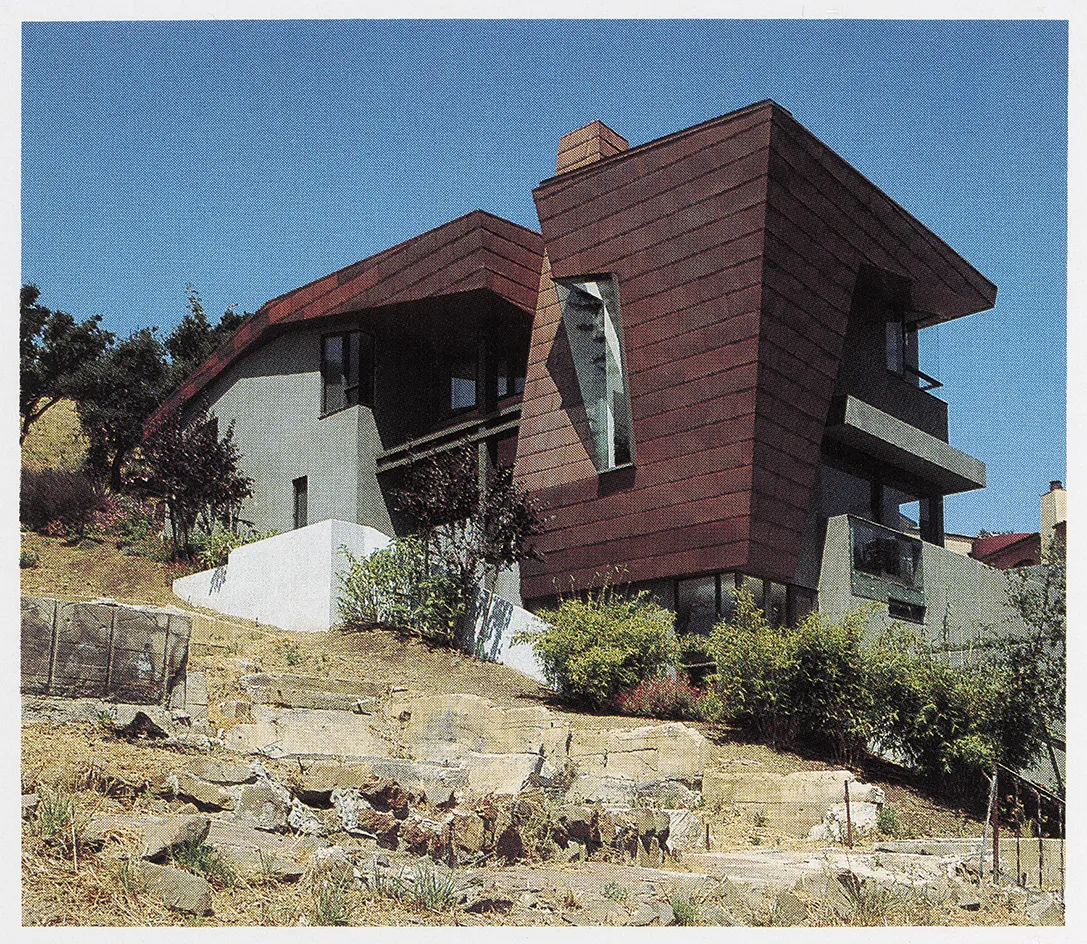
Goldberg-Bean House, Los Angeles
Now, a new book by Getty Publications, Franklin D. Israel: A Lifetime in Architecture, puts the spotlight on this lesser-known pioneer's work. In a moving tribute, author Todd Gannon, a professor of architecture at Ohio State University, brings the man and his work back to life.
He has used the archive of Israel’s models and drawings at the Getty Research Institute to trace the evolution of a prodigy from student sketches to his designs for a new city centre in Teheran, through his brief practice, culminating in the Weisman Pavilion, Los Angeles, the Drager House in Berkeley, the Dan House in Malibu and the UC Riverside Arts Building, completed by his associates after his death. Here, one can clearly discern the trajectory that would surely have brought him larger commissions.

Tisch/Avnet offices, Culver City
Gannon also reveals the anguished struggle of a gay man to conceal the disease that was slowly destroying him, even as he increased his productivity as an architect and teacher, and sustained a network of friends and clients. It’s becoming harder to remember the terror that AIDS inspired while it was still an incurable, mystery disease. As Herbert Muschamp, the brilliant New York Times critic, wrote, 'It has fallen to Israel’s generation to negotiate a contract between stellar promise and early death.'

Israel Callas Shortridge: University of California Riverside Arts Building
It’s tempting to quote at length from a monograph that is beautifully written, keenly analytical and full of sharp perceptions about Israel, his peers and the city in which he worked. In his summation, Gannon observes: 'Countering the figure of the lone genius, [Israel] was a committed collaborator who never did anything alone. Against the prevailing tendency to equate great work with raw authenticity, he revelled in dreamlike artifice… From the start, Israel excelled at elaborate set pieces and dramatic promenades. He laboured over surface finishes, material selections, lighting and colour, coupling the steady hand of the master architect with the keen eye of the decorator.'
Would that every architectural monograph were so instructive and such a pleasure to read.
Franklin D. Israel: A Lifetime in Architecture, £50 (Todd Gannon. Getty Publications). Also available from Amazon.com