Water world: a mesmerising installation by Bureau de Change unfurls

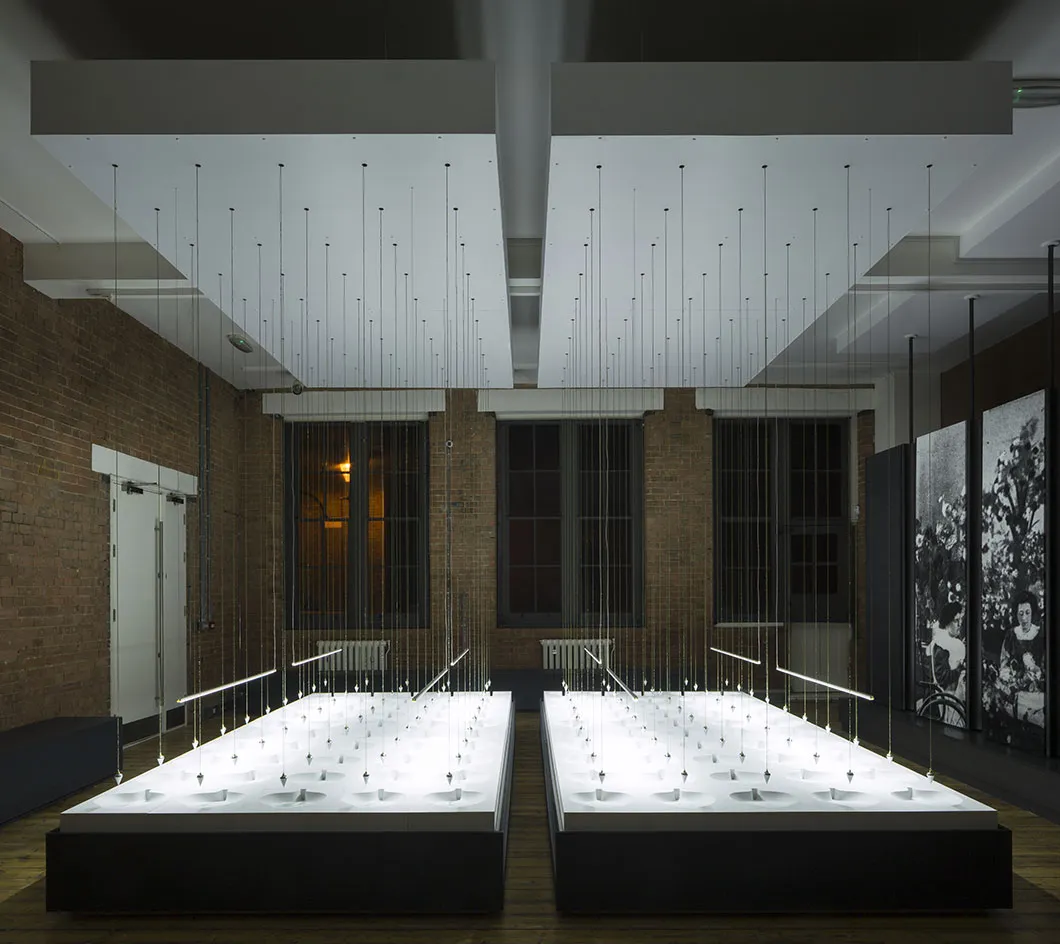
Bringing together Clerkenwell’s rich industrial history and the Sto Group's range of IQ façade finishes, dynamic young architecture practice Bureau de Change has just unveiled a captivating installation at the manufacturer’s London gallery space, Sto Werkstatt.
Entitled ‘Droplet’, the piece is a ‘sensorial’ installation, explain the architecture firm’s directors, Billy Mavropoulos and Katerina Dionysopoulou. ‘The main challenge of the brief was how we could utilise a product whose "magic" effect is essentially invisible,’ adds Dionysopoulou. ‘The installation sets up a "compare and contrast" scenario, whereby the IQ coating can be seen working in a live way.’

Installation view of 'Droplet'.
A visit does not disappoint. The display, arranged in a grid formation, consists of 100 elegantly made pendulums and a three-dimensional surface of 100 petal-like forms below them. Tinted water drips down the pendulums’ chains onto the sculptural carved forms underneath – which are CNC'd from Sto’s lightweight façade material Verolith – creating an ever-changing pattern within this calmly energetic piece. A soundtrack of water dripping completes the effect.
'We are using a set of the company’s intelligent paints – one that repels water and one that doesn't,' explains Mavropoulos. ‘The texture of the water-repellent pain replicates properties of the lotus plant, which allows water to glide over it smoothly.’
The site-specific installation also drew on the Sto building’s history, which at the end of the 1800s and beginning of the 1900s was part of the John Groom Foundation, which employed disadvantaged women in flower-making (creating flowers out of textiles was big business in London at the time).

The installation's base is CNC'd into a pattern of lotus leaves, referencing the way the plant interacts with water.
'We worked with the Metropolitan Archives, which are situated around the corner, and borrowed their flower-making tools, which we 3D-scanned and 3D-printed to display them here,' continues Mavropoulos. ‘These helped inspire the petal shapes in the installation. Even the pendulums refer back to Clerkenwell’s history and specifically its long tradition in clock-making.’
The multi-layered show aims to unfold the area’s different historic layers, while offering a dynamic display that engages the visitor, and an inspiring showcase of Sto’s cutting-edge product.

The exhibition shows delicate pendulums hanging from the ceiling. These guide tinted water that drops onto a leaf-inspired three-dimensional base below, creating patterns

The architects tapped into the area's history and specifically the Sto Werkstatt building's history as a flower-making facility in Victorian times

Two types of tinted water are used – one that is completely water resistant, and one that isn't, emphasising the different effect each creates
INFORMATION
’Droplet’ is on view until 16 December. For more information, visit the Sto Werkstatt London website
ADDRESS
Sto Werkstatt
7–9 Woodbridge Street
London EC1R 0LL
