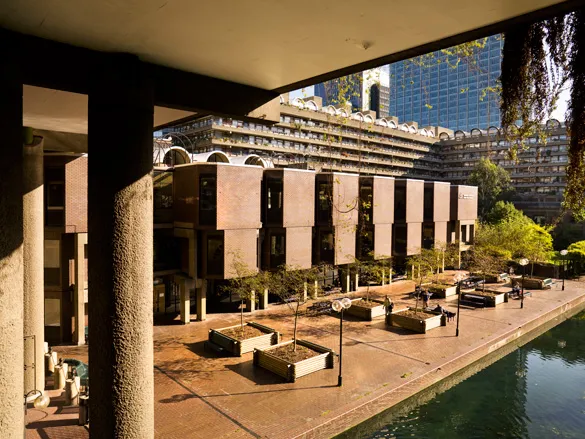
The panoramic view from the Wallpaper* offices takes in the elaborate concrete tips of the three Barbican towers - Lauderdale, Cromwell and Shakespeare. Against a backdrop of glass, steel and cranes, these Brutalist hunks have endured for decades, slowly but surely becoming one of the capital's most desirable contemporary addresses.
Elain Harwood's new monograph for the RIBA traces the story of the practice behind them - Chamberlin, Powell & Bon - from its establishment in 1952 by Peter Chamberlin, Christof Bon and Geoffry Powell, through to the seemingly endless rounds of negotiations and redesigns that came to characterise the Barbican job, some three decades in the making.
CP&B met at Kingston University, with their influences and interests gradually converging throughout the late 1940s and early 1950s, partly driven by the impending Festival of Britain and its importance to the creative classes.
The practice's first project was the Golden Lane Housing in the city of London, still held up as an exemplar of how to build decent, affordable, spacious and well-loved flats, and there were also major works at New Hall and Churchill College in Cambridge, as well as the grey, expansive but expressive campus at Leeds University.
The Barbican still stands supreme, however, as a symbol of optimism and self-confidence as well as a stark reminder of the power wielded by a blank slate. Today, there are few modern global cities that could offer up such a site, giving the muscular buildings a uniqueness that might never be repeated. Harwood's monograph benefits from her extensive experience of post-war British architecture and familiarity with many of the key players of the era.

Lauderdale, Cromwell and Shakespeare, the three towers of Barbican by Chamberlin, Powell & Bon

A perspective from 1956, suggesting the intended vibrancy of Barbican, but with very different elevations from those realised later

The first Barbican scheme, from 1955, pyramidal block of flats to rear left

The Cooper Taber Seed Factory, Withan, C. 1957. An early example of work by Chamberlin, Powell & Bon

Churchill College Competition, persepctive by Gordon Cullen

Exhibition stand for the British Aluminium Company, 1949, by Brown and Chamberlin

Perspective by Ian Baker of Geoffry Powell’s winning scheme