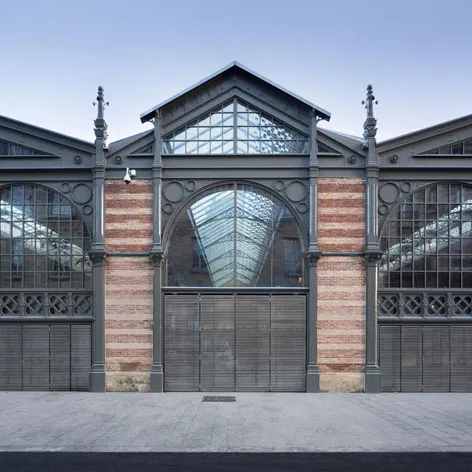
Throughout the history of Paris, Upper Marais has seen an impressive succession of buildings. It has been the site of the Knights Templar's medieval fortress, used as the Royal family's prison during the French Revolution; an 18th century Rotunda, belonging to the Order of Malta and including high-end shops; and finally, it hosted several wooden pavilions built in 1809 housing a large flea market, and later replaced by sleek iron constructions under Baron Haussmann. Two of the six pavilions have survived, after being saved in 1976 by local activists who campaigned against them being torn down for the sake of a carpark.
Listed as a historic monument soon after the demolition of the famous Grandes Halles - a major iron-and-glass oeuvre by Victor Baltard - today's Carreau du Temple, set to reopen at the end of April, is an exemplary project. Its new purpose as a mixed-use sports and cultural facility was defined by a public vote. Paris-based architecture practice Studio Milou - specialists in the adaptive reuse of heritage buildings - seamlessly integrated contemporary acoustic and insulation standards into the 19th century framework.
For lead architect Jean-François Milou, it was both a professional challenge and a matter of principle. It is, he says, 'a technical demonstration that Baltard's Halles could have been perfectly maintained.' The refined iron structure was faithfully restored to its original design. Brick infills were replaced by glazing, so that the transparent façades flood the Carreau with natural light and open it to the curious eyes of the passers-by.
The flexible interior, complete with mobile partitions and retractable stands, allows the hall to be reconfigured for everything from community events to trade shows and artistic performances. Moreover, the Carreau is set to become the centre of Paris' new fashion district and a bustling destination during prêt-à-porter weeks.
This will continue the Carreau's long-standing connection to fashion - a connection hailing from the times when the Order of Malta's privileges allowed local merchants to sell costume jewellery and Indian print cotton prohibited elsewhere in the country, and reaching well into our times when Yamamoto, Galliano and Dior Homme catwalked their collections under the old market's zinc roofs.

The main entrance opens into an immense hall suited for various events, from fairs to fashion shows, while a small auditorium and a café are located at the rear

The refined iron structure was faithfully restored to its original design

Mobile partitions allow the hall to be reconfigured for different events

Industrial oak flooring and wall panels create an elegant marquetry effect

The lower floor houses a vast lobby showing traces of old masonry, two sports grounds, and a few multifunctional spaces

Its new purpose as a mixed-use sports and cultural facility was defined by a public vote

A new roof was conceived with glass panels covered with photovoltaic cells forming designs reminiscent of pixels

To convince the heritage authorities to replace the masonry in the lower part of the building with glass, the architects suggested adding a layer of steel grills. Seen from afar, the building retains its visual unity, but upon closer inspection, the transparency increases revealing the spectacular interiors

Each section of the façade integrates a door, so that the Carreau can be fully opened towards the street
ADDRESS
Carreau du Temple
2 rue Eugène Spuller
75003 Paris