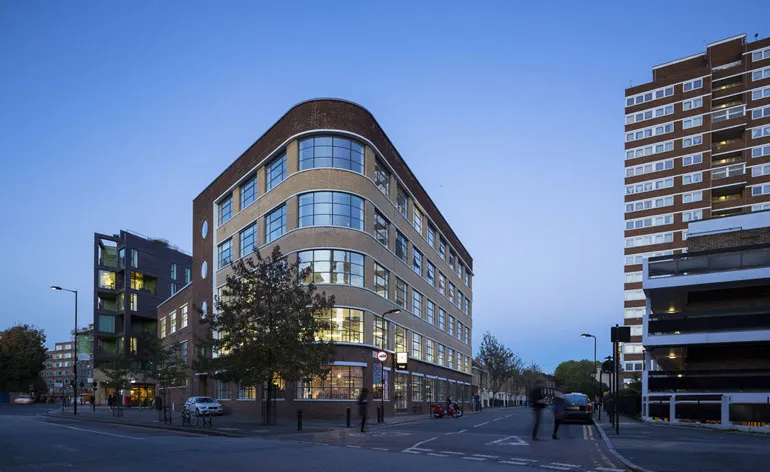
The new home of British menswear accessories manufacturer Drake's brings together its design, manufacturing and distribution arms under one roof, a former 1930s factory on the corner of the aptly titled Haberdasher Street in Hackney, east London. The scheme exposed as much of the existing structure as possible, explains project architect Nicola Rutt, a partner at London-based practice Hawkins Brown. 'We wanted to maximise the internal space and daylight and celebrate the light industrial nature of the building.'
Many of the building's original features, such as the porthole windows, the cantilevered concrete canopies, the clock and the cage for the lift have been retained or reintroduced. 'The curved brick facade is the building's strongest feature so we were keen to reinstate curved windows to every floor,' says Rutt. The architects took their client to the Crittall factory in Essex, where windows have been handmade for years using traditional processes. 'It was particularly important to Drake's that the architecture and interiors reflect their commitment to craftsmanship.'
At ground level the building contains a factory, an administration area, a meeting room and a warehouse for packing and distribution, while the first floor is occupied by the design studio and workroom where the company's ties are manufactured and undergo 18 separate quality checks. The scheme also incorporates speculative workspace and new warehouse-style apartments for rent on the upper floors and, in an interesting reinstatement of the British tradition of living above the shop, Drake's directors, Mark Cho and Michael Hill, have taken up residency of two of the nine apartments.
Here again the architects took their cues from the best that the classic 1930s structure had to offer. The herringbone pattern of the original external brickwork (and, coincidentally, the weave of many of the fabrics Drake's uses) is echoed in the detailing of the residential oak parquet floors and terrace decking. It's yet another fitting and inspired touch in a quintessentially British design project.

The brand's new HQ sits on the corner of the aptly titled Haberdasher Street in Hackney, east London

The scheme exposed as much of the existing structure as possible

The architects aimed to maximise space and keep the building's industrial character

At ground level the building contains a factory, an administration area, a meeting room and a warehouse for packing and distribution

A simple metal staircase connects internally the ground floor with the facility's second level

The first floor is occupied by the design studio and workroom where the company's ties are manufactured and undergo quality checks

A separate room is used as a showroom for meetings with clients

The scheme also incorporates speculative workspace and new warehouse-style apartments for rent on the upper floors

'The curved brick facade is the building's strongest feature', say the architects, who were keen to reinstate curved windows to every floor

Opting for Crittall windows, the architects took their client to the company's factory in Essex, where windows have been handmade for years using traditional processes

Drake's directors, Mark Cho and Michael Hill, have taken up residency of two of the nine apartments

The herringbone pattern of the original external brickwork is echoed in the herringbone detailing of the residential oak parquet floors and terrace decking