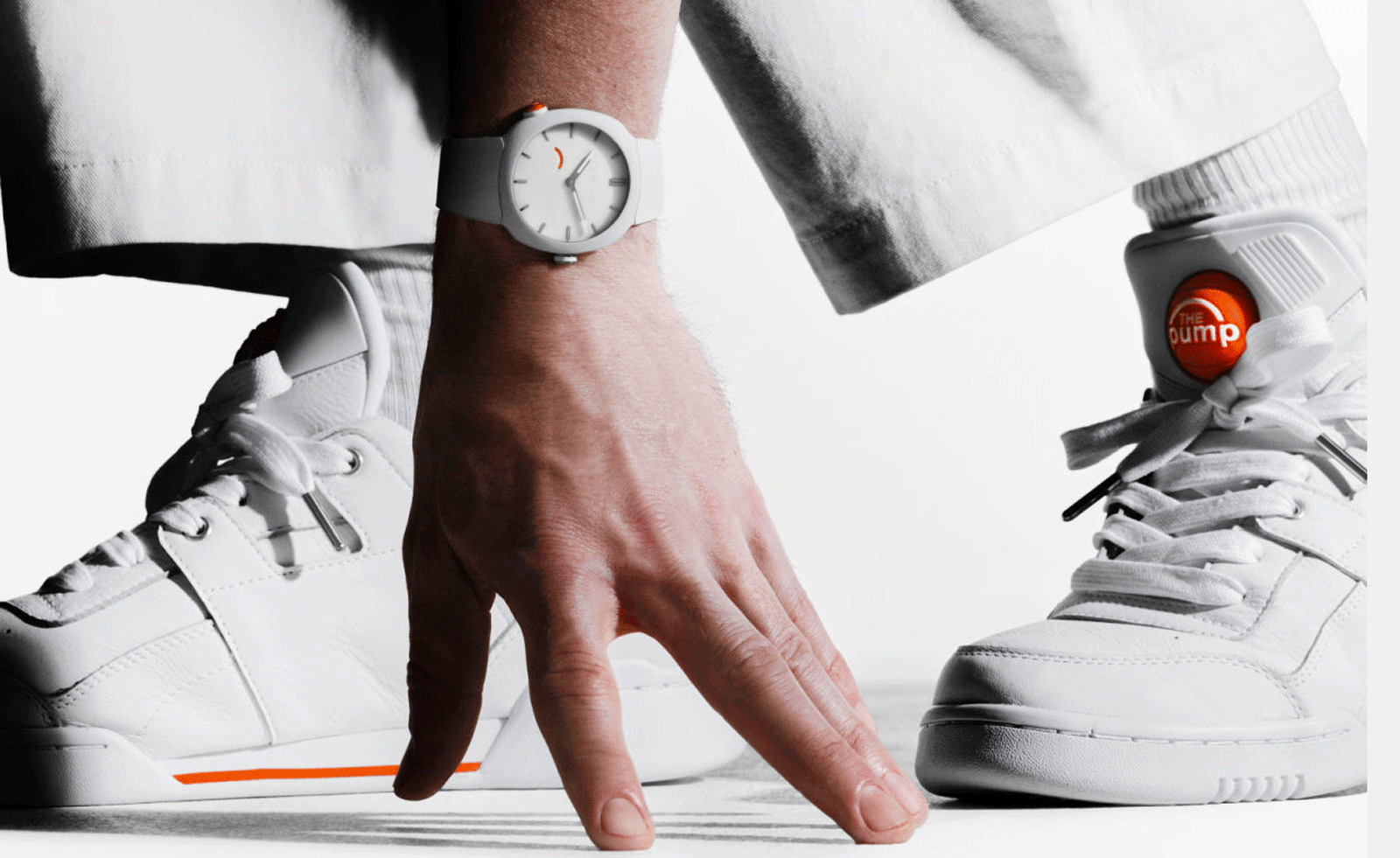
Bertrand Meylan, co-CEO of H Moser & Cie, concedes that initially the idea seemed like a crazy one. ‘We were contacted back in 2023 by a guy who had been in contact with Authentic Brands Group [which acquired Reebok in 2022], one of whose owners was into watches and wanted to do a collaboration,’ he recalls. ‘We just ignored that at first. I mean, what were they thinking of? But then we started to think about it…’
More specifically, Meylan started to think back 30 years or so to when one of his favourite pairs of trainers were his Reebok Pumps. And, as much as a collaboration between a high-end Swiss maker of avant-garde watches and a British-cum-American sneaker company – and not even one of the big two at that – seemed counter-intuitive, Meylan laughs that he 'started to feel nostalgic, and so started to think about some kind of angle that made any sense'.

The Pump, as Meylan stresses, was 'an iconic product'. Indeed, it was likely Reebok’s most groundbreaking design, allowing wearers to use a toy-like, half-basketball-shaped button on the tongue to hand-pump air into chambers inside the shoe, thus providing each foot (since no two are alike) with a more snug, custom fit. There was a button on the heel that worked as a release valve.
The idea was borrowed from a mechanism designed for a Raichle ski boot and then developed by Ellesse, which Reebok acquired in 1988. Several concepts were advanced, including a self-inflating model (later rejected for being too complicated, requiring the use of pressurised air canisters) and the successful hand-inflated one – based around a system co-designed with a medical device manufacturer that was expert in the making of inflatable blood pressure cuffs.

After some tweaks to the aesthetic (the first version was pretty ugly) and to manufacturing (thanks to a sewing error, half of the first production batch wouldn’t inflate), the Pump would launch to great fanfare, the most expensive sneaker yet commercially produced. By the end of 1990, it was calculated that, if the Reebok Pump alone was an athletic shoe brand, it would be the world’s fourth largest.
But how to translate the idea of an inflatable trainer to a watch? H. Moser & Cie initially considered something akin to an inflatable strap, but this struck the company as gimmicky. Instead, it took 18 months of R&D to adapt its automatic HMC 500 small seconds movement to come up with a way of using an anodised aluminium pusher – in orange, as was the inflator on Reebok Pumps – to ‘pump’ the watch’s winding mechanism. Each press of the pusher on the Streamliner Pump – as the watch has been named – transmits the energy to the barrel spring and activates a power reserve indicator.

'I’ve been wearing one for a while now and have to say that pumping it become habitual,' says Meylan – he compares it to a fidget toy. 'That’s important for a manual wind watch anyway, but we were also careful to design a movement that couldn’t be overwound. You can keep pushing the pusher even when the mechanism is fully wound. And you get used to pressing it when you’re a bit bored. That said, it is a more natural gesture to power a watch in the way that a conventional winding crown isn’t. Funnily enough, I remember playing with the pump button on my shoes all the time too.'
Meylan can revisit that feeling too: each of the Streamliner Pump watches – available in an edition 250 in matte black and 250 in white forged quartz fibre casing – comes with a matching, special edition, low-top pair of Reebok Pumps (Reebok has over-produced so customers should be able to get their right size, with any remaining pairs going to Moser staff and friends – and maybe ultimately into the hands of sneaker collectors).

The pump-action winding mechanism is both a curiosity and a delight. 'But I think that without the Reebok collaboration it wouldn’t have been anywhere near as cool as it is,' Meylan enthuses. 'The fact is that luxury [as much of the Swiss watch industry defines itself] doesn’t have to mean pretentious. And it’s important to remind ourselves of that.'
