Jack White on his first art exhibition: 'You have to get your ego out of the way'
The White Stripes and Raconteurs frontman reinvents the detritus of life for his first art exhibition, 'These Thoughts May Disappear', at Damien Hirst's Newport Street Gallery in London
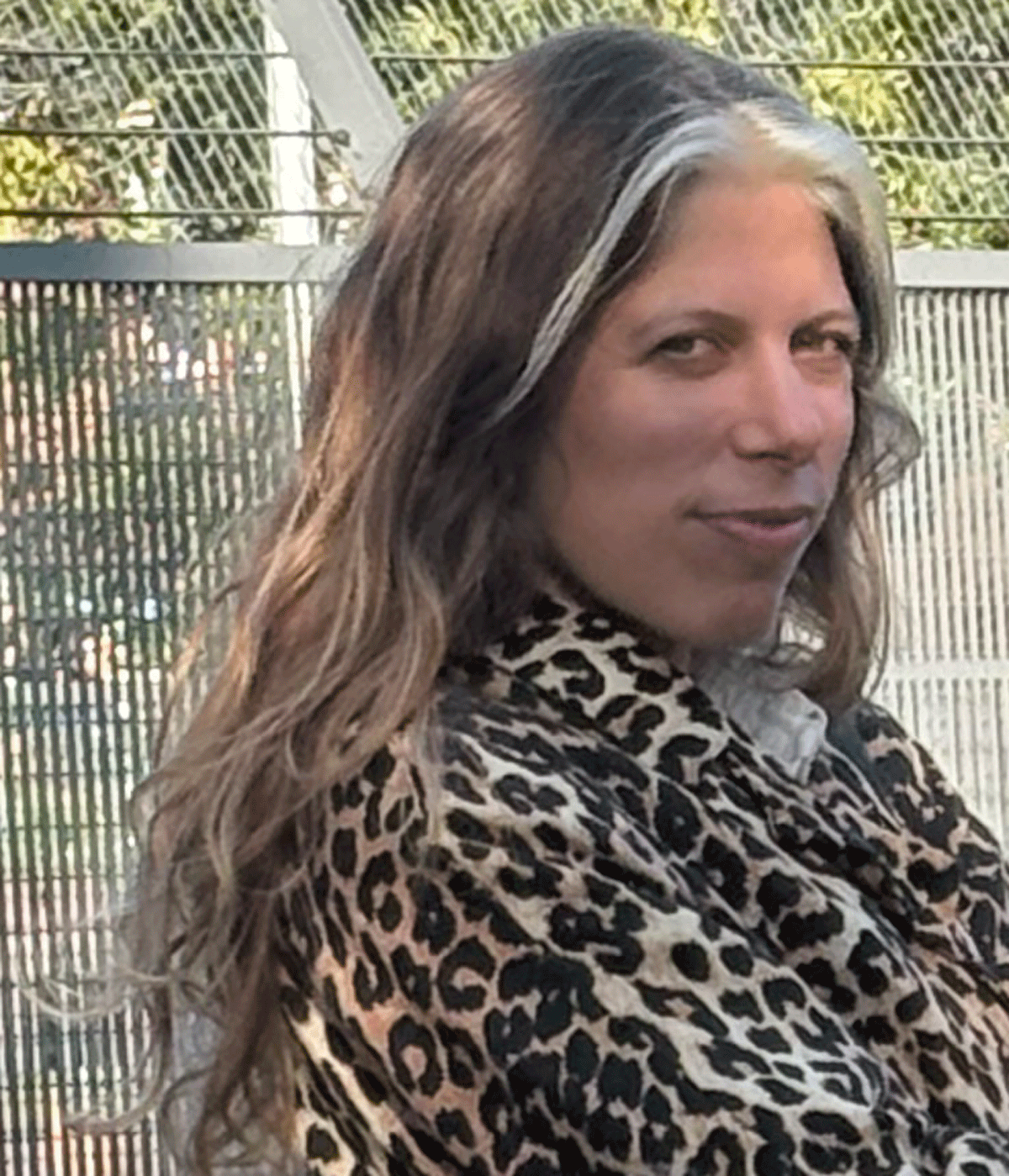

‘People don't know this side of me. I want them to see that this came from a passionate place, in an attempt to try to get somewhere with it,’ says Jack White, walking me round his first London exhibition, These Thoughts May Disappear, the day before it opens at Damien Hirst’s Newport Street Gallery.
Upon first thought, it is perhaps an unexpected move from White, better known as a musician and frontman of bands including The White Stripes and The Raconteurs and founder of Third Man Records. Yet, even a cursory glance into White’s background reveals a creative polymath who has always worked across multiple disciplines, interested in those hazy spaces where music, art and design begin to blur.
Born in Detroit, and now based in Nashville, White discovered the possibilities in an urban landscape early on, taking the raw materials he saw all around him and stripping them down or building them up, painting them or partnering them, driven by a desire to create.
‘If you have a truck and it's big garbage day and you're in Detroit, you start garbage picking. I was taught about the creativity in taking an old piece of furniture that's headed for the dump and rescuing it and bringing it back to life. It was the first thing I was taught to do with my hands. Someone would say, "I’ve got this old chair of my grandfather’s, I don't want to throw it away." So you reglue it, and then you refinish the wood, reupholster it with new fabric and padding, and you bring it back to life.’

Jack White, God’s Smuggler (1996), Plywood, wood, metal, plastic, lacquer, epoxy resin and latex paint
It was only a couple of years ago that White realised that he'd been living by this philosophy in every area of his life. Musically, in his revitalisation of blues and folk, and tangibly, in the physical homes of the independent label, Third Man Records, and vinyl record plant, Third Man Pressing, founded in 2001 and located in Detroit’s historical Cass Corridor. ‘It permeates everything,’ he adds.
White’s first job, as an apprentice at 15, was as an upholsterer, which he followed with the opening of his first shop, Third Man Upholstery, at 21. The space doubled as a studio, and everything – from his tools to his business cards – was yellow, white and black, an early recognition of the significance of a design identity, culminating most famously in The White Stripes’ strict red, white and black palette.
Colour is the first thing you notice upon entering These Thoughts May Disappear. Colour, and the sheer amount of works, which amply fill the lower and upper floors of Hirst’s airy and generous space. White estimates there are around 70 pieces, but is corrected – there are over 100. ‘When Damien [Hirst] first mentioned doing a show together, I came and saw this place,’ White says. ‘It’s massive. I thought, well, I'll have enough for the first room. Maybe that's it. Would they be OK if it's just the first room and the rest is empty, and we don't use that part?’

Work by Jack White and Damien Hirst
But as the exhibition started to take shape, filling the space was no longer a concern. Hirst and White first met when White was in the city for the opening of the London outpost of Third Man Records, a stone’s throw from Hirst’s studio in Soho. In 2021, White performed an impromptu gig on Hirst’s balcony, after which he showed Hirst pictures of his sculptures on his phone. ‘He said, "Oh, when's your next show?” and I said, "I've never done one.” No one had ever really invited me to or encouraged it, so I've never really sought it out. I just made work in my own time. He said, "Well, why don't you do one at our gallery?”’
'No one had ever really invited or encouraged me [to exhibit my art], so I never really sought it out. I just made work in my own time. Until Hirst said: "Why don't you do a show at our gallery?"'
Jack White
Four years in the making, the exhibition unites a vast body of new work created for the show with more historical works, going back to pieces White made as a teenager, with an emphasis on found materials at its heart. He worked with Connor Hirst, Damien’s son, on a curation which encompasses many works never shown publicly before.
Throughout, there is a nod to this early scavenger spirit, the resurrection of dead materials, or discarded objects, rethought entirely or coated generously in a glossy epoxy resin (‘I like making it so you want to eat it, you know – you just want to take a bite out of the box,’ he says). He is drawn to certain motifs which he reworks throughout. Strikingly, when you enter, it is a model he has dubbed Ukulele Joe, a figure he originally found in a junk shop and then reproduced in a rainbow of different iterations crafted from 3D-printed thermoplastic resin, in different colours and sizes.

Jack White, Blue Ukulele Joe (Small) (2025)
On our walk-around, he pauses before the life-size version. ‘I just idolise him,’ he says. Why? ‘He's just so suave. He's got everything figured out. He's so secure in his look. His face is so compelling to me. There's a bit of that multiculturalism of America. There's the kitchiness of America, camp ideas of carnival prizes mixed with what people would put in their home as a nice piece of art – but it's really made out of chalk.’
Stretching up to the double-height ceiling in the second room is a remake of the 2015 sculpture The Red Tree, a project which originally saw White paint a dying tree in his garden red. It has been carefully reproduced here. ‘It died, I brought it back to life, and it died again, and now we're bringing it back to life in a fake version of it – a plastic resin version of the tree which is also the height of the room,’ says White. ‘It was very collaborative for me in Nashville, with the team in London and the fabricators in China. To be able to be a director of a concept was really nice.’
Some pieces are slyly playful. White has repurposed a series of oak and pine wood pallets, imagining different, official uses for them. ‘The beginning of this concept was a fake company called the Pallet Cleanse Corporation. I was garbage picking all these pallets, and I was imagining if there was a company that used them for different businesses and different genres and special interests.’ So we have one for ambulances, painted helpfully with red crosses, and one for schools from which chairs are stacked. They hit that teasing spot – satirical, but also possibly quite a good idea.'

Jack White, Ambulance Pallet (2025)
Many things aren’t quite what they seem here. While White has created a world outside of music, it lingers. He demonstrates the microphone in the ear of his lifesize Ukulele Joe – sing through it, and your voice will project through his mouth – and feel free to adjust the echo. Beautifully constructed chairs contain hidden amplifiers and speakers. A bag of scented cedar wood is secreted inside one chair. Under another, I glimpse a samurai sword.
The exhibition closes with the work of six artists, from Ai Weiwei to Damien Hirst, who have put their own interpretation on the amplifier White designed for Fender in 2024. ‘There was only one rule: it has to still be able to play,’ White says. ‘I’m just so thrilled they would do this.’
Throughout, White’s joy in a more unconventional standard of beauty is clear. ‘Does this thing still have the potential to be beautiful and come alive again?’ he asks. ‘Can you bring it back to life? These things have spiritual connotations at times. When you look at the concept of any time a human being tries to create, they are in a way, mimicking creation from God. We can't create from nothingness, we have to create from something that already exists, whereas if there is a God, he or she created from nothingness. Can you imagine if you could wave your hand and make a beautiful statue appear? We can only work from the scraps that we were given on this planet. I like that. That's a challenge.’
'We can only work from the scraps that we were given on this planet. I like that. That's a challenge.'
Jack White

Jack White, Roadside Campfire (2025)
Why now, I ask. He hadn’t even thought about putting on an exhibition until Hirst asked him, he says. ‘When someone knows you in the mainstream, you go with it, because you've got a window where people are relating to something you're creating. I was in a bunch of other bands when The White Stripes broke, it was – OK, that's what you want me to do. Even in music, I wanted to be a drummer. I didn't want to play guitar, but that's what people wanted me to do. They related to that part of me, so I don't give a shit. I'll do what works with them, I'm going to go up and do a half-hour drum solo. Maybe someone might like it, or I might read my poetry, and maybe a couple of people might like it. But if I put a melody to that poetry, now I have got 100 people in the room wanting to share it. So I'm going to see now, for the first time, how people are going to respond to things that I physically created.’
White approaches his art as he does his music – he doesn’t know what will happen with the found materials he collects, but he steps back and allows them to come to life. ‘You set up a room, and you bring in the materials, and you get out of the way. Get your ego out of the way, get any of your hang-ups out of the way, and let it happen. If you come in like no, no, no, it has to be like this, and be strict about certain things, it might work, but it also might block you from the beautiful things that might happen by accident.’
THESE THOUGHTS MAY DISAPPEAR, from 29 May – 13 September 2026 at Newport Street Gallery, London

Jack White, Xylophone (2025)