A series of large, dense, dark paintings confront the viewer as you enter ‘Francis Picabia. Expanding Horizons’ at Hauser & Wirth London. They are from the artist’s postwar years, when he and his wife Olga returned to their Paris studio apartment following two decades on the Côte d’Azur. In declining health and with little money, Picabia continued to paint restlessly in the crammed space, exploring ideas, forms, compositions, expressions, often layering them as well as drawing on literature, and ancient and medieval art.
Renewing his interest in abstract and nonfigurative art, he continued to paint against the grain of his contemporaries, showing no interest whatsoever in the movements of the moment. These are some of his finest works, at once magical and mysterious, or as Sarah Allen, partner and head of research at Hauser & Wirth, describes them, ‘scary and powerful and radical, not dictated by any conventions or pressures from the art world’.

Francis Picabia, Composition abstraite, 1947
Niagara, Composition abstraite, Trèfle à une feuille, Le viol – painted between 1946 and 1948 – see paint thick and layered and smudged on surfaces. Look closely and on some you can see another artwork hidden behind, the one or two Picabia painted over, with his previous signatures – scribbled on all his artworks, often in red – barely concealed. Times were tough for Picabia, but equally, he had long had a habit of revisiting canvases, often layering old works with new ideas.
Organised in collaboration with the Comité Picabia and spanning five decades of work, ‘Expanding Horizons’ offers a rare glimpse into the career of one of the twentieth century’s most influential and exciting artists. Born François Martinez Picabia in Paris in 1879 to a Cuban-born Spanish father and a French mother, Picabia moved through artistic movements in rapid succession. Displayed at H&W are examples from these periods – from early landscapes to Dada works and Transparencies, nudes and realist works made during the war, and onto his final textural abstract paintings.
‘For all five decades, he was ceaselessly reinventing himself,’ says Allen, who co-organised the show. ‘He was never resting on his laurels. He wasn’t afraid to take risks, to jump off in completely new directions, or simply not to be liked.’

Francis Picabia, Le Zèbre (The Zebra), c. 1909-1933
His 1902 impressionist landscape is one of the earliest works on view here, as we begin to see a shift as early as 1908 towards neo-impressionism, then Fauvism and Cubism, as seen in an oil painting from around 1911. The work was believed to be encouraged by Gabrièle Buffet-Picabia, his first wife, an avant-garde musician whose musical thinking had helped shape his move into abstraction. Allen describes her as someone who ‘really wanted him to push the boundaries’ – a person with serious musical training and a deep investment in new forms of expression. You can sense this in Le Zèbre (circa 1909-1933), which sees the neo-impressionist coastal scene superimposed with a loose, playful line drawing of a zebra-like form and what might be a tablescape. The painting is one of many showing how the artist revisited and revised canvases across decades.
In 1915, on his return to New York – he had first travelled there in 1913 for the Armory Show – Picabia began the mechanomorphic work. These are machine-portraits and invented apparatuses, friends and lovers redrawn as spark plugs, cameras, electrical diagrams. It is the vocabulary that would carry him through Dada’s New York, Zurich and Paris years until 1921, when he renounced the movement as no longer new and walked away.

Francis Picabia, Genèses (Geneses), c. 1930-1931
Picabia’s Transparencies series arrived from the late 1920s. Allen points to preparatory works on paper from 1926 and 1927 as evidence of the thinking before the layering began: single, unlayered figures drawn from museum guidebooks and from Catalan church frescoes. Picabia often referred to such publications, had them annotated, thumbed, rearranged. Allen explains, ‘He wasn’t the sort of guy who would be standing in front of a Botticelli drawing from life.’ You can see the method fully realised in Genèses (1930-1931), with a pair of monkeys dissolving into a pair of humans, a white hoop bending off-centre, dice falling, figures from Romanesque fresco sliding beneath figures from Renaissance painting.
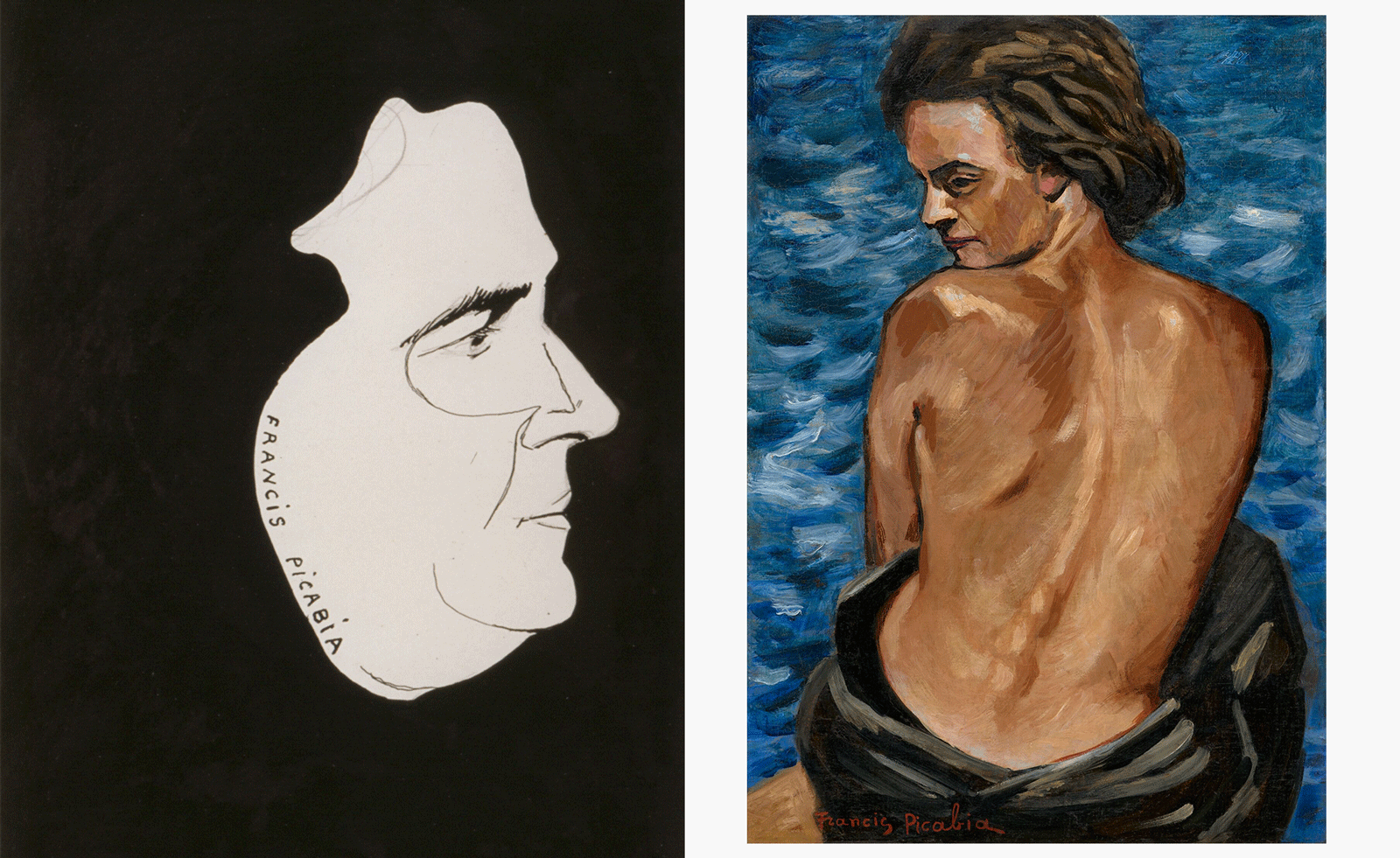
From the 1930s to the 1940s, Picabia began working from various magazine sources – Paris Magazine, Paris Sex-Appeal, Mon Paris – painting nudes with the unusual, flattened surfaces of their source photographs. A great example displayed here is Nu de dos devant la mer (1942-1943), with the model, back to the viewer, seated before water. As in the others, the lighting is slightly off, and the background and foreground have been stitched from different sources.

Francis Picabia, Untitled, 1932
Allen notes that when the source image was placed alongside the painting, a significant addition became visible, ‘There is no black drapery in the source, and there is no black knee. This was something he added,’ for weight, for structure, for reasons that remain his own. These are paintings made by someone who had been thinking about the relationship between found images and painted surfaces since at least 1901, when he first began using Spanish postcards as source material.
We return to Trèfle à une feuille, or one-leaf clover, the show’s gravitational centre. ‘It’s not called a four-leaf clover, because his luck had run out,’ comments Allen. The form is shieldlike, masklike, reading as an African sculptural object or Romanesque abstraction, and comes forward from a field of dark paint with something close to menace. Olga Mohler, who had been with Picabia for more than two decades of his life and who would have to sell works to cover his burial costs in Paris in 1953, kept this particular work for years in her collection.
Meanwhile, Composition abstraite (1947) pulls in another direction entirely – a form that recalls a shell, or an ear, or something not yet named. The stippling builds up in layers that seem, improbably, to be lit from within. Allen believes this period involved a dry brush, and possibly – in some works – pigment blown directly onto the canvas. He was not well, and you sense this in the colour and surface. ‘I get the same sense of desolation, and confusion, and isolation,’ she says, ‘that I get looking at a Giacometti sculpture.'

Francis Picabia, Ilma's Paris Horizons, 1951
The exhibition closes with Ilma’s Paris Horizons (signed 11 May 1951), a delicate ink on paper inscribed throughout by Olga, under Picabia’s direction. The text comes from Viola Ilma’s post-war Paris newsletter – the American journalist’s chatty dispatches on the city’s restaurants, boutiques and bars, picked up by Paris-Presse – and the names slip across the page: Hôtel George V, Maxim’s, Balenciaga, Hermès. Text returns as a compositional device, drawing us back to the artist's seminal L'Œil cacodylate (1921) and the Dada spirit that animated his early work. In Dada (1951), he personifies the movement with a knowing irony, a parting note on its death.
‘Expanding Horizons’ captures the artist’s spirit of ceaseless reinvention. For Picabia, there was no hierarchy of source images. A cave painting newly discovered, a postcard, a museum guidebook, a girlie magazine – all were equally available, equally exciting. He had been doing it half a century before appropriation had a name. The layering, the repainting, the multiple signatures accumulating on a single canvas across decades – these were his practice. Few artists have stood at so many of the 20th century’s openings, and fewer still have walked away first.
‘Francis Picabia. Expanding Horizons’ is at Hauser & Wirth, 23 Savile Row, London, from 21 May to 1 August 2026, hauserwirth.com