The highly atmospheric paintings and drawings of acclaimed Swedish artist Karin Mamma Andersson at once pleasure the eye while keeping it on tenterhooks; they seem to almost will the viewer to clamber inside in an attempt to unravel their intrigues. Indeed, exactly what might transpire if you found yourself roaming around one of her vast, sometimes angsty landscapes or contemplative, curious interiors seems entirely the point. As Andersson once said: ‘I guess I want people to go into the painting and not be sure what they've gotten themselves into.’
If her work builds on tensions or uncanny combinations, it brims with recurring motifs; chairs, masks, deer, dolls, classical sculpture, domestic objects, skeletons, horses, items of clothing or shoes. There are often miniature paintings within her paintings. ‘In Mamma Andersson’s paintings the order of things is often disturbed, the connection between the various parts of reality is often broken, and I think the reason many of her paintings give rise to feelings of discomfort and unease is that the door to chaos stands ajar in them,’ observes writer Karl Ove Knausgaard, whose book jackets have featured the artist’s works.

Mamma Andersson, Mademoiselle, 2022
A month before the opening of a new exhibition, ‘Œuvres sur papier’ at David Zwirner Paris, which will showcase a collection of original works on paper, including aquatint, etching, painted proofs, lithograph, and woodcut, Andersson - a fizzy, generous raconteur - is in her studio in Södermalm, Stockholm. She is standing amongst several large new works in progress, the beginnings of a new series for a show in Los Angeles in 2028. Two pairs of legs - one plaster white, one tar black emerge out of the left hand side of a canvas, which also features a bright cloud hovering over an unusual, brooding bay, while a tall figurative sculpture stands tall in the opposite corner.
Behind her the word VOODOO is taped to a wall above a black and white image of ‘Hangman’, a figurative work from 2014, an iteration of which is being shown in Paris. There is a photograph of Picasso dancing, of fictional Swedish icon Pippi Longstocking, there are masks, a dartboard, vintage images from Vogue, Van Gogh portraits, an image of radishes and a sculptural self portrait made by her ex-husband Jockum Nordström.

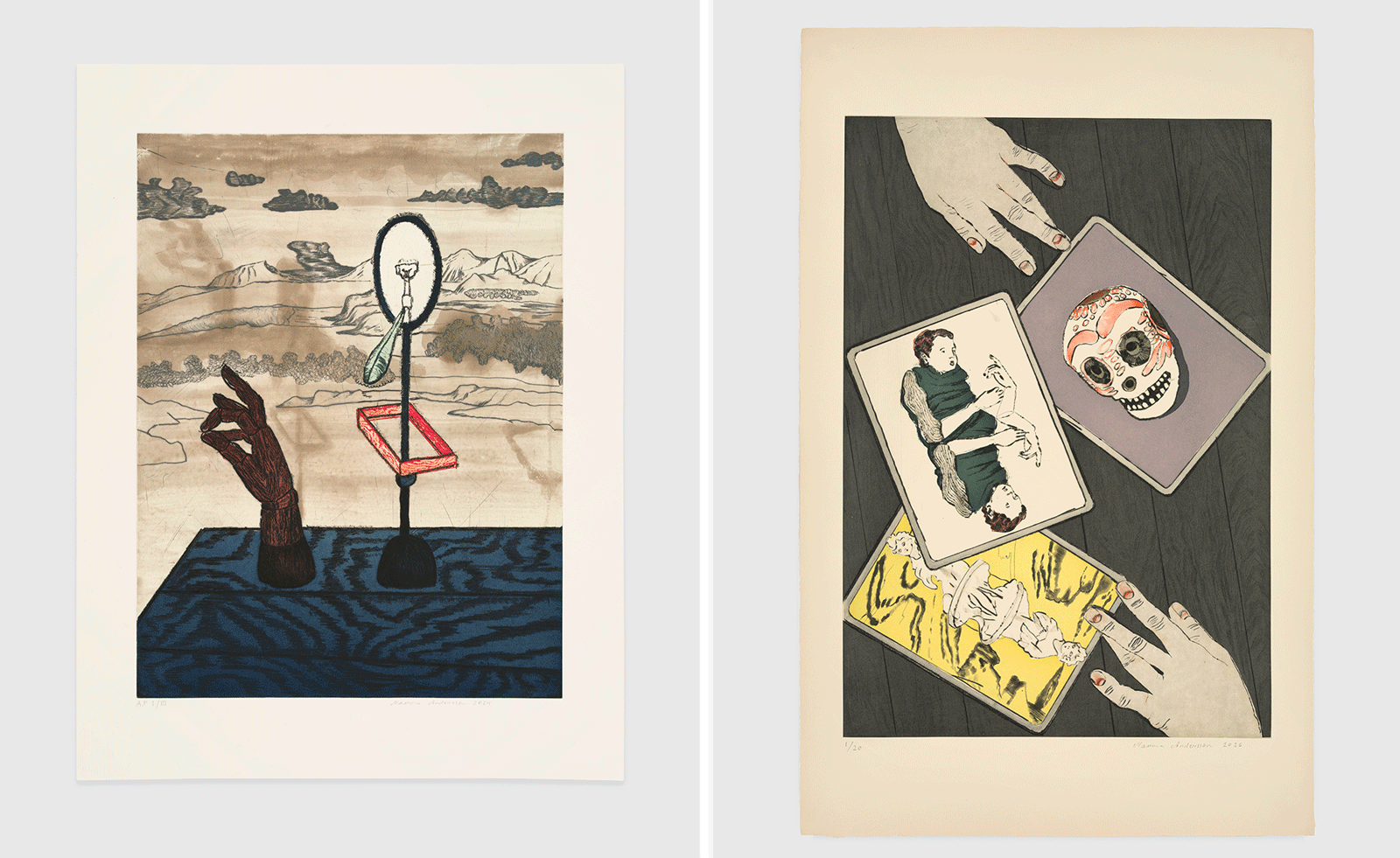
Mamma Andersson, Porte clé, 2026
On a nearby table sit etchings Andersson created over a two year period with intaglio print studio Atelier Tazé-Lipreau-Arai in Paris, which are called ‘Porte cle’ and reference the 2023 exhibition ‘Adieu Maria Magdalena’. One depicts an classically elegant female figure in a period outfit, holding a mirror, inspired by a image Andersson found in a fashion history book. Another is of a mountainous landscape with a still life composition in its foreground, featuring a wooden anatomical hand that resembles one sitting on her studio windowsill and which imbues the work with a certain ponderous mystery. ‘Now, when I look at them, they’re a little bit like book illustrations,’ reflects Andersson. ‘Like Alice in Wonderland.’
During the printing process, certain tests might not emerge exactly as she imagined, but instead of abandoning them, Andersson paints on them. The ‘Scenes from a Marriage’ series, part inspired by the 70s Ingmar Bergman television show and a murder reconstruction photo - some of Andersson’s earlier works revolved around crime scene photography - is a case in point. The Paris show will also include vitrines featuring reference materials and books, including those by Knausgaard, which will sit alongside their original artworks.

Mamma Andersson, Porte clé, 2026
For Andersson, ultimately, the most important thing is that her work continually surprises her; she doesn’t know where a body of work will go when she embarks on it. ‘I don't want to have an obvious answer. It's too boring,’ she says. ‘I want something to surprise myself with a combination of colours or materials. Thick or thin paint. Shiny or dry. Things which I haven't done before.’ It is also important to work on many things simultaneously to allow paintings to connect and talk each other. ‘You can feel very strongly that some paintings are very good for each other. They give each other energy. But others can destroy each other.’
Born in 1962, in Luleå, a small city bordering the Arctic Circle in Northern Sweden - a very particular landscape which has been frequently captured in her work - Andersson initially studied sculpture, before transferring to Fine Arts at the Royal Institute of Art in Stockholm where she graduated in 1993. Drawing was Andersson’s first language. ‘I had a huge problem with reading because I didn't know I had ADHD at that time,’ she says. ‘I would read a page of a book, and would have no idea what I had just read because my head was somewhere else. At school, I would just go to the toilet, and sit there drawing.’
At 6 years old she became obsessed with cutting out images from magazines, an interest that remains. ‘I find things and put them on my wall, like a memory or notes.’ She can also be found - she says, laughing - rescuing books from the recycling or garbage. But if previously she created a picture synopsis before embarking on new work, now she plans much less. ‘My process has changed a lot in the last 5-6 years. I have a feeling to be more free now. I don't have anything to prove.’

Mamma Andersson, Porte clé, 2026
The notion of an obvious plot in her paintings has also lessened, giving way to work centred around feelings, situations, atmospheres. By way of explanation, she remarks: ‘If you look at photos from Chornobyl today, you can see for yourself that something has happened here; even if you don't know anything about the catastrophe, you can feel it from the abandoned houses, playgrounds, and swimming pools.’
‘Adieu Maria Magdalena’ was, reveals Andersson, very much about her divorce from Nordström, and finding herself alone for the first time at almost 60 years old. Painting was the only thing she could do. Empty rooms feature multiple opened doorways or corridors, a painting of a skull hangs on a deserted wall whilst ‘The Misunderstood’ hums with the ghosts of Hammershøi and Magritte; three decapitated hands appear at the bottom of a classical interior. In ‘Quel Bordel’ a hunched figure in knickerbockers is poised in a corner of the canvas in a setting that teeters wonderfully somewhere between a landscape and a theatre set.
‘Even if I was painting a lot about the separation. I don't think I understood that when I did it. But that is always the case. When I have a distance from what I have done, I can see very clearly what it's about,’ reflects Andersson.

Mamma Andersson, Porte clé, 2026
The artist’s obsession with dolls she likens to a freedom that has allowed her to not paint faces - she felt she had done too many in her earlier work. ‘Sometimes I can long to be like Alice Neel. Some of her portraits are so good. Or Van Gogh. Otto Dix. Egon Schiele… In one way, I want to make good portraits or [paint] human beings, but I also have a longing to be more abstract sometimes, but I know I'm never going to be abstract.’ Why? ‘Because I talk too much [laughs]. I'm too obsessed with storytelling.’
In her excellent ‘The Lost Paradise’ paintings of 2020, women with their backs toward the viewer wear sleeveless batik print tops and knee-high flat boots, one of them smokes as she walks into blackness. Andersson says these paintings are about many different things: a homage to the 1970s (music, fashion, film), to her mother who made a lot of batik clothing - ‘though it didn’t look that’ - and the boots are a nod to ABBA. She smiles before getting serious. ‘This gesture, when she is walking away to nothing, it’s about what it is to be a human being. We just continue eating fish and animals. We poison the seas. We destroy everything around us. And now it’s war in different places. How can we risk this planet?’ She pauses. ‘Because we just walk around with a cigarette, listen to music and think everything is OK. It’s me, it's you; we keep going - the show must go on.’
‘Œuvres sur papier’ runs until June 27 at David Zwirner Paris, 108, rue Vieille du Temple, 75003 Paris