Despite a lean show schedule – largely down to the number of Italian brands choosing to go co-ed in recent seasons, including Gucci and Fendi – Milan Fashion Week Men’s A/W 2026 edition provided a nonetheless intriguing line-up of runway shows, from those that asked the big questions (at Prada, in ‘uncomfortable’ times, Miuccia Prada and Raf Simons asked what do we take from the past, and what do we leave behind) to those that revelled in the joy of dressing (Ralph Lauren’s return to the Milan runway for the first time in 20 years was one such show). Others introduced fresh perspectives: in his second on-schedule show for his brand Setchu, 2023 LVMH Prize winner Satoshi Kuwata – a Kyoto-born designer who lives and works in Milan – was a rare representative for emerging talent at the week (typically Milan has been dominated by its blockbuster names).
Here, Wallpaper* selects the standout shows of Milan Fashion Week Men’s, which we saw runway-side as they happened (also see our Milan live blog, where we recorded all the action as it unfolded).
Zegna

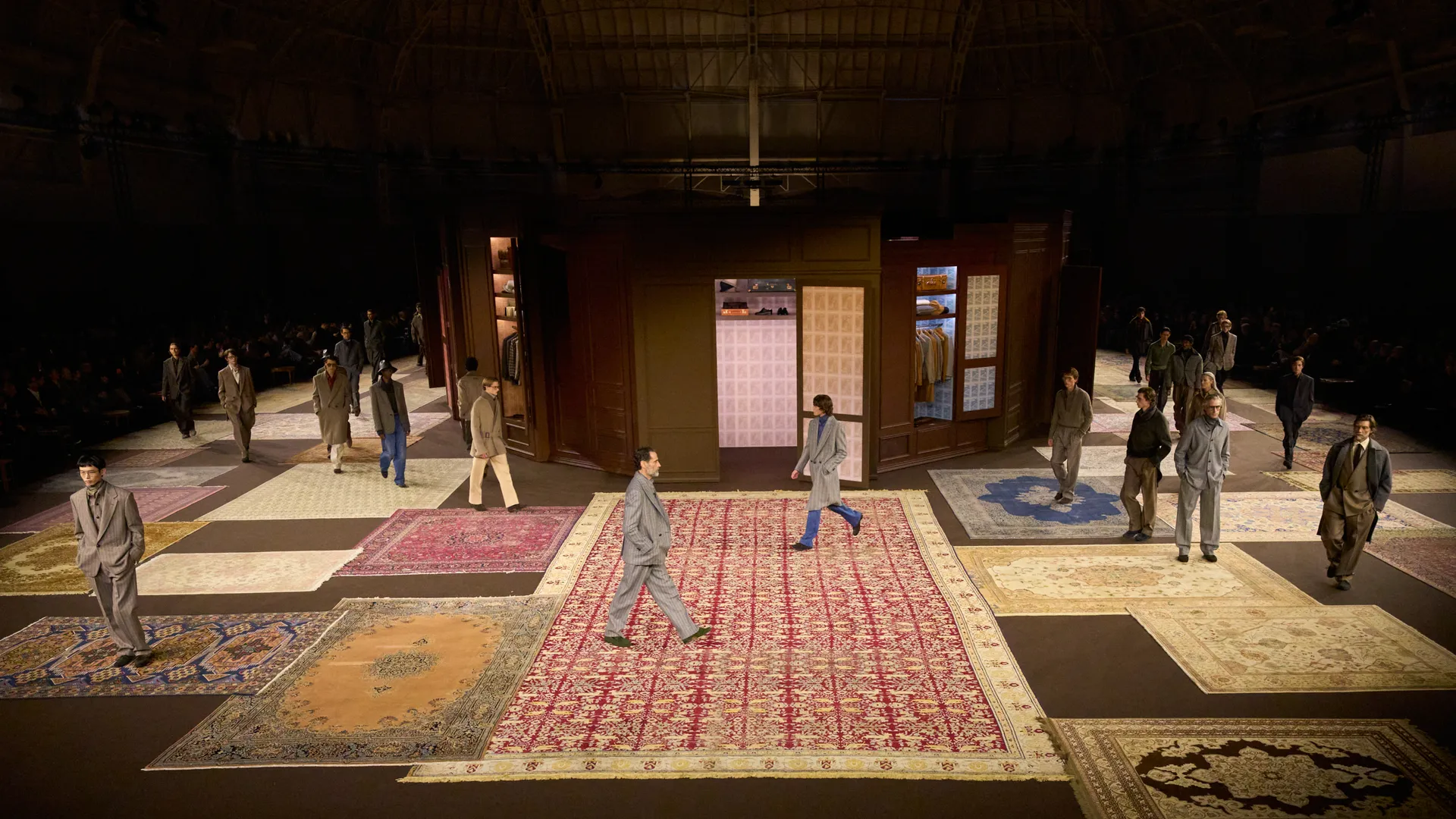
Themes of inheritance are prescient at Zegna: on 1 January Edoardo and Angelo Zegna, fourth-generation members of the textile dynasty, became co-CEOs of the house founded by their great-grandfather, Ermenegildo Zegna, over a century ago (they succeeded their father, Gildo Zegna, who will become executive chairman). For his latest show – a return to Milan after showing last season in Dubai – creative director Alessandro Sartori mined similar themes, transforming Milan’s Palazzo Del Ghiaccio into a vast dressing room, complete with a series of towering closets, each filled with pieces from the real-life wardrobes of Gildo and his cousin Paolo Zegna. They spanned the personal and the inherited: an impromptu history of the house through the clothing of its protagonists. Sartori said he was fascinated by the idea of a garment as a vessel for memories; of creating clothing that is built to last and passed through generations. ‘I am after the sense of wonder that happens when one finds a piece that was owned by one's father, grandfather, uncle; the discovery that comes from studying other ways of dressing, which prompts a willingness to try something new,’ he said.
As the show began, models wove their way in and out of the wardrobes, Narnia-style; their own looks, which had a nostalgic elegance, captured a mood of ease and eclecticism as if they were picking out garments as they went. Indeed, Sartori described the look as dégagé: silhouettes were cut with his eye for generous, contemporary proportions, while a rich melange of fabrics spanned heritage tweeds, Shetland wools and a mohair gabardine in classic hues of brown, anthracite grey and black (shots of sapphire and mustard enlivened the look). Like last autumn/winter, outerwear was a true highlight: boxy overcoats took on roomy silhouettes with clever double-breasted fastenings (buttons were reduced into a line of three, held in place by the middle button), while utility jackets in suede had a 1970s flavour, as if plucked from one of Sartori’s time-travelling wardrobes. ‘We take deep pride and make a lot of effort in doing what we do,’ he said. ‘So the idea of creating something that can be kept, reused and reinterpreted for a long time energises us.’

Paul Smith

In the collection notes, Paul Smith name-checked his new head of men’s design, Sam Cotton, whom the stalwart British designer credited with helping him see his archive through ‘fresh eyes’. That archive is physical: a vast storage facility in Smith’s native Nottingham, comprising over 5,000 pieces, collected by the designer over the near-half century since he opened his first shop in 1970. ‘The joy of having the archive like this is that my own design team visits regularly and comes back with great enthusiasm for things they found there,’ Smith said in a voiceover to the salon-style A/W 2026 show, held in his Milanese headquarters on Saturday afternoon. ‘Seeing it through their eyes gives me energy, makes me see things in a new way.’
As such, tropes from the archive reemerged, like a series of ‘inside-out’ tailoring from the late 1990s, an era towards which that Smith and his design team had been drawn back. There were also elements from the 1980s, too – broad-shouldered tailoring recalled corporate attire of the era, while a riff on the tricorne hat had a New Romantics feel. Botanic prints, hanging glass bag charms and ‘bookish’ glasses added to the eclectic mood of the collection – Smith said another inspiration was French artist and filmmaker Jean Cocteau. As Smith, who turns 80 this year, bounded down the stairs to take his final bow, there was a celebratory mood: in the post-show chatter, there was a broad consensus that this was his best show in some time.

Setchu

For his A/W 2026 show, Setchu’s Satoshi Kuwata invited guests into his new Milan studio, a light-filled space which, for the occasion, had been lined with tatami sleeping mats. Though he now lives and works in Milan, Kuwata’s native Japan (the 2023 LVMH Prize-winning designer was born in Kyoto) remains prescient in his work; here, it emerged in woven straw sliders and booties (recalling both the tatami mats and traditional woven baskets), as well as the often unconventional cut of his garments, something now synonymous with contemporary Japanese fashion design.
This season, for Kuwata, as he elaborated in a charming introduction to the collection (the designer appeared on the runway personally to introduce its themes), had begun with fishing – his favourite pastime. Particularly, a recent trip to the barren landscapes of Greenland, a stormy mecca for fishing aficionados, who travel to its plentiful (if dangerous) waters. As such, garments had a feeling of function and protection (albeit in often unconventional style), from bags that, via a series of zips, transformed into garments to cocooning outerwear (jackets looped over the head and were curved at the sleeve) and flourishes of fluffy white ‘fur’ that loosely drew on historic garments in the Greenland National Museum in Nuuk (he likened them to those of the Ainu shamans of northern Japan in their use of natural materials to protect against the elements).
Now in his third season showing on the runway – the first show took place at Pitti Uomo, the second in Milan last season – Kuwata is bringing fresh energy to Milan Fashion Week Men’s, which has been notorious for its lack of emerging talent (the city’s banner names have long dominated). Judging by the buoyant mood in the room afterwards, he is a much-appreciated new fixture.

Prada

At Prada, co-creative directors Miuccia Prada and Raf Simons said that they were looking back to the past to look forward to the future with an A/W 2026 menswear collection that was about ‘evolution not erasure’. Backstage, Simons likened it to a kind of ‘archaeology’. ‘There is a lot here from the past,’ he said. ‘If you take the layers away, you always find a kind of beauty. There’s the knowledge that you still want to celebrate and use, but you also want to innovate.’ Befitting the collection’s thematics, the show took place amid an OMA-designed set that looked as if an Italian palazzo had been sliced away through its floors – whether in the midst of its destruction or renovation.
Mrs Prada and Simons looked towards menswear archetypes – among them the businessman’s shirt, the raincoat and the double-breasted suit – skewing their proportions until they became something new. Cuffs of shirts became supersized, layered under ultra-narrow double-breasted tailoring and overcoats, while mackintosh-style jackets came with colourful overlays and matching sou’wester hats. ‘It’s a moment of really big change,’ said Mrs Prada, who was keen to note the ‘uncomfortable’ political climate that backdropped the show. ‘Who knows the future? So [you have to think about] what you want to keep. What can you transform?’
‘Think about the businessman's or the politician’s shirt in this moment,’ added Simons. ‘You can transform that in two steps, in three steps, in four steps – what if you made the stripes horizontal? What if you gave it a T-shirt neckline? What if you age it? It’s about transforming things that you respect and love. Maybe they have the wrong connotation at a certain moment of time, when we don’t want that American corporate, masculine power. But what if you make it young, make it in beautiful colours?’
Read our full review of the Prada show here.

Giorgio Armani

Having eschewed the usual Emporio Armani show on Saturday evening (the menswear is expected to be shown alongside the womenswear collection in February), the house hosted its A/W 2026 Giorgio Armani show on the closing day of Milan Fashion Week Men’s. A starry crowd gathered for the occasion (including Heated Rivalry’s Hudson Williams, who earlier in the week walked for DSquared2 in a much-Instagrammed moment). It marked the first menswear show since the death of Mr Armani this past September, and the solo debut of Leo Dell'Orco, the longtime head of the men's style office of the Armani Group (as the designer’s right-hand man, he worked with Mr Armani on the menswear house’s collections; as it stands, the future creative directorship of Giorgio Armani remains unknown).
This was a collection of evolution, not revolution: a respectful continuation of Mr Armani’s legacy of louche elegance, from lustrous collarless silk suiting (the house said ‘cangiante’, an irridescent silk, was a ‘metaphor’ for the collection – ‘something in constant transformation... catching the light in ever new ways’) to oversized trench coats and fluid tuxedos, the last studded with glimmering crystal brooches. There were also some great pieces in leather – the tie-waisted flight jacket worn by Kit Butler, cut to the roomy proportions of Mr Armani’s 1980s oeuvre, shows how contemporary (and indeed borrowed), the designer’s archive still feels. As ever with Armani shows, the reception was rapturous: all the more so when a visibly emotional Dell'Orco took his final bow.

Ralph Lauren

The Ralph Lauren show marked the brand's first in Milan for two decades, with the eponymous designer opting for an intimate salon-style presentation in Palazzo Ralph Lauren (a Mino Fiocchi-designed villa that the brand acquired in the 1990s) over a more blockbuster happening. It worked: his Polo Ralph Lauren and Ralph Lauren Purple Label presentations were shown back to back, and there was a charm to seeing the clothes up close and in motion, an optimistic offering that mined the designer’s hallmarks – from the preppy uniform of Polo Ralph Lauren (an aesthetic being readily embraced by a new generation of fans, as well as here at fashion week) to on-the-ranch Americana, old Hollywood eveningwear and plenty of brilliant denim (Lauren’s patched-up and repaired jeans are also having a street style comeback)
Styled eclectically – often these tropes were mashed up into a single look – Lauren said the collection itself was ‘inspired by the different ways men live’ (a message from the 87-year-old designer, who did not travel for the show, was placed on attendees’ seats). At over 70 looks – closed out by Tyson Beckford in a shaggy-pile coat, tuxedo, cowboy hat and hiking boots – there was, simply put, something for everyone. But what united the broad collection was a certain Ralphness that makes these much-reinterpreted archetypes distinct. ‘When I began designing menswear, I was drawn to the timeless elements of tradition, but I was never bound by it,’ he said. In this welcome return to the runway, it’s clear this attitude lives on.
