As a minimalist, Korean-born artist Lee Ufan believes his role is to 'rearrange elements, rather than create something new out of the blue'. Using this philosophy, Ufan has generated paintings, sculptures and works on paper that possess a sense of tranquility, often made using simple repeated gestures and always with an emphasis on the importance of emptiness. 'Space means the infinite,' he was once quoted as saying. 'Buddhism teaches that being is possible only because there is also nothingness, and appearance coexists with disappearance.'
Having moved to Japan at the age of 20, he became best known for founding Mono-ha in the 1960s (Japan's equivalent to Italy's Arte Povera movement) but in more recent years, following a retrospective at the Guggenheim in New York in 2011 and a solo show at the Château de Versailles last year, Ufan's international star has been rising.
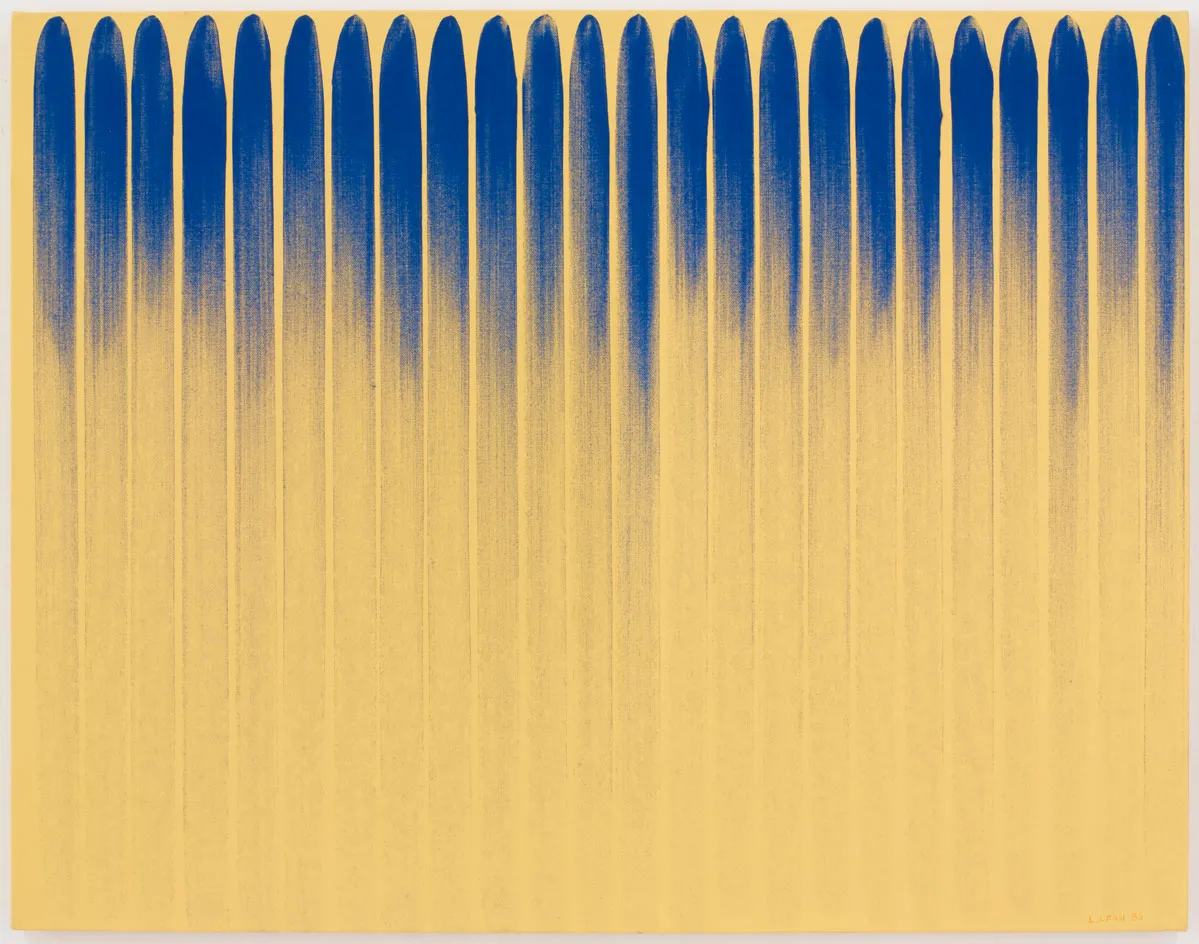
Next month, two of the artist's major series, titled 'From Point' and 'From Line', will form the major focus of an exhibition at Pace London. Both series stem from the belief that lines and points are the basic units of the cosmos, Ufan applying a single hue to the canvas with simple repetitive brush strokes. In 'From Line', paint is applied in long, sweeping, drawn-out vertical rows from top to bottom, allowing the colour to fade as it cascades down the canvas. Similarly, in 'From Point', the paint is applied to the canvas in compact daubs and drawn out from left to right. With each new canvas, Ufan varies the starting point of each line, creating rhythmic, staggered rows.
Known for his meticulous approach, the process of application and absorption of the paint was made purposefully slow and ritualistic by Ufan, who made his own powdery crystalline paint from a recipe of ground mineral pigment and animal-skin glue. The result is a shimmering blue mixture that increases the level of friction between the paint particles and the artificial hair brushes. 'Something endlessly appearing as it endlessly disappears. Something receding endlessly as it endlessly approaches.'

Marking his debut at the London gallery, the show follows a retrospective at the Guggenheim in New York in 2011 and a show of ten sculptures at Versailles last year. Pictured: From Line, 1979

Having moved to Japan at the age of 20, Ufan became known for founding the Mono-ha movement in the 1960s (Japan's equivalent to Italy's Arte Povera movement). Pictured: From Line, 1979

In 'From Line', paint is applied in long, sweeping, drawn-out vertical rows from top to bottom, allowing the colour to fade as it cascades down the canvas. Pictured: From Line, 1979

In 'From Point', the paint is applied to the canvas in compact daubs and drawn out from left to right. With each new canvas, Ufan varies the starting point of each line, creating rhythmic, staggered rows. Pictured: From Point, 1977

Both series are inspired by the belief that lines and points are the basic units of the cosmos. Pictured: From Point, 1980

To create the works, Ufan made his own powdery crystalline paint from a recipe of ground mineral pigment and animal-skin glue. The result is a shimmering blue mixture that increases the level of friction between the paint particles and the artificial hair brushes. Pictured: From Point, 1978
ADDRESS
Pace Gallery
6 Burlington Gardens
London W1S 3ET