It's a funny thing, Peter ‘Hooky’ Hook is telling me down the line from a California hotel room, ‘to still relish something that you did under very difficult circumstances’.
I’m talking to the bass player – once of Joy Division, then of New Order, now of The Light, the band he formed to play both those previous bands’ songs – about Eternal (Live). It’s a lavish new Joy Division boxset comprising 14 CDs, documenting 16 gigs, and two DVDs of filmed performances. The audio, video and accompanying photography and text vividly capture the short, intense onstage existence of the band, their lifespan cut short after the 1980 death by suicide, aged 23, of Ian Curtis, the frontman who struggled with depression, severe epilepsy and the side-effects of his medication.
‘And it’s a wonderful thing,’ Hook continues, able to be beatific about the near five-decades-deep shared creative endeavour even as his infamous rift with his former bandmates remains as entrenched as ever. ‘Because we made Joy Division’s music, particularly Closer,’ he says of 1980’s second album, released two months after Curtis’ death, ‘and did some of the gigs that are featured on this, when Ian was ill. And as someone said to me yesterday: “It must be really weird, playing Joy Division music to 3,000 people in San Francisco.”’

He couldn’t disagree with that. With Joy Division – the name by which he, Curtis, Bernard ‘Barney’ Sumner and Stephen Morris started performing in 1978 – ‘I was professional for six months. If you can call professional being on £13 a week! And when Ian died, we thought everything had died with him. So it’s amazing to be here, 46 years later, watch how popular it is, and see what an investment that time and difficult working procedures were. Because it's still paying off.’
That ongoing investment finds form in the thoughtful, immersive, world-building creation, design and packaging of Eternal (Live). With spruced-up, 2026-level sound mastered at Abbey Road Studios, the grotty, sticky pub and club venues of 1979 and 1980 never felt more present. With artful updates on Joy Division’s visual language, their heritage and iconography has rarely felt more alive than in this weighty packaging, all housed in a 12-inch x 12-inch lift-off-lid box.
The cover image is a 2023 Wolfgang Tillmans photograph, with the explanatory title Sirius through a Defocused Telescope. ‘I see it as a bookend to the cover of [1979 debut album] Unknown Pleasures,’ explains Peter Saville, longstanding creator of Joy Division and New Order artwork. ‘That’s an image from deep space, a data recording from the first discovered pulsar. And here we have the star Sirius. Conceptually, this idea of an astronomical image is a perfect counterpoint to Unknown Pleasures.’
That new image was chosen by Warren Jackson, who works with Sumner as a personal creative/art director. Its usage was secured when Saville approached the German photographer – a visual artist whose work now commands vast sums, but who was happy to do Saville and the band a favour in terms of usage rights and costs.
‘The influence of Joy Division has gone far and wide,’ says Saville, ‘and across all sectors, to filmmakers, photographers, artists, fashion designers. And Wolfgang is a perfect example of an innovative artist who came through photography, into fine art, in this post-Joy Division era, and to a highly regarded, celebrated [level]. So, the idea of being able to propose it to Wolfgang was in itself very pleasing to me. That’s a very satisfying part of the history of the band.’

Alongside a powerfully Proustian essay by Simon Armitage, the Poet Laureate who was a year-zero Joy Division fan, the interior booklet features 16 pages of evocative portraiture and reportage imagery. They’re by the now-celebrated photographers that the band picked to work with them, and who rose with them, including Anton Corbijn, Kevin Cummins and Jill Furmanovsky. As Corbijn – who directed 2007 Curtis biopic Control – puts it to me: 'I always wanted to work with people who are very serious about what they're making. And Joy Division were that.'
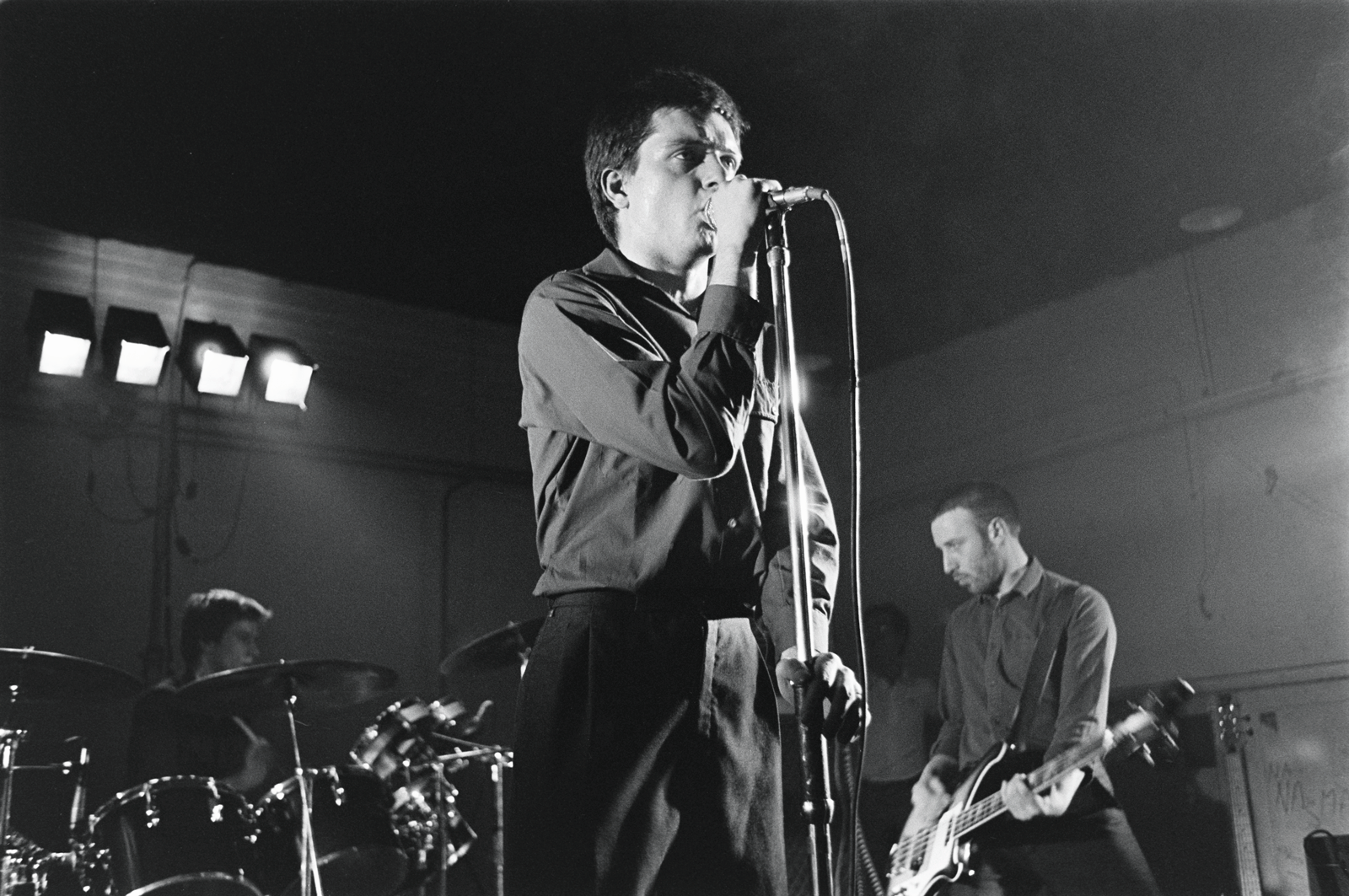
Here are time-capsule monochromes of the gigs captured on the live discs. Hook and guitarist Sumner, intent on their instruments, shot by fan Jonathan Crabb at London’s Hope and Anchor pub, 27 December 1978 – the night that, en route home to Manchester, Curtis had his first recognised epileptic seizure. The singer, head thrown back and blurred in Furmanovsky’s image, at London’s YMCA, 2 August 1979. Drummer Morris, sweat-drenched and locked-in, shot by Martin O’Neill, in front of the paisley-esque wallpaper of Bowdon Vale Youth Club, Altrincham on 14 March 1979.
'Oh, God, yeah, I remember that youth club!' says Morris with a laugh. ‘We played it twice. It was good to do things for young people,’ he adds, mentioning two gigs in one day at Liverpool club Eric's, the first a matinee, ‘the idea being that under-18s could see you’. There is, too, video footage from that night in Altrincham in the boxset’s films, shot by Malcolm Whitehead. He was head of Ikon, which was the filmmaking arm of Joy Division’s record label Factory. Not, insists Morris, that the band had one eye on posterity.
‘It was basically just Malcolm saying, “I want to film you”, and us leaving it to him. We weren't going to say: “Please don't do that, because years later we don’t want pictures of us playing in a place with red flock wallpaper popping up on YouTube and destroying our once powerful, dark mystique,”’ the musician says larkily.
Corbijn, though, thinks the musicians ‘must have had some idea’ about the strength of good photography. ‘You had Bowie [around] and you’d like to look as cool as that. So I’m sure there was that kind of desire.’ He mentions his first, much-reproduced shoot with the band, 15 quick minutes in November 1979 on the steps of Lancaster Gate Tube station in west London. ‘When they saw those, they realised there was a strength there. They were the only people who weren’t shooting “art” pictures.’

The Joy Division Eternal cover
Morris valorises those images for reasons for that are, not unusually for the cheerfully plain-spoken drummer, more prosaic. ‘Anton said, “Go down these stairs”, took a couple of pictures and said, “Right, that’s it”. That turned out to be a great photograph, obviously, Ian looking backwards and we’re all coming down the stairs. But the fact that it took him less than 15 minutes to take our picture made him an al right guy to us. We thought, “He can do that again!”’
Hook, finding rare common cause with his former bandmate, tells a similar story. ‘I remember a French photographer, very famous in France, who came to do pictures. Barney was in a terrible mood, and he said, “I'll give you five minutes”. The guy started ranting on in French and pidgin English: “You cannot treat me like this! I have come all the way from Paris! I have many, many pictures to my name!” And when he stopped, Barney went: “Four minutes.”’
As for Corbijn’s own memories, of the gigs, in particular, they’re more blurred. He does, though, recall the night of 4 April 1980 at the Rainbow Theatre, shots from which close the booklet in totemic, shivery greyscale: Curtis, gripping his microphone stand as if his life depended on it. As well he should: ‘Ian had a fit onstage that night and they had to carry him off. That was scary to see. I used that in Control.’
Ian Curtis, of course, was a star who burned brightly and intensely for too short a time. I ask Saville if that isn’t too much of an on-the-nose interpretation of the image that adorns Eternal (Live). Especially given how it – as the designer put it – bookends, almost half-a-century on, the image on the cover of Unknown Pleasures.
‘That is one of the interpretations on the pulsar,’ he agrees. ‘Basically a star that is no longer, but the signal and the energy of which continue in infinity. That is a reading of the pulsar from Unknown Pleasures. It's a dead star, the energy of which is with us forever. It's still radiating around the universe. And you can make that same analogy with the star Sirius.”
Like the title said: this is Eternal.
Eternal (Live) is out on 25 September via Warner Music, available at hmv.com