
Melissa Auf der Maur is at home, enjoying a rare moment of peace in the midst of a hectic schedule. Just two days before she reunited with the Smashing Pumpkins on stage at Lollapalooza in Chicago, joining her former band for a performance of 'The Everlasting Gaze' from their 2000’s Machina/The Machines of God. Auf der Maur’s guest spot (the Pumpkins were also joined by Olivia Rodrigo and Yungblud) won’t be the only prominent role the photographer, musician and gallerist is taking this year.

Self-Portrait in Eagle Fisheye Mirror, “Grunge Estates,” Rue Saint-Dominique, Montreal, 1994
This Autumn, a new exhibition opens at the Art Gallery of Ontario featuring over 200 over the Montreal-born artist’s photographs, My ’90s Rock Photographs (DelMonico Books) taken almost obsessively during an era of constant touring and recording, a time when a roll of 35mm film was on her rider and hotels, tour buses, gigs and festivals provided an ever-changing subject matter.

Self-Portrait in Cracked Mirror, “Grunge Estates,” Rue Saint-Dominique, Montreal, 1993
The show and monograph follow on from last year’s publication of Auf der Maur’s acclaimed memoir, Even the Good Girls Will Cry: A ‘90s Rock Memoir (Da Capo Press), which chronicled her time playing bass in Hole between 1994 and 1999, Smashing Pumpkins in 1999 to 2000 and the solo work the followed. They’ll be followed by a new album, Bass Womb Room, featuring 4-track demos and field recordings from the era.
Now based in Hudson, NY, where she is the cofounder of the multidisciplinary art centre Basilica Hudson, Auf der Maur spoke to Wallpaper* about this current flurry of creative work, her evolving, holistic approach to photography, music and art and what comes next.

Self-Portrait with Billy Corgan, Sidestage, Siamese Dream tour, Club Métropolis, Montreal, 1993
Wallpaper*: Where are you now?
Melissa Auf der Maur: I am in upstate New York, on the eve of fulfilling my dream as a fine art photographer in a museum with a book. That’s all I ever wanted, but I got derailed a hundred times. And in my mid-fifties, I get to establish myself in that land, and I am so grateful to the creative gods and goddesses that brought me here. Especially to the AGO, who know my archive better than I do now.
So I am here, starting my new life as a true multimedia artist, which is what I always thought I was. But I got very defined as a bass player and as a musician, obviously, and I’m so grateful that was my destiny. But I had so many longings outside of that were never fulfilled.

Courtney on Bike, Backstage, Nine Inch Nails Self Destruct tour, USA, 1994
W*: Did the music feel like a side quest at the time?
MadM: When Courtney [Love] called me to ask me to join the band, and I said no, thank you. I’m a photographer, and I’m going to go do my masters, and that has always been the anchor of the crossroads, and very clear to me. But the question for me always has been, how long do I derail? When do I return?
This is the question that has seemed to run through my entire life, personally and creatively and professionally, especially as someone who went into motherhood after she quit music. How long do you serve these other callings that are absolutely fulfilling and meaningful and powerful?

Self-Portrait in House of Mirrors, USA, 1995
W*: Do you not think that you can take on all those various things?
MadM: I don’t look at the world through lenses of right and wrong and gender and man and female. I look through more of a kaleidoscopic psychedelic lens, of energy in the cosmos and stardust. Back in 1994, I somehow managed to get a photo exhibit of my college work at this legendary dive bar in the Lower East Side of Manhattan called Max Fish. It featured a piece that’s also going to be in the AGO, ‘The Sky Is My Ocean’, a compilation of blown-up images of my SX70 Polaroids, self-portraits, and close-ups of Renaissance paintings. For me, it was when I found my voice.
I have always been obsessed with the Renaissance moment - as a young person, I started seeing myself in Botticelli paintings. I found myself in Botticelli’s muse as much as I did in Robert Smith of The Cure. When I started photographing those samples, it’s almost like sampling in music, creating what now looks like an Instagram grid, only back in the 90s.

Dreamgirl Fans, Live Through This tour, USA, 1995
W*: How else do you think your approach back then is mirrored by today’s media?
MadM: The creative packages I’d send to friends back then were as much a part of my soul expression as me being on stage at Lollapalooza. They were all the same and equal to me. In some way, feel like I was looking at the Renaissance because there was this explosion of spiritual media meets religion back then. I hope I was not just out of time, but I was ahead of time - I was waiting for the next Renaissance, or I was romanticizing the last Renaissance.

Self-Portrait with Hole, Lollapalooza, USA, 1995
W*: You’re saying you’ve never been as inspired and driven as you are now. What was the instigating even to go through your archives and did your archives inspire you, or were you inspired to go through them?
MadM: The instigation was becoming a mother. I’m over a decade into motherhood and have a deep desire to integrate and unpack, integrate my past, my present, my future, and be healed, unpacked light for my daughter. My memoir is dedicated to my daughter, and all the girls of the world. I consider it all to be one big multimedia archive project - the memoir, the photo book, the exhibit, the demos, entirely spawned by the eve of turning 50.
I’ve always worked in decades - every decade seems to be really particular for me as well as thematic. Obviously, my memoir is dedicated to the decade that defined me and my generation, ’91 to 2001. After that I had this weird decade, and then I had my daughter in 2011. That will be my second memoir, about becoming a mother and what that does to a human, but also to a creative. To someone who has lived a life serving their inner voice, and then you switch in the most beautiful, physical, spiritual DNA way to serve another’s voice and to nurture the creation of another being.
W*: So that marked a major change in your process?
MadM: That was the decade of transformation and complete metamorphosis. If you want total metamorphosis, transformation, unlike anything else, have a child. If you don’t, you’ll have a fine life. You’ll have a great life as a creative. You can continue to evolve, but if you want an actual, down on your knees, fucking complete changeover, then have a baby.
I didn’t want to be on tour, so of course I quit music to become a mother because I wanted to be home. I transformed how I live my life and how I move the energy through my body and how I serve my creative inspirations. I had founded a non-profit art centre, Basilica Hudson, in 2010, a physical space for other people’s work and for music and art and dedicated a whole decade to give back to others. I had the luckiest creative life, although dark and difficult – getting to be in two giant rock bands and then make solo records and travel the world so many times over.
Courtney Love on Stage, Lollapalooza, summer 1995
W*: How did the memoir come about?
MadM: I had completely gone from a global musician to a local art centre den mother. I had to find my way back, and the best way for me to do it was to start writing about it. Both my parents were literary people, and I’ve been keeping a journal since I was 12 years old.
We live in a very creative area. The Hudson Valley area has a great liberal arts college, Bard, with an amazing photo, film, and multimedia department. I started hiring students scan my negatives and had little army of photo people just scanning and going through my negatives over the course of many years.
W*: Why do you think you turned your back on the 90s for so long?
MadM: I’ve written my memoir now to explain how. It was adventurous and amazing, but how painful and dark! I joined Hole in the wake of death, so as if it wasn’t enough to join a band with the ghosts of Kurt and Kristen, but also the loss of innocence of our entire generation. I embarked on a very melancholic, hard journey with both bands - when I joined the Pumpkins, D'arcy [Wretzky] had gone missing in action.
The amount of casualties of that time… I also dive in very deeply on the death of my father [the journalist and politician Nick Auf der Maur] at the peak of my time in Hole. His death is the defining dark night of my soul that I’ve been healing from ever since. Writing this book was the essential healing. The wound and facing the grief of my father, not to mention my collective unconscious grief of my generation, was central to writing this book.

Courtney Commands Canadian Crowd, Edmonton, Canada, 1999
W*: Let’s talk about your photography. The images are so redolent of that era, the flash, the saturated colour, the drama of the compositions. It’s a sort of bridge between formal photography and today, where everyone captures everything on their phones.
MadM: I truly was the only person who had a camera on me every day, everywhere I went. I had obviously studied photography and loved my Nikon FE SLR, but when I became a bass player in a rock band it was too bulky so I moved into a point and shoot. I had a slightly wide-angle lens, so that specifically I could capture more of the room, and those self-portraits where I’d reach my arm out around and photograph these other people.
What’s strange is that I saw that I was sort of butchering photography - I didn't havea light meter and I had never used a flash in my life. I was used to existing light and really working on exposure and then printing in the darkroom. So what I was doing was sacrilegious in many ways.
[For a long time] my archive felt like garbage to me. When I left the Pumpkins in 2000 I had made a pledge to myself to quit music and finally go back to photography. I spent a long time the following year looking through the archive and trying to imagine what I could do with it. I realised I needed a decade or two for the answer to come to me.
That’s been what’s so inspiring and exciting, both for the stories in the memoir, but more specifically for the photo archive, is a quarter of a century is exactly enough time [for it to become] be a cultural offering for people to glean something about humanity and about pop culture and about history, not just about like some girl in a rock band.

Self-Portrait on Stage with the Smashing Pumpkins, Cape Town, South Africa, 2000
W*: Will this creative rebirth you’re undergoing continue with new work?
MadM: I will continue to write. There’s no question. I loved writing that memoir. It came like flowing out of me so quickly. The photography archive has potential for collaborations with other artists and other mediums. For example, there’s a soundtrack for the installation in the exhibition, a mixed media installation that has sound, projections, photos and structure., a giant mirror pyramid with stacks of television monitors from the videos from my archive.
I was inspired by the three-dimensional sound dream I had at the age of 19, which is in my book. I received messages that pretty much changed the way I live, changed the way I see the world, and changed my path in music. There’s a soundtrack that I recorded for it, a hybrid of field recordings, my four-track demos, and 21st-century intervention connected by a heartbeat. I’ll also be bringing the Bass Womb Room to life – it’s in a beautiful Frank Gehry-designed pavilion.


W*: You were on stage with the Pumpkins just a few nights ago.
MadM: It was the coolest thing ever. Everything is coming back. Everything is returning. I don’t understand how it’s possible, but it is. I had invited Billy Corgan to my event in LA in the Spring and we had this very meaningful conversation around my memoir. It just so happened that day he’d confirmed that the Pumpkins were going to headline Lollapalooza in their hometown. We’ve only seen each other a handful of times in twenty years, and he just said, well, maybe you should join us for a song. I said sure, maybe.
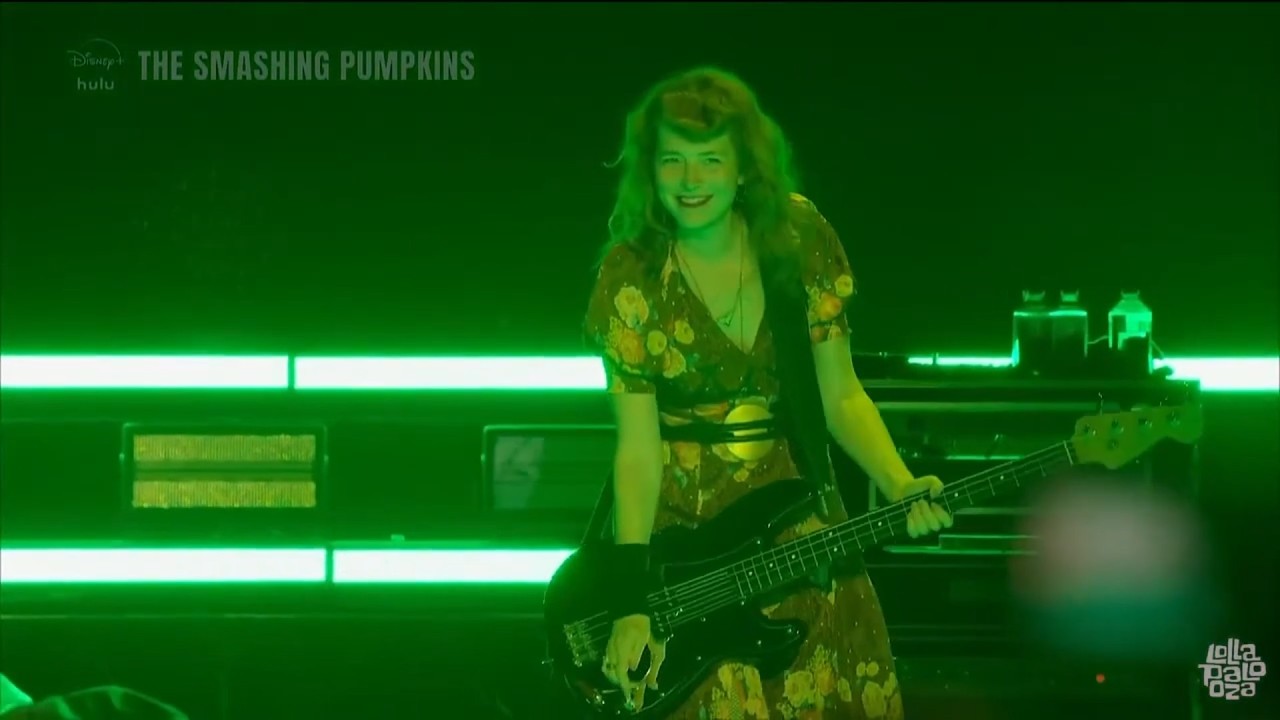
When the gig was announced, my teenage daughter was like, ‘Holy shit! Look at this lineup!’ Because she likes Charlie XCX and Tate McRae so of course she said, ‘we have to go. You have to say yes.’ So I called Billy up and said I’d do it. And then what happens? Olivia Rodrigo was the other guest and she invited me and my daughter to Daisy Chain Fields.
It’s merging my past life with my current life. It’s just the best. The highlight of it all, the most important thing to tell you, is that I miss my fucking bass so fucking much. This entire thing, this archive scanning, this museum exhibit, this writing of this book is all one big trick to get me back into my bass.

Melissa Auf der Mar, 2026
I’m also singing on Courtney’s new record. Courtney is in great shape, and she’s going to have a big resurrection in 2027. She’s got a solo record coming out, a memoir, and a really good documentary film. I suspect there’ll be a lot of activity around all of these people and bands.
The most beautiful thing is that my grunge parents, Billy and Courtney, who found me and took me under their wings, are forever my gateway into this big world. We’re all closer than we’ve ever been. It is a happy ending, considering how hard that moment was for all of us.
Melissa Auf der Maur: My ‘90s Rock Photographs is on at the Art Gallery of Ontario, AGO.ca, @AGOToronto
The accompanying monograph, Melissa Auf der Maur: My ‘90s Rock Photographs, is available from Shop.AGO.ca and Artbook.com, $65 CA / $49.95 US
Melissa Auf der Maur, xmadx.com, @xmadx, xmadx.bandcamp.com