It’s a scorching day at Lacock Abbey, in the village of Lacock in Wiltshire, and, beneath the screeching of low-flying swifts, Martin Parr’s widow is in the National Trust property’s Manger Barn, discussing her husband’s final work. And his legacy.
‘This project, it really did resonate with him,’ Susie Parr says of ‘Lacock’, a series of portraits of English community and tradition, a year in the taking and curating, which the great photographer-documentarian completed shortly before his death at 73 on 6 December 2025. ‘He was also aware that he was not well. He kept saying, “I'm in the departure lounge." And this was a manageable, doable piece of work.
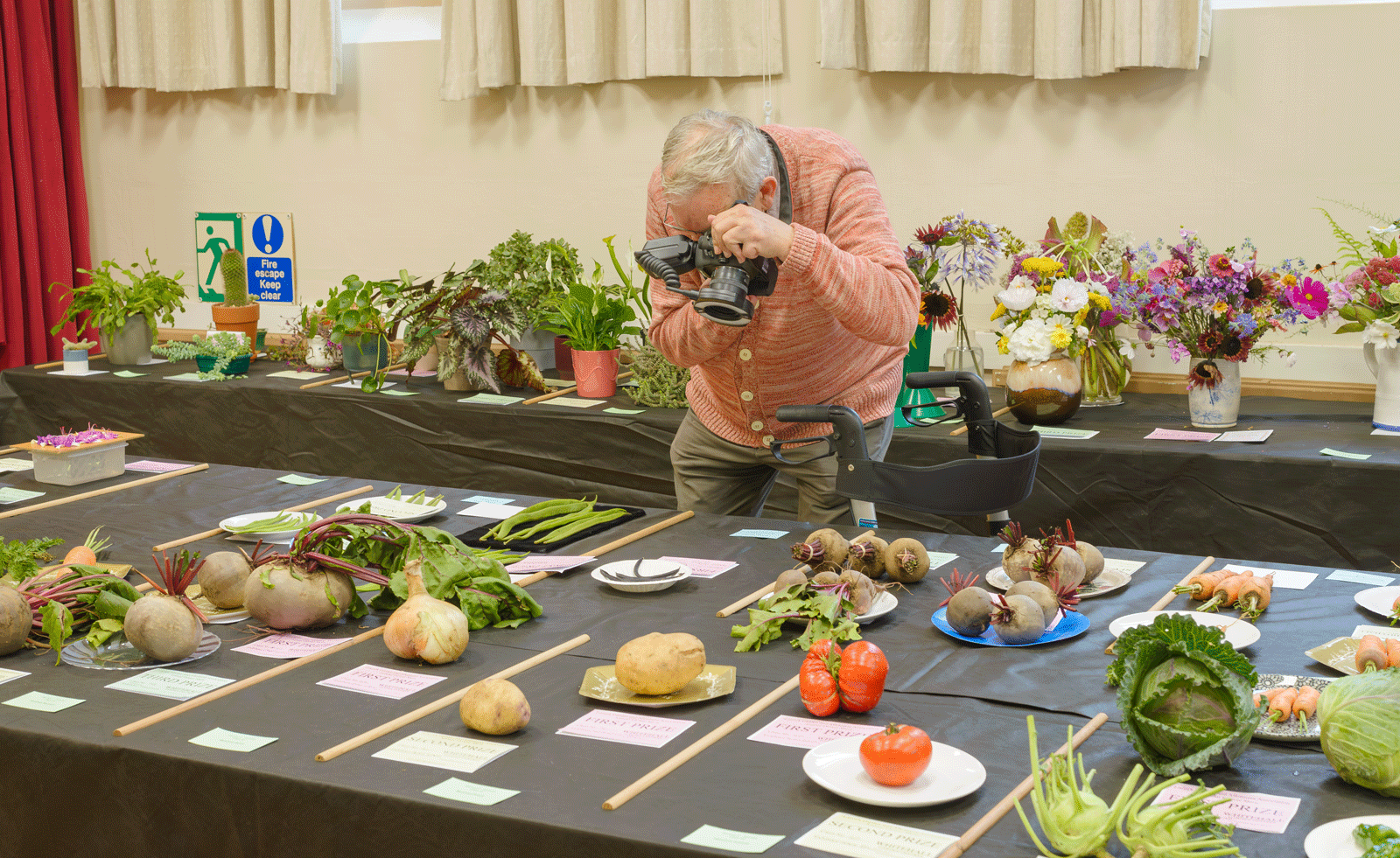
‘Very different from his fashion work,' Susie adds with a smile of these typical Parr portraits – vivid but unadorned – of shopkeepers and schoolchildren and scarecrows; of VE Day 80th anniversary parties and the Garden and Allotment Association Annual Flower Show; of prize-winning potatoes and best-in-class raspberries and a stout vicar bedecked in Union flags. ‘Martin was the most unlikely fashion photographer – he really hated fashion, actually! He really wasn't at all interested! But it did bring in money for the [charitable Martin Parr] Foundation.’
Across 2025, Parr travelled from the couple’s home in nearby Bristol to shoot in and around the abbey and the adjoining picture-perfect village. Susie and Dr Andy Cochrane – curator of ‘Lacock’ and of the abbey’s Fox Talbot Museum that’s hosting the year-long exhibition – think he must have visited around 30 times.
‘He was drawn to the ordinary, day-to-day life of people, rather than the extremes of how people are behaving’
Susie Parr
Parr was a photographer with an anthropologist’s eye, and Cochrane says that all his career-long themes ‘permeate through the work at Lacock: material culture; the daily life of people; and the conviviality, how people engage and get on with each other. That's all embedded in this photography.’
In multiple ways, the series is a carefully considered bookend to an extraordinary career. Parr had shot (briefly) in Lacock in 1988. As the one-time residence of scientist and photography pioneer Henry Fox Talbot (1800-77), Lacock Abbey is widely viewed as the home of photography, hence the National Trust’s on-site Fox Talbot Museum. And the new project became a perfect distillation of Parr’s perennial interest in what his wife calls 'the middle ground. He was drawn to the ordinary, day-to-day life of people, rather than the extremes of how people are behaving'.
Susie Parr and Dr Andy Cochrane tell Wallpaper* more.

GB. England. Wiltshire. Lacock. V.E. Celebrations. 2025. Photograph by Martin Parr
W*: Susie, that 1988 visit to Lacock – how did that come about?
Susie Parr: We had been living in Wallasey in the early 1980s, and Martin did his [1983-85] work in [Merseyside seaside resort] New Brighton, The Last Resort, which was the work that shot him to fame. But he also got a lot of criticism for being a middle-class photographer photographing working-class communities.
So, he was thinking: ‘I need to photograph my own tribe.’ And we were thinking: ‘Where can we live to enable you to do this?’ I was the breadwinner at the time, and I got a job in Bristol. So we moved down here and he started that work. It was supper parties, cricket matches, private schools. Very different from the New Brighton work.
Visiting Lacock was part of that. He loved a summer fête and he came and photographed plant stalls, things like that, for a [1989, Thatcher-era] project about the middle classes called The Cost of Living. Those photos, some of which are in this exhibition, were for that project.
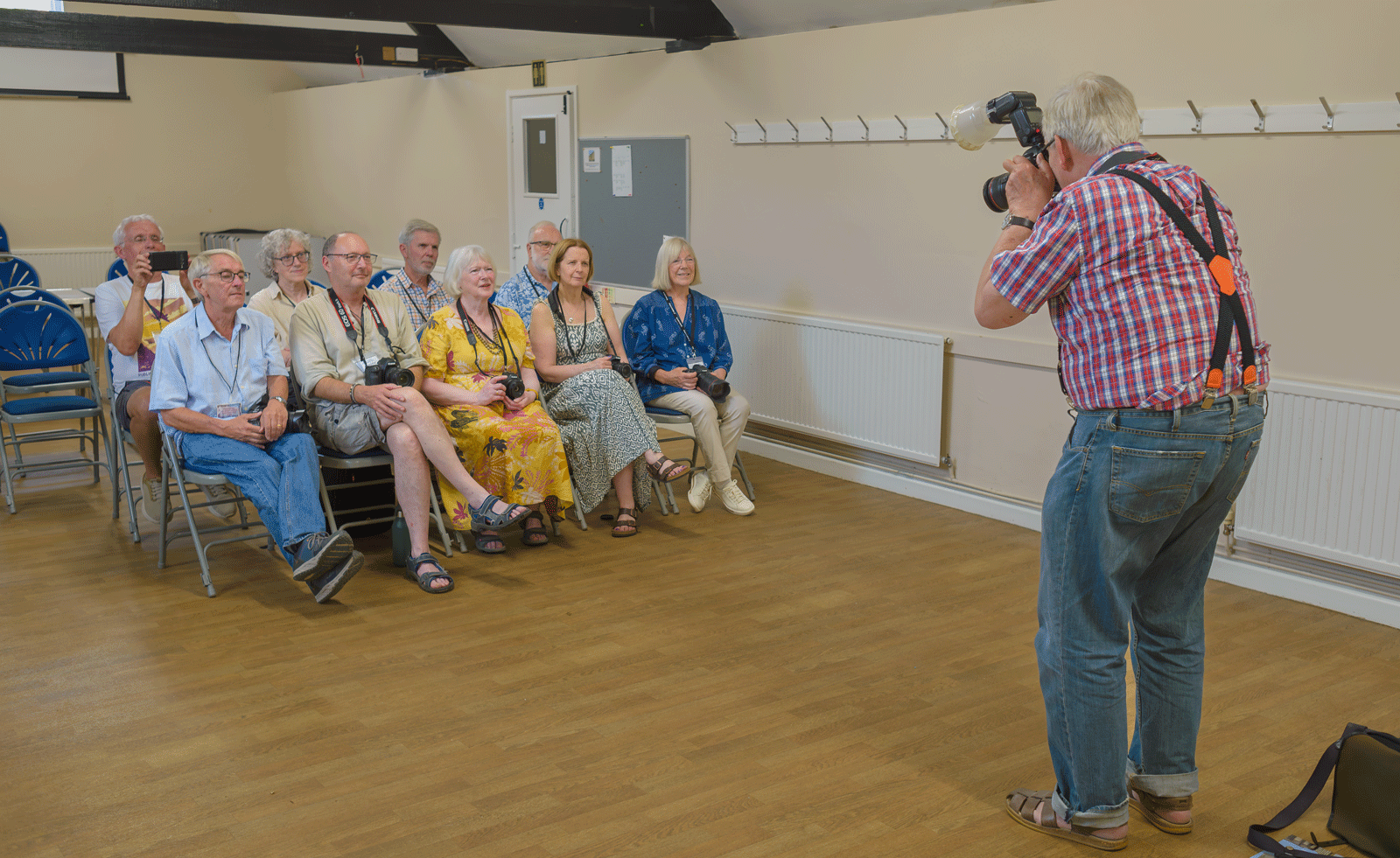
Martin Parr at Lacock, 2025
W*: So it was a kind of visual anthropology.
SP: Absolutely. He wasn't articulate about it. He just thought in images. He wouldn't be able to analyse his work in an intellectual way. He just had an anthropological approach to ordinary life.
Andy Cochrane: In one of the first meetings that we had at the foundation, Martin brought out an anthropological book that was written in the 1940s, with colour-saturated photography by John Hinde. It was about understanding a National Trust village, Luccombe in Somerset, as part of a Mass Observation project.
I think Martin always wanted to go there and photograph it, and then went instead to Chew Stoke [in Somerset for 1992 project A Year in the Life of Chew Stoke Village]. So there had [long been] a sense of trying to document a National Trust village.
W*: Did the villagers require much persuasion to let him into their homes?
AC: At first, a lot of people, if they're not into art or photography, were unaware of who Martin Parr is… But with Simon [Dunn], the vicar, we did a free screening of [2025 biographical documentary] I Am Martin Parr in St Cyriac's church and invited the village.
And, of course, as people were getting themselves photographed, and the foundation was printing them immediately and handing them back out to the village, it created a critical mass [of interest].
He was also keen to engage with community groups, the clubs, the church, the school. So he was going to all these events in the evening. He was in the yoga club and the photography club and the art club. And the pace that he worked was really impressive to see. He was moving at a pace that was a young man's game!
SP: He was so disciplined and hardworking.

At Lalock, bell ringers, left to right: Steve Griffin, Sara Bye, Roger Lewis, Jenny Hancock and Tony Summers, 2025. Photograph by Martin Parr
W* And, apparently, disarming. As one of his clearly smitten subjects, Azar Watling of local business John Watling Bespoke Jewellery, says in the accompanying video showing in the museum, ‘he was a little bit cheeky’.
SP: His natural communication style was a bit to the point, blunt, no messing about, no small talk. But when he wanted to engage with people, he could be very funny and charming, with a little bit of banter. He could do that, but it wasn't his natural style.
‘There are so many photos of fetes with Union Jacks and bunting… At his funeral, we recreated a country fête for the reception’
Susie Parr
W*: The village’s VE Day 80th anniversary celebrations in May 2025 must have been catnip for Martin, given everything it represents and the associated, flag-waving iconography.
SP: He did like a Union Flag, but he wasn't very happy about the way they'd been used recently, and all the St George's flags everywhere. He was always wary of the Brexit-y, Reform-y-type thing. But he was never politically critical of any group.
But flags were definitely an important iconography for him – there are so many photos of fetes with Union Jacks and bunting and everything like that. At his funeral, we recreated a country fête for the reception. We had lots of the kind of [food] from his photographs: sad cupcakes, rainbow-coloured cakes, lots of sandwiches wrapped in clingfilm.

A prize-winning potato at Lalock, 2025. Photograph by Martin Parr
W*: Did he like a cake to eat as well?
SP: He loved a cake! Favourite cake? Lemon drizzle, I’d say. Mine? I’m not a cake person, but... a nice fruitcake sometimes. He loved his cup of tea and a cake at 3.30pm. And the final picture in the [‘Lacock’ exhibition] book is his cup of tea and his plate with cake crumbs on it. For me, it’s a poignant full stop to the project.
W*: From a Lacock Abbey point of view – being the home of the beginning of photography – showcasing the final major commission from one of our greatest ever documentarians must feel particularly providential for the property and the National Trust.
AC: It's pretty neat and it’s pretty helpful. The [Fox Talbot] museum was set up in 1975. The National Trust didn't have the money for a museum then – doesn't now! – but they were helped by another internationally famous British photographer, Cecil Beaton. So last year was the 50th anniversary, and Martin was here at that time doing this project. And now with Martin, who’s bigger than Cecil, he’s set it up for the next 50 years.
It is so generous, for the village, the National Trust, and it's a gift to everyone to be able to see this work.
W*: How good a summation is this exhibition, in this place, of Martin’s interests, his eye, his instinct, his emotional feelings for Britain and its people?
SP: I was surprised when I saw it. It's actually very kind. And very different from [his other work]. Because he could have come in and done a number on the hordes of tourists who come to the Fox Talbot Museum. But he didn't. It’s a return to the much earlier, more elegiac way of working. More connection, more gentleness. So I think it's the perfect way to end for him.
W*: Do you mind if I ask, Susie, how emotional is it for you seeing this work displayed here? We're not that many months on from your husband's passing.
SP: I must say, I did get a bit choked when I was looking at the images to write my little introduction [in the book]. But I think I'm OK now. I'm sort of used to it.
I'm finding it really interesting to think about it, that he actually went beneath the façade of the model village to look at real people and real communities. So again, it's another thing to be very proud of about Martin, that he finished off in this way… This, for me, is a perfect rounding of the circle.
‘Lacock’ by Martin Parr, 27 June 2026 – 27 June 2027, Fox Talbot Museum, Lacock Abbey, Wiltshire

The Scarecrow Festival in Lacock, 2025. Photograph by Martin Parr

Parr photographing a cricket match at Lacock, 2025