
When Shigeru Ban, the Japanese architecture pioneer, completed Paper House in 1995 on the shores of Lake Yamanaka in Yamanashi Prefecture, it was a meticulous experimental composition, created from 110 recycled paper tubes. The house was minimalist, flexible, rhythmic, curved, strong, lightweight – and, yes, made of paper.
Shigeru Ban, a contemporary architecture master
Spanning just 10m by 10m, Paper House was defined by its pared-back sculptural form and unusual material make-up, with a soft S-shaped flow of paper tubes blurring inside and out; a sharp horizontal roof floating above glass doors; and a loo playfully contained in an oversized paper column.
Perhaps most noteworthy of all? Not only was it Ban’s first paper house – it was the first permanent building in Japan to receive approval by the government to use paper tubes as the primary structural material.
The house perfectly embodied the architect’s vision of creating a protective human sanctuary, rooted in material innovation, cost-efficient sustainability and positive social impact – and paved the way for decades of award-winning humanitarian architecture.
Who is Shigeru Ban?
Ban is among Japan’s most celebrated contemporary architects. Since opening his studio in Tokyo in 1985 – now also with bases in Paris and New York – his name has become synonymous with unique architectural systems and experimentations with paper.
His paper tube structures – flexible, functional, pared back – have been used as emergency housing across the globe from post-disaster Japan, Turkey, India, the Philippines and New Zealand, as well as refugee camps in Rwanda.

Shigeru Ban, when he won the 2024 Praemium Imperiale Architecture Award
Beyond paper, Ban is no less renowned. The architect has brought to life countless projects underpinned by systems and material innovations (from shipping containers to laminated bamboo), including museums, cultural centres, private residences and hotels.
Threading all his projects together? An experimental vision of architecture as flexible systems rather than fixed structures, complemented by clean contemporary Japanese aesthetics, inventive materials and instinctive sustainability.
'When I started working this way, almost 30 years ago, nobody was talking about the environment,' said Ban, when he was awarded a Pritzker Prize in 2014. 'But this way of working came naturally to me. I was always interested in low-cost, local, reusable materials.'
The origins of an architect
The starting point can be traced to his childhood in Tokyo, where he was exposed to creativity and beauty through his fashion designer mother and his father, a classical music-loving businessman at Toyota.
At a young age, he decided to become a carpenter after witnessing traditional craftsmanship work being carried out at his family’s wooden home, before settling upon architecture after designing a model house for a ninth-grade school assignment.

Temporary shelters in Turkey by Shigeru Ban Architects
A turning point was when he came across an article about John Hejduk, the 'paper architect' – and instantly inspired, he decided he wished to study with him (Hejduk was dean of Cooper Union’s School of Architecture in New York at the time).
Ban went on to spend a number of formative years studying architecture in both California and New York, where he was deeply influenced by his exposure to conceptual experimentation and structural innovation.
Back in Japan
Upon returning to Japan and setting up his own practice, he spent the first decade exploring experimental ideas of lightweight modular building systems and material testing through small-scale residences and exhibition design – culminating in the creation of Paper House in 1995.
The same year, Kobe city was hit by a devastating earthquake – prompting Ban to create Paper Log Houses as temporary housing for the displaced – a minimal, lightweight structure, with a foundation of sand-filled beer crates, walls of paper tubes plus a roof and ceiling of tent membranes.

Shigeru Ban’s mini Paper Log House was on show at The Glass House in the USA in 2024
It led Ban to create the Voluntary Architects Network, a non-profit organisation which develops temporary housing for victims of natural disasters and conflicts, using his Paper Partition System (PPS) – balancing privacy and human dignity with safety, sustainability and cost efficiency.
Paper architecture
Since then, his paper architecture has appeared in disaster zones around the world, from his epic Cardboard Cathedral in the aftermath of New Zealand’s 2011 earthquake, to countless paper tube innovations in places including Pakistan, Turkey, Syria, Ukraine and Morocco.
Ban's creative vision has simultaneously continued to unfold beyond humanitarian work, with a growing body of architecture exploring themes relating to nature and humans, sustainability, functionality and material experimentation.
Highlights include the 2010 Centre Pompidou Metz in France, with its bold organic roof curves, made from a light-filtering Teflon-coated fibreglass membrane and a hexagonal lattice of laminated wood.

Christchurch Cardboard Cathedral, 2013 New Zealand
Ban’s mastery of large-scale timber carpentry is also centre-stage in Mount Fuji World Heritage Center in Shizuoka Prefecture, with an inverted conical form mirroring the silhouette of Japan’s tallest peak reflected in water.
Further innovations are synergised at Shishi-Iwa House, an intimate nature-immersed retreat in Karuizawa, Nagano Prefecture. Here, Ban designed two elegantly minimalist wooden structures, both inside and out, which seamlessly harmonise with the landscape.
For one of the buildings, Ban created a new structural system using PHP – paper honeycomb wedged between plywood – enabling its organically curved form to flow between the trees, without disturbing the forest.
'I wanted to “insert” the building between the trees,' he explains. 'As a result, the organic design of the building came from the existing tree layout.'

Shigeru Ban, Centre Pompidou-Metz, Metz, France, 2010, as seen in the 2024 monograph on the architect, titled 'Shigeru Ban. Complete Works 1985 – Today'
Lovers of Ban’s work would also do well to make a pilgrimage to Simose Art Garden Villa overlooking the Seto Inland Sea in Hiroshima Prefecture, where he designed every structure – including a playfully expansive art complex with umbrella-like cypress pillars, flower-strewn hillsides and moveable galleries in colourful containers hovering on water.
Best of all, it’s possible to stay overnight, not only in new Ban-designed guestrooms, but also in full-scale recreations of some of his most iconic residences. Among them? A serene and airy reimagining of Paper House at Lake Yamanaka – exactly where it all began.
Shigeru Ban's 8 key buildings
Paper Log House

Shigeru Ban’s Paper Log House seen at The Glass House in the USA in 2024
Where: Japan
When: 1985
Configured as a traditional gabled-roofed home, the Paper Log House concept was born out of Ban’s desire to reduce waste. He began experimenting with the idea of using paper tubes – harnessed by locally sourced wood – in 1985.
House of Double Roof

House of Double Roof, seen here installed at the Simose Art Museum
Where: Japan
When: 1993
Conceived as a case study house for experimental living, House of Double Roof was designed for a region in Japan that suffers from heavy snowfall. Playing with roof design, Ban attempted to separate the home's flat roof from its ceiling.
Curtain Wall House

Curtain Wall House
Where: Tokyo, Japan
When: 1995
Created for a forward-thinking client who was after a modern home in downtown Tokyo, Curtain Wall House uses fabric for its enclosure and was conceived as an experiment in urban living.
Paper House

Paper House, seen here installed at the Simose Art Museum
Where: Japan
When: 1995
This was Ban's first permanent paper tube structure. It was minimalist in its layout and organised on a 10 x 10 metre plan, featuring 110 paper-tube columns. These were arranged in an S shape.
Centre Pompidou-Metz

Where: Metz, France
When: 2010
Bringing together art spaces and theatre as an annexe to Paris' famous Centre Pompidou, this project by Shigeru Ban Architects features organic curves and a glass shutter facade.
Christchurch Cardboard Cathedral

Where: Christchurch, New Zealand
When: 2013
Part of Ban's emergency architecture work, the Christchurch Cardboard Cathedral was a response to the New Zealand earthquake of 2011. The structure was, as its name suggests, composed predominantly of paper.
Aspen Art Museum
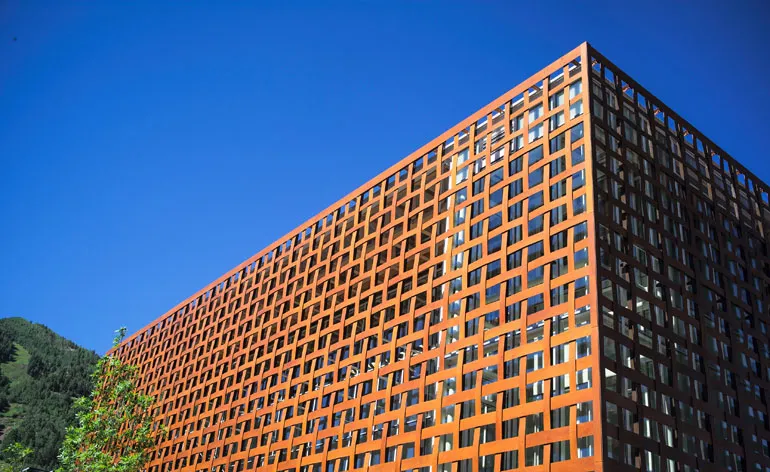
Where: Aspen, CO, USA
When: 2014
Encased in a woven wood facade, Shigeru Ban's new Aspen Art Museum in Colorado, USA, is set against the scenic backdrop of Ajax Mountain.
Simose Art Museum

Where: Hiroshima, Japan
When: 2023
A series of rebuilt Shigeru Ban houses became available to experience and rent at the Simose Art Museum in 2023. The institution was designed by the same architect in Hiroshima, Japan and features colourful galleries set within water.