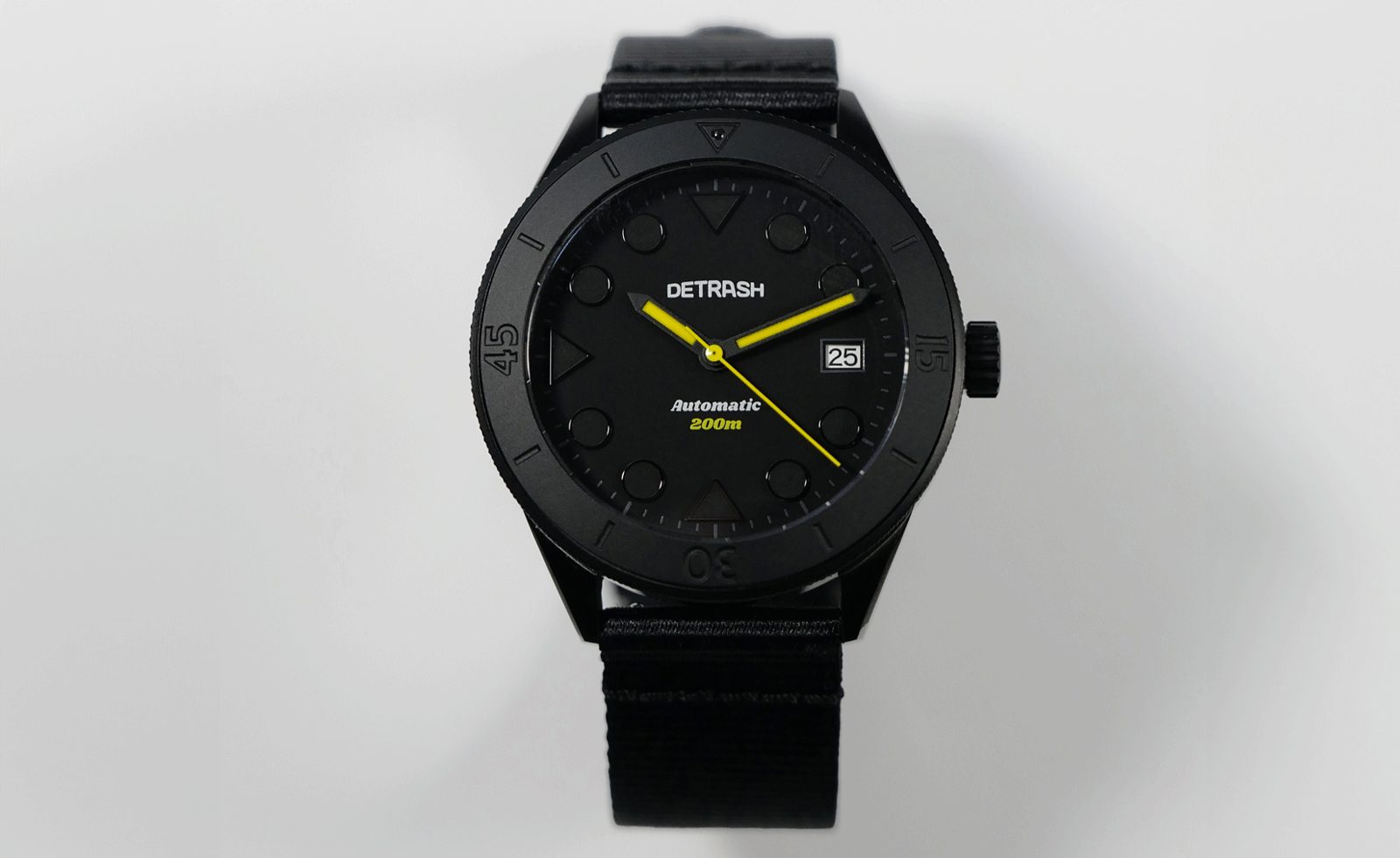
Guy Blaskey concedes that not everyone thought the name he gave his watch brand – Detrash, which launched in 2024 in Dorset, UK – was a good idea. 'I’d get a lot of hate online: Why do you put ‘trash’ on the dial?”’ he recalls. 'But I wanted to wear the brand’s commitment to sustainability on its sleeve, and to spark conversations about it.'
Indeed, Gotham’s Vigilante 2, the new model from Detrash, comes with a case made of 80 per cent recycled steel (as high a percentage as is possible for surgical-grade steel at present) and a strap made from recycled ocean plastics, swappable with another made from beer waste. A percentage of each sale goes to environmental charities. Detrash is now planning a dial made from Surfite, an upcycled material made from hardened layers of resin by-product from surfboard manufacturing.

'The demography of the watch customer is, broadly, getting older, and if the industry is to attract younger people, it has to care about sustainability,' says Blaskey, previously an entrepreneur in the FMCG (fast-moving consumer goods) market. 'That’s more interesting to a lot of consumers than, say, its power reserve. In fact, I think it’s offensive that so many watches are so expensive and not more sustainable.'
Certainly, while some brands at the higher end of the market have dabbled with sustainable materials – Panerai, Oris, Chopard, Ulysee Nardin, among others – Blaskey argues that in watches, the sustainability drive tends to be at the more affordable end: Detrash watches retail for under £400. Yet Gotham’s Vigilante 2 also comes with a Japanese automatic movement, sapphire crystal glass, a ceramic bezel and 200m of water-resistance.

Likewise, the spec of California-based watch brand The Sacred Crafts’ Adam Greener diver – with a bronze case made from reclaimed boat propellers and a dial in a proprietary ‘Seaglass’ material made using recycled fishing nets – also has a 300ATM water-resistance (equivalent to the pressure at a depth of 3,000m), an ETA automatic movement and a 42-hour power reserve. The challenge, says The Sacred Crafts’ founder Matt Harkins, is ‘what can be done in this [sustainable] way without losing the aesthetics that collectors are looking for in a watch’.

The spec is critical, explains Zacharias Dahl, CEO of Swedish sustainable watch brand Triwa (a contraction of ‘Transforming the Industry of Watches’), which has recently launched its £215 Koster GMT model with a dial handmade from recycled plastic composite, but also with an automatic movement, 20ATM water-resistance, and so on. Sustainable watches have to offer a much higher spec [for the price], in part, says Dahl, because of assumptions about sustainable materials.

'The more luxury end of watchmaking still tends to be driven by brand status, and status doesn’t yet align with sustainable materials,' Dahl suggests. 'Possibly, that business model is too ingrained [to depart from traditional materials]. But new brands have to find a clear angle to drive growth – and increasingly that’s sustainability. Our customers are turning to sustainable watches as a form of rebellion [against watch industry norms].'

According to Stephane Waser, CEO of prestige brand Maurice Lacroix – which caused a stir by launching its Aikon Tide watch, made from plastic bottles recovered from the seas – the broader industry is moving towards sustainable materials, if maybe not being sufficiently vocal about it. 'There’s a certain image to plastic, yet carbon fibre is seen as a technical performance material, so often [it’s] a question of how materials are packaged,' he says. He cites a shift from animal-derived straps to rubber ones, from mined diamonds to lab-grown ones.
'The industry is already doing a lot towards sustainability, but doesn’t speak much about it, perhaps because it doesn’t seem to support sales,' Waser adds. 'In the end, the industry has to satisfy customer needs. And the question is, who do you want to speak to? It’s younger generations who are paying attention to [ecological impact].’
Perhaps that’s why it’s not only more affordable brands, but also younger brands that are building a track record in foregrounding sustainability, including in the more prestige market. Late in 2025, ID Genève, for example – which was founded in 2020 and put on firmer financial footing in 2023, thanks to a CHF2m (£1.9m) buy-in from investors including Leonardo DiCaprio – launched its Circular S Eclipse. Its case is made from 100 per cent reprocessed, low-carbon stainless steel – made using a solar furnace to melt down surplus steel scraps. The strap is made from recycled grape residue from a Châteauneuf-du-Pape estate. It’s also a £4,000-plus watch, with others in the brand’s collection priced at £8000-plus.

'Many of the more established luxury watch brands were born into another context, but we were launched just a few years ago and had to deal with the reality of that time – which is much more mindful of sustainability,' says ID Genève’s CEO Nicolas Freudiger. 'People still often assume there’s some trade-off on quality in sustainable materials, [so] right now it’s a question of speaking to a more avant-garde customer. But in time, the sustainability narrative will become [the most important one] for the luxury industry.'