
The Architecture Association (AA) has unveiled to the public its Department of Tropical Architecture Archive – an extensive, fascinating and important digital platform documenting projects, pedagogies and legacies springing from its historical namesake academic division, which showcases the powerful impact the department's graduates had in shaping global architecture.

Velayu Kandavel (with A.N.S. Kulasinghe): Colombo Planetarium, Sri Lanka, 1965
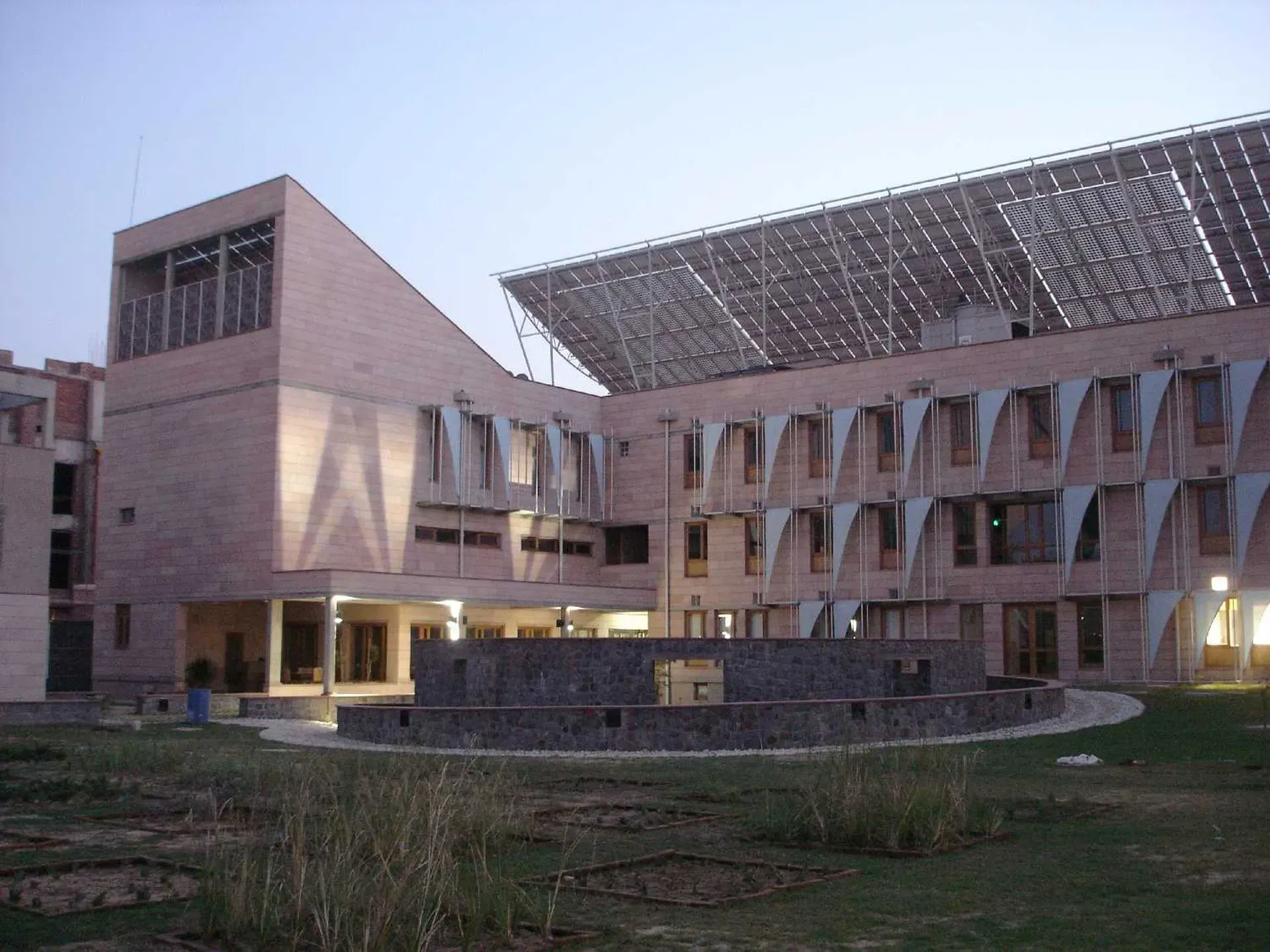
Ashok Lall, Institute of Rural Research and Development (IRRAD), Gurgaon, India, 2012
Discover the AA’s fascinating and important Tropical Architecture Archive
A significant research undertaking of over two and a half years, the project traces a range of personal and collective geographies from 540 AA alumni, spanning individual and institutional levels, internationally. The result is impressive. The archive digitised and now makes available myriad drawings, photographs and other media that were previously inaccessible – either in private hands or personal, family collections.

Maath Al Alousi with his model for the Abu Dhabi Municipality competition, 1979. Aga Khan, ArchNet CC-BY-4.0

Dr Otto Koenigsberger: Maas Family Summer House (1927)
Of the archival holdings, the school has in its possession a large proportion of the work of its founding director, Dr Otto Koenigsberger, from 1957-71. This includes everything from his own student work under the tutelage of German architect Bruno Taut in the 1930s to his role as federal director of housing in India from 1948-51. In these archival drawings, one can trace the department's early pedagogical focus, which centred on climatic concerns such as orientation, aspect and topography.
Projects such as his Maas Family Summer House (1927) appear attuned to their landscape. Archival images show a large roof, spacious verandas and a robust, deep construction that responded spatially to site and setting.

DTA graduates, Francis Akobia Amanfi (back left), John Nutsugah (front, second from left), Francis Segbedzi (third from left), Walter Akude (far right), c 1965

Patrick Wakely: DTA Student Work: University, Dar es Salaam, 1963. AA Archives
Later projects by Koenigsberger in India, in his role as director of housing, show an attempt to adapt this language towards developing a contextual response to different climates. The Central College for Women, Nagpur (1940) shows an arrangement of rooms planned around a central courtyard, with deep reveals and overhangs to mediate the southern sun. Other projects in Mysore for the TIFR experimental building show experiments with louvred façade systems designed to mitigate heat and dust – an overtly modernist international style adapted to suit local site conditions.
These experiments are further evident in the archival teaching material, which highlights a concern around elements such as wind direction, soil make-up and sun-path diagrams. There is an analytical rigour to understanding place, and it is not hard to imagine how such a focus might have influenced some of the department's most renowned alumni, including 20th-century architecture critic Kenneth Frampton, known for coining the term ‘Contextual Modernism’ – modernism that responds to the specific conditions of place.

Ram Karmi: Student Dormitories ‘Gimmel’, Ben-Gurion University of the Negev, Be’er Sheva, Israel, 1982

Ram Karmi: Negev Centre, Be’er-Sheva, 1963
Although the department initially attracted a largely European cohort, many of whom looked to develop an understanding of climate-led design within newly independent nations as fertile ground in a limited postwar European context, this was subverted in later years. The department slowly established a strong identity and undertook an influx of professionals from over 80 countries outside Europe.

Valentine Gunasekara: St. Anthony's Nursery School, Colombo, Sri Lanka, 1973-1974

Valentine Gunasekara: St. Anthony's Nursery School, Colombo, Sri Lanka, 1973-1974
Archival entries include individuals such as artist, photographer and architect Maath Al Alousi (Baghdad, 1963-1964), who joined the department while working in the Ministry for Housing in Baghdad, and studied to develop an understanding of building construction with specific applications to an arid climate.
Projects developed on his return show meaningful engagement with context, using familiar local vernacular and reinterpreting this towards a version of Iranian modernism. Completing a range of civic and private projects in Baghdad across many different scales, his work deploys the same recognisable values taught at the department – namely, leading design solutions with an understanding of local microclimates.

Valentine Gunasekara: Tangalle Bay Hotel, Sri Lanka, 1972-73

Valentine Gunasekara: Tangalle Bay Hotel, Sri Lanka, 1972-73
Meanwhile, Indian architects, such as Ashok Behari Lall (1969-1970), joined the programme aiming to understand the use of locally sourced natural materials. On returning to India, Behari Lall completed the Institute of Rural Research and Development (IRRAD) in Gurgaon, where local stones, including granite and sandstone, are recycled to keep the project’s embodied energy to a minimum. The project also uses design strategies that maximise reliance on natural daylight, passive air ventilation, and an organic continuity between interior spaces and outdoor courtyards.

Muzharul Islam: Jahangirnagar University, Student Halls
The AA's Department of Tropical Architecture Archive is now live, but it remains an important work in progress for the renowned London school. ‘There is still plenty more mapping to be done, to visualise the networks of institutions and practices which interacted with the Department… The traces of empire are everywhere,’ explains Edward Bottoms, head of archives at the Architecture Association.
‘What we want to do is to carry on documenting, and to utilise this as an open and equitable source, a live receptacle. We look forward to the research that will come out of this as an extraordinary resource to researchers,’ adds AA director Ingrid Schroder.

DTA_Teaching Material

Otto Koengisberger, Mithapur Master Plan, 1948. AA Archives