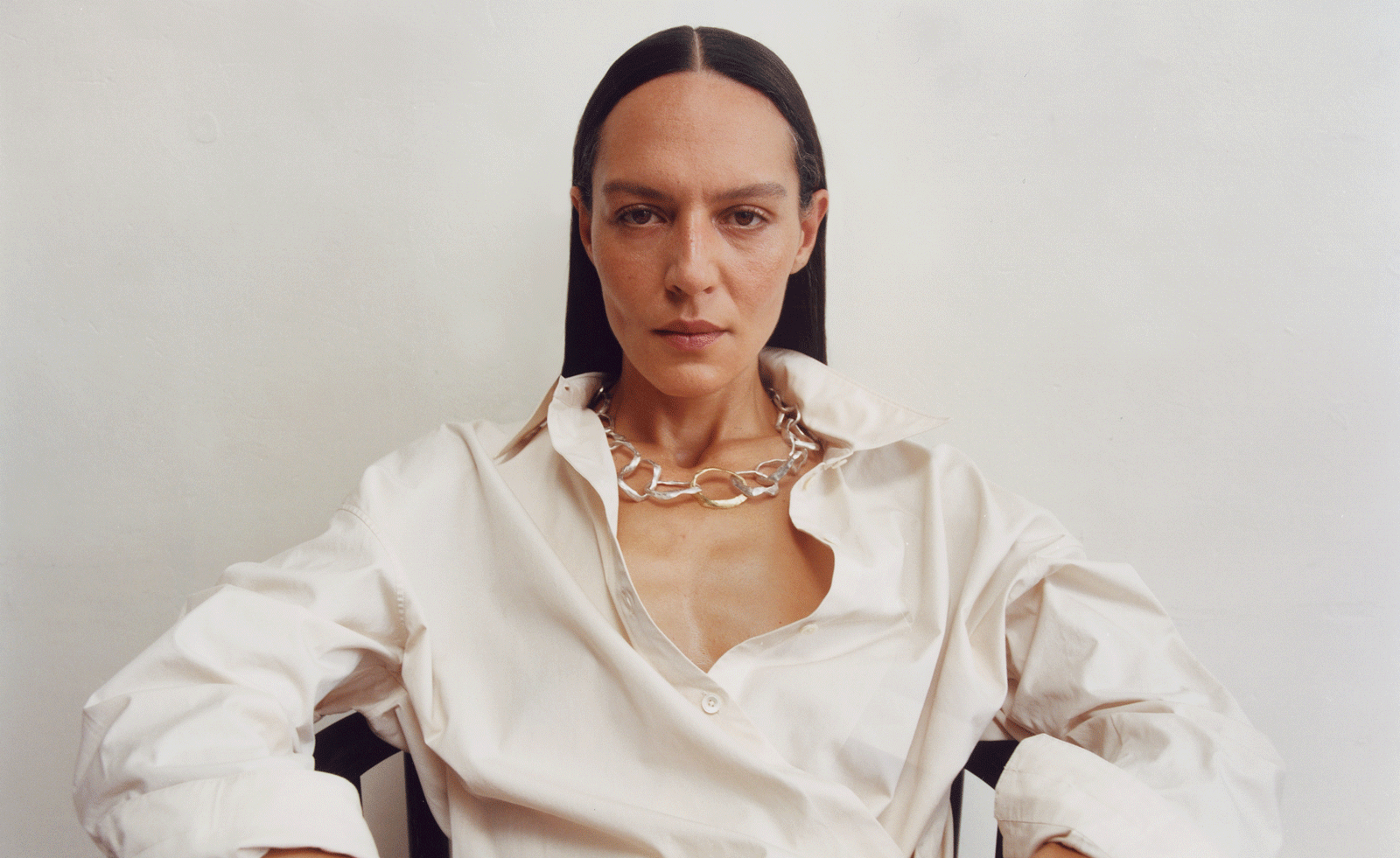
From London to Lahore, New York, Paris, Milan, and Cornwall, some of today's most visionary jewellery designers are deeply attuned to the landscapes around them. Whether translating street signs, folkloric symbols, or everyday objects into elaborate and detailed design forms or using textured surfaces sourced from their immediate surroundings, they employ techniques that range from hand-carved wax and woven silver to pressed pennies and repurposed machinery. Each designer works with metal, stone, and found objects to create pieces that are at once delicate and boldly modern, drawing on a rich seam of references from design and art history, to cinema and costume.
Georgia Kemball

London-based jewellery designer and maker Georgia Kemball draws on a wonderfully playful range of references. Some of her rings feature hand-carved cherubs cradling freshwater pearls; the Fish Fin Ring wraps a fish’s anatomy around the finger; and the Bone Pendant holds a real bone fragment, functioning as a talisman of memory, courage, and protection for whoever wears it. She also creates delicate charms, including one that spells out ‘I Love You’ in tiny, deliberate dots. Her Orgy Ring is modelled after an 18th-century piece in the British Museum collection and encapsulates her fascination with history and the very intimate, personal act of wearing jewellery.
Kemball’s jewellery started when she began creating jewellery gifts for friends. Trained in textiles at the Royal College of Art, she found herself drawn to jewellery’s intimacy and scale. Her work is grounded in lost-wax casting, carving each design by hand before casting it in precious metal, a process that suits her focus on creating intricate, emotionally charged detail. Versatility also defines her approach to jewellery making. Her pendant charms can hook onto safety-pin-like fastenings, worn solo or clustered on a chain. Kemball is now developing a new collection focused on men’s rings and bold unisex pieces in collaboration with stylist and costume designer Calvin How.


SIGLA

A household object transformed into something you wear! SIGLA's Salt Shaker Ring takes the Art Deco salt shaker as its muse, crafting it in recycled silver with a subtle nod to Elsa Peretti's legendary designs for Tiffany. SIGLA’s jewellery pieces are delightfully unexpected. Elegant, intricate brooches, rings and necklace designs references costume design, cinema, fashion history, and the everyday.
Founded in 2025 by Natasha Law and India Ayles, each SIGLA piece is crafted in Vicenza, the historic heart of Italian goldsmithing. The name is drawn from the Roman siglum (a maker’s mark pressed into metal), and captures the studio’s ethos of creating jewellery with identity, intention, and the unmistakable imprint of the hand. In their own words, SIGLA’s pieces feel like opening your grandmother’s jewellery box and finding something unexpectedly relevant again, without knowing exactly why it feels so right.
The Dove Brooch is statement piece, which can be bought in multiple varieties, including with hand-mosaicked rose, crystal, and red siam ombre gemstones, complete with a tiny rose-colored eye. Designed for shirts, jumpers, tailoring, or outerwear, it’s a symbol of peace, and a perfect example of SIGLA’s playful approach to tradition.
Their plaited S-link chains draw on the engineered precision of a bicycle chain and the shimmer of sequins from Golden Age Hollywood, creating a material sensitivity that feels almost textile in spirit.
The studio channels the bold geometry, sleek lines, and glamour of 1930s costume jewellery through a contemporary lens, shaped by the founders’ diverse backgrounds. Natasha and India first met studying art history at University of Cambridge. Natasha went on to design womenswear and leather accessories at Giorgio Armani, while India worked as a costume designer for film, spanning superhero franchises and period dramas. This year, SIGLA goes mobile. With a custom display system on wheels, they’re taking their collections on the road to pop-ups across London, Milan Design Week, and on to Florence, Marseille, and Cadaqués, with the aim to revive the travelling-salesman tradition as a modern, female-led journey, making movement, encounter and display part of the work itself.


Zohra Rahman

Twisted heart-shaped NYC Heartbreaker Earrings, inspired by the curled wrought-iron gates of New York, sit alongside Zohra Rahman’s core collection pieces that includes a necklace reimagining the ‘Mashallah’ motif found on building facades, vehicles, and in markets throughout Lahore. The urban textures of Lahore and New York City are central to Zohra Rahman’s designs, shaping her work with a blend of grit, poetry, and playful elegance.
Throughout her collections, Zohra Rahman experiments with texture and movement, reinventing the way each piece interacts with the body. Her inventive joinery allows components to twist or coil, creating dynamic designs that function differently from every angle. The sterling silver Hell Hatch Ring features a fiery, flame-like face, with its hand-pierced oblong top sits atop a split-wire band that twists and wraps around itself, forming a fluid yet structured base that anchors the design with effortless precision. The Coil Hatch Ring has a hand-wrapped, coiled sterling silver face. By combining unexpected and tactile finishes with meticulous craftsmanship, she transforms jewellery into playful, sculptural objects that are as much about sensation and interaction as they are about visual impact.
A graduate of Central Saint Martins, Rahman launched her label in 2014. From her intimate atelier in Lahore, Rahman trains jewellers through apprenticeships and collaborates with local engravers and stonecutters. Working between Lahore and New York, she draws on dual cultural worlds, absorbing urban aesthetics, spirituality, and everyday design, to create pieces that are at once personal and political. Her upcoming work expands into mobiles, sculptural objects, and bespoke commissions, continuing her exploration of jewellery as a transformative, transportive medium.


Keshav Anand

At first glance, London-based jeweller and editor Keshav Anand’s pieces might read as relics or historical artefacts, but their hybrid themes make them unmistakably contemporary. Anand mines overlooked symbols and imagery to craft ornate talismans and miniature sculptures in gemstones and recycled precious metals. His pendants feel at once ancient and contemporary, with their earthy jewel tones, crafted from bloodstone, Dalmatian jasper, obsidian, tiger's eye, emeralds, rubies, pearls, gold, and silver, and intricate detailing. Drawing on queer South Asian narratives, Anand evokes the region’s transfigurative entities, from the intimate love scenes carved at Khajuraho to the elusive Tamil sphinx, Purushamriga, bringing together storytelling and ritual in his jewellery pieces, reviving stories long buried, some deliberately obscured through the destruction and pillaging of sacred sites.
While studying Fine Art at Central Saint Martins, Anand was inspired by artists who explored the relationship between sculpture and performance, for instance Franz West’s wearable papier mâché and plaster pieces, and François-Xavier Lalanne’s zoomorphic desks and fireplaces. Functionality and design resonated with this creative practice, and jewellery making evolved from that impulse. He sees jewellery as both protective and uplifting, almost like a talisman to wear that can brighten the day. His references are wide-ranging, spanning Greco-Roman antiques, Indian temple carvings, Victorian gems, and deeply personal influences from his family. Gold, in particular, has long given him a tangible sense of connection and a way to feel close to loved ones, even those far away or no longer with us.
Fervent Moon

You might know Fervent Moon from the long-running NTS Radio show of the same name. Founded by artist Lewis Teague Wright, Fervent Moon has been on air for over 13 years, hosting an ever-shifting mix of genres and themes. The project began online in 2008, when Wright launched a website that uploaded a single mp3 each week for seven days, creating a fleeting, rotating archive. Guest selectors from around the world contributed seven-track selections, building a dispersed, ephemeral sound library.
From barbed-fence–like bracelets and necklaces to molecular rings and iced gem linked chains, Fervent Moon’s collection explores a rich variety of textures and forms. This is in part a reflection of Teague Wright’s practice, which moves fluidly between embroidery, sculpture, video, and jewellery design. For him, a chain is never just a chain. It is a wearable sculpture, attuned to the rhythms of the body. Through sculptural forms, documentation, and sonic world-building, Fervent Moon’s pieces exist as both a physical, wearable object and a transmission, translating sound into form and feeling.
His latest charm collection is a wearable archive, designed to be worn alone or layered over time. Each piece is a pressed penny inscribed with phrases like Cherry on the Top, Kiss Me My Fool, or Satyr, which draws on his research and obsessions, nodding to ideas from the Dionysian impulse of Roman theatre, where chaos, appetite, and comic relief danced through carved masks. Fervent Moon’s design focus is to create maps with no fixed destination, bringing together themes from play and sculptural storytelling into his work.


Julia Tyrrell Bunge

Based in Paris, artist and jewellery designer Julia Tyrrell Bunge finds her materials where you might least expect them — in the cogs and chains of discarded bicycles, reclaimed and recast in silver into sculptural jewellery that sits as comfortably on the finger as it does suspended from the ear. Her designs explore malfunction, obsolescence, and the unexpected poetry of broken systems. Gears, links, and engineered components are reimagined into pieces that feel surprisingly elegant and organic.
A signature motif is the derailleur chain: layers of stacked links reimagined as a bold bracelet, echoing the bicycle gear mechanism that lifts a chain from one sprocket to another. The Marotte Earring turns tiny metal baubles into playful, kinetic hoops, while her sculptural rings, which are threaded, twisted, and overlapping, cradle vivid Tourmaline Green stones, merging industrial edges with refined craft.
Each component is cast or set in silver, forming structured compositions built from repeated and reconfigured parts. What once functioned as machinery becomes ornament, and what once wore out becomes enduring and everlasting. She began making jewellery to give these discarded materials new life as lasting, wearable objects. Now, she is developing a new collection that pushes her practice further, by experimenting with form, function, and kinetic movement to explore how engineered systems can continue to live on, transformed, on the body.
Zoé Mohm

Zoé’s jewellery looks as if it has slipped out of a folktale and wandered through a dream. Her pieces twist together symbols, knots, and illogical ties in a way that feels both folkloric and surrealist, creating intricate designs which seem to defy structural logic as metal softens and coils around chokers, ear cuffs, rings, and brooches. Her work feels delicate and otherworldly, with designs that look hand-spun by a storyteller, not forged in sterling silver.
I first encountered Zoé’s work displayed with Suns Works at Basel Social Club in Basel in 2025, where a hand-forged, cast sterling-silver brooch caught my eye. An engraved eye wept a long swaying teardrop charm, paired with a dew-drop-tipped yarrow blossom. It felt like a wink to classic Surrealist imagery, but told in her own language. Across her designs, even a simple safety pin can become uncanny, reimagined as a hand-forged sterling form with a woven basket head and a dangling pebble charm. The Achillée Fog Drops earrings are segmented, with leafy marguerite-daisy and tiny pebble charms. The Calla Cluster Bracelet is an astonishingly beautiful hand-woven sterling silver mesh bangle draped with calla lilies, hearts, bead sticks, dew drops and a lone bird. Her Tassel Necklaces are light, open-mesh rope chains whose ends are swallowed hollow pebbles sprouting chain tassels. Even a simple safety pin becomes uncanny in Mohm’s work, reimagined as a hand-forged sterling form with a woven basket head and a dangling pebble charm.
Mohm was born in Vaulx-en-Velin, France. Whilst she never formally studied jewellery, she made it instinctively as a child. Her training was in textile embroidery, weaving and tapestry – disciplines that gave her a deep, technical fluency with handwork. When friends began asking her for custom jewellery in 2020, her practice grew naturally, and her textile thinking followed her into metal where she often weaves, knots, braids, and constructs silver as if it were thread. Her jewellery may be sterling silver, but it still behaves like fabric: soft to the imagination, endlessly intricate, and threaded with stories.
CC-Steding

CC-Steding is the collaborative jewellery project of Ben Chaplin and Nichola Farnan, whose work spans pins, earrings, headpieces, necklaces, and bracelets. Their pieces carry a distinctive buoyancy, often intertwined with subtle nods to politics, history, and human stories.
Amongst their designs are woven and riveted silver pins and single earrings, and their sterling silver collar clips, a collection inspired by the ‘Paperclip Resistance’ in Norway during World War II. Teachers and students wore paper clips (or ‘binders’ in Norwegian) as a gesture of unity and defiance against the Nazi occupation, a symbol so powerful it was eventually banned. CC-Steding channels this spirit of resilience and meaning into wearable form.
All CC-Steding’s jewellery is designed and handmade in their London workshop, primarily in silver and gold. Process is central to their practice. At the heart of their work is a belief in highlighting the making process as meaning — each piece designed to show its own construction, prompting the question of how and from where it came to form. They are equally drawn to the emotional life of jewellery. Designed for longevity, they see the marks an owner leaves over time on a jewellery piece not as damage, but as the final layer of a piece finding its form.
Collaboration is another thread running through the studio's practice, with recent collaborative work including jewellery and hardware developed for Cecile Tulkens and Independentes De Coeur, to a recent contribution to the GmbH AW26 runway presentation. Looking ahead, a small new CC-Steding collection will debut in Paris in June. In May, they will travel to Tokyo to exhibit new pieces for the first time and visit key retailers, bringing CC-Steding’s playful, thought-provoking jewellery to a global stage.


Willa Hilfreich

Delicate engravings unfold across chunky silver forms in WILLA / HILFREICH’s one-of-a-kind range of rings, from tiny walkers, blossoming flowers, drifting twigs, each piece a miniature world rendered with obsessive care. Statement works include long, dagger-like sand-cast earrings textured with applied Keum Boo 24ct gold foil, holding dangling spheres. Another standout design is a relief ring where two birds sit encased in its surface while others gaze upward at an ancient comet. Above them, two stick figures share a dinner, each crowned with a single sapphire. Elsewhere, a spinning pendant reveals a walking figure on one side and a carved mouse’s feet, tail, and scattered grapes circling its edges.
Willa Hilditch’s practice began in fine art. She first studied at Chelsea College of Arts and then completed the Drawing Year at the Royal Drawing School. Working across sculpture, drawing, and painting, she eventually shifted toward wearable pieces after an evening wax-carving class – a technique now central to her process. Most of her jewellery is cast using the lost-wax method, later embellished with kinetic elements, fine chains, and small precious stones. Self-taught through trial, error, and YouTube, her references emerge less from conventional jewellery and more from contemporary art and ancient artefacts, forming a visual language that is tactile and narrative, with the aim of being unpolished. Alongside jewellery, her drawing practice continues to evolve, she has the dream of merging the two more directly in future research and making.


Emily Nixon

Cornwall's rugged coastline is the starting point for everything Emily Nixon makes. Working directly from the landscape, she shapes and presses warm beeswax around found stones, jagged, molten rock surfaces and cliff formations, translating their raw, elemental surfaces into jewellery — rings, necklaces, and bracelets — that feel as textured and alive as the terrain that shaped them. After studying textiles at Goldsmiths, University of London, alongside artists such as Damian Hirst and Sarah Lucas, Emily worked as an artist, weaving sculptures from steel wool and found objects. She later opened the Ash Gallery in Edinburgh and worked as curator of Newlyn Art Gallery, a role that brought her to Cornwall in the early 1990s and shaped her ongoing artistic preoccupation with the natural world.
In 2000, Emily’s practice evolved into jewellery making. The Rock Drawing Necklace was her first design to use the beeswax method around found stones. A series of imperfectly circular sterling silver links, interrupted by a single solid 18ct yellow gold link, forms an irregularity in the necklace, a reflection of a coastline where nothing is quite symmetrical. The Pebble Circles Pendant distils this further with smaller, softer links on a delicate chain, their rounded forms showing the slow, patient eroding work of water on stone. In the Tide Collection's Stone Set Rings, metal wraps around each stone as the tide wraps around rock, the solid recycled 18ct yellow gold shaped by hand around natural sapphires from Sri Lanka, likely formed over 150 million years ago, and a natural diamond from southern Africa, older still at over a billion years. Geological time is made wearable.
The metals are all recycled, reflecting a deep commitment to responsible sourcing and the circular nature of working with natural materials. Skilled jewellers and goldsmiths in her West Cornwall studio burnish, finish, and set the stones. Every piece is both a reflection of the Cornish terrain and a meditation on the timeless dialogue between human craft and the earth itself.


