The watch industry has used a year of economic uncertainty and shifting US tariffs as a catalyst rather than a constraint, as brands leaned into creativity. We have seen core designs reimagined, as big brands and indies explored new materials with renewed purpose. Instead of playing it safe, Swiss brands embraced the craftsmanship collectors appreciate and paved the way for modernity rather than looking in the rear-view mirror. By developing thoughtful trends that feel less hyped than forward-looking, we have seen a wave of slimmer silhouettes, refined engineering and expressive dials that balance modernity with longevity. Here are five creative trends that shape a new, intentional era of watchmaking, strong enough to set the standards for a resurgent 2026
Stone dials

A malachite dial on a Dennison watch
We got the first taste of resurgent stone dial art in 2024, and this year has seen the trend go from hyped small runs to a steadily rising trend. Brands like Rolex surprised us at Watches & Wonders, while revived Gerald Genta have recently launched a meteorite version of their sea-urchin-shaped Oursine, with a meteorite dial. And the independents, like Dennison, are all turning up their creative volume. Designed by Emmanuel Gueit of AP’s Royal Oak Offshore fame, this revived brand has embraced the combination of slim, shaped cases and stone dials with fervour. With shapes reminiscent of What Gueit’s father created for Piaget in the sixties, the brand has reinvented itself throughout the year, proving that stone dials is more than a fad, and debuting gem set cases to dial up the glitz factor. The ALD Malachie Diamond version captures the essence of the trend, with a wild stone pattern that makes each dial unique, framed by a baguette-set bezel and matched to a matching green strap.
Avant garde modernity

The Vanguart Orb
With the subversive flair of MB&F setting the stage, on the independent side of watchmaking young brands are embracing wild new designs, and it’s good news. While many brands still seem to be stuck on rewind, offering ever-tweaked versions of sixties wristwear, collectors are waking up to future-gazing brands like Vanguart. Their Orb is a sleek, architectural flying-tourbillon watch whose openworked movement is enclosed in a 41 mm case just 10.5 mm thick, and was last seen on the wrist of big time collector Michael Jordan. Hand-finished surfaces accentuate a sculptural symmetry of the curved case, while inside, a skeletonised calibre reveals a flying tourbillon at 6 o’clock, a nod to centuries of Swiss watchmaking. The barrel can be seen at 12, and a diamond-set rotor is flipped to the front where it swings orbits in automatic mode, with an ingenious locking function keeping the Orb in Manual mode. With a 60-hour power reserve, a titanium (or rose-gold) case, and an integrated strap, it is as much a mechanical sculpture as a timepiece.
3D printing beyond the prototypes

3D-printing never really took off as a manufacturing tool after its late 2000s hype, but major watch brands have been using it for prototyping for years. It is finally entering the stage (and wrists) with brands like the small Dutch brand Holthinrichs and British-based Apiar leading the tech front, proving once again that it takes small brands to embrace the risks and be the first to reap the rewards. The Apiar 3D-printed Gen1.0 evokes a radical new direction for wristwatches: metal additive manufacturing and generative design. Its Grade-23 titanium case is remarkably lightweight (≈ 38 g) and composed of three 3D-printed pieces, enabling forms impossible in traditional watchmaking. The web-like, skeletonised dial structure and open, aerospace-inspired geometry give the watch a strikingly modern, technical look. Paired with a movement from La Joux-Perret, this watch is a statement of sustainable innovation and engineering ambition rather than tradition.
Integrated bracelets, but with a modern twist

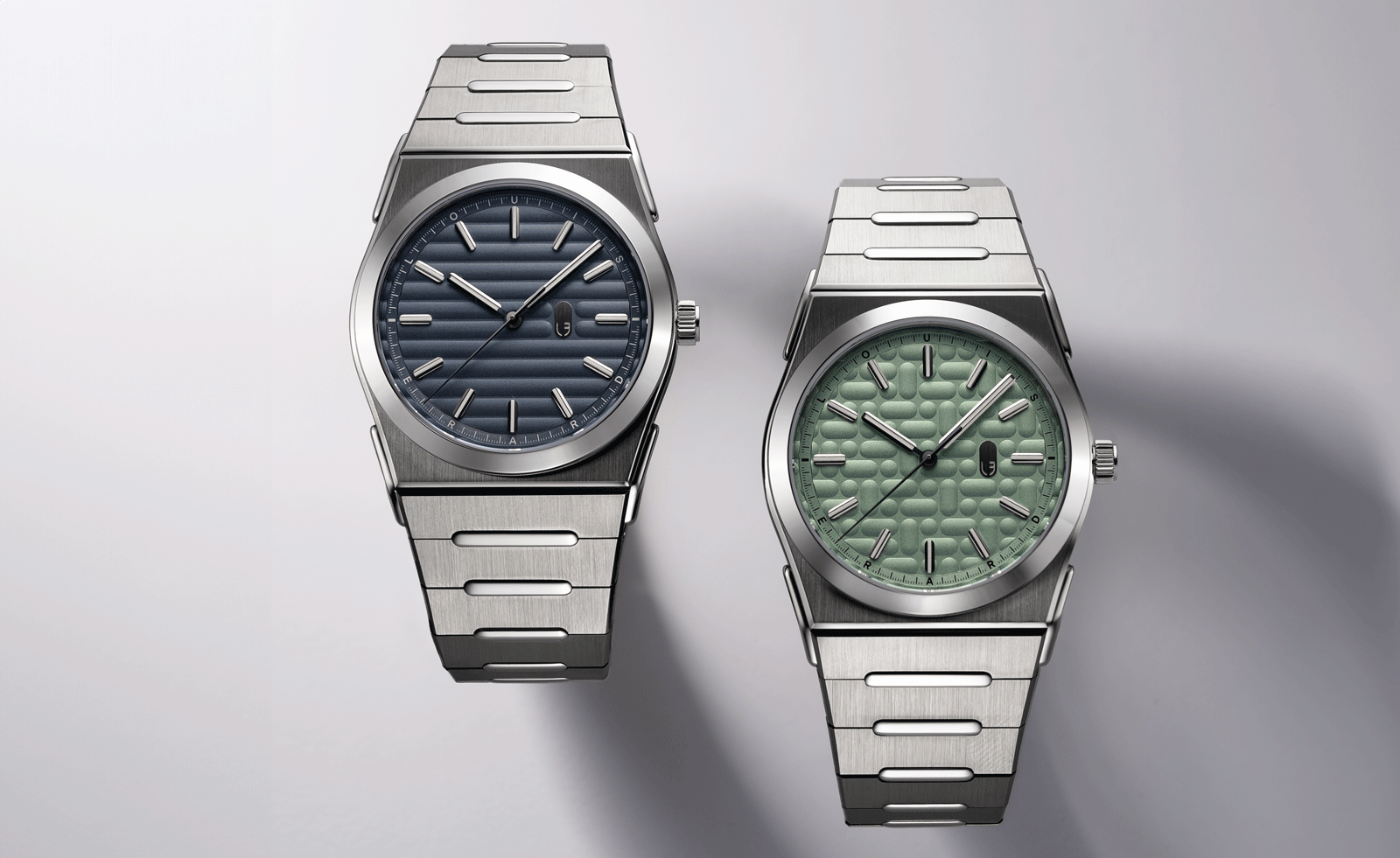
Brands are starting to see beyond the rose-tinted retro view that has created a hundred homages, seeing the integrated bracelet design as a springboard for modernity. We have seen it this year from Christopher Ward, the successful British brand, while the Swiss brand Louis Erard’s 2340 is a great example of reimagining the refined sport-chic integrated-bracelet. With a distinct, angular case that marries lightweight titanium craftsmanship with simplicity, it offers something new. The 40 mm-by-8.95 mm case blends brushed titanium with studied polished accents and flows seamlessly into a 92-component five-link bracelet. Inside ticks the Sellita SW300-1 automatic movement, offering a power reserve of about 56 hours. Dial choices include mint-green, slate-blue or deep-blue textures, all with diamond-cut markers and lumed hands. It’s a trend we want more of, and one that, when done right, blends minimalist sophistication with strong presence.
Favourites reimagined

While Louis Erard and others seek to reinvent the sleek comfort of integrated bracelets, other brands stick to their proven designs. But we have seen a rising trend of embracing successful shapes with new, future-proof materials, with Cartier’s Santos XL now available in a lightweight titanium version. Tissot has been riding the retro-wave for a few years now with the brand-boosting PRX, but has reset the hype-meter with carbon fibre. The new carbon-fibre version of the PRX delivers a stealthy, contemporary statement while preserving the hallmark integrated-bracelet lines of the original’s 40.5 mm case. But now we have it on a textured rubber strap, redone with a forged carbon case and matching carbon dial, each piece being unique thanks to the material’s natural marbling. The automatic Powermatic 80 movement still impresses with its 80-hour power reserve, while matte surfaces, a sapphire crystal, and a rubber strap complete the stealthy, reinvented look: lightweight, rugged, and ideal for everyday wear.