
It’s a brave person who’s willing to venture outside the secure and familiar mobile eco-systems crafted by Google and Apple. Android and iOS dominate smartphone sales for good reason; they’ve facilitated the evolution of the mobile phone into a completely essential part of everyday life.
Even those who stray outside the garden walls to dabble in the equal-but-different operating systems created for the likes of Huawei (HarmonyOS) or even an open-source equivalent like the Linux-based Ubuntu Touch is opening themselves up to a world without straightforward access to WhatsApp, tap to pay, or seamless photo back-ups.

Fairphone Generation 6 smartphone
For a certain buyer, idiosyncrasy will always trump convenience. Kickstarter is awash with out-there ideas like Oukitel’s WP100 Titan, a rugged phone that has an onboard 100 lumen projector, while another truly unusual prospect comes in the shape of Honor’s Robot Phone, expected to hit the market any day. Alternatively, you project a very different kind of image through the ownership of a Vertu phone.

Vertu Agent Q in Solid Walnut
The original boutique smartphone brand is still in the running, although status, not simplicity, is its primary USP. Security also gets a look in – with promised ‘Absolute data sovereignty, safe from cloud breaches’ – and the Agent Q also promises a mechanical zoom lens. It’s available in solid walnut for a shade under £5,000.

The Meadow smartphone
Maybe it’s the hackability and added friction that actually appeals? It won’t have escaped your notice that smartphone addiction is very much a thing. If you want to avoid these weapons of mass distraction, the jury is still out on whether this is a job for hardware, software, old-fashioned willpower or strong-armed legislation. Unsurprisingly, there are phone makers who are here to help.

HMD Skyline's Detox mode
We’ve reported on things like HMD’s Better Phone Project, as well as sleek hardware like the Balance Phone and Light Phone III, as well as the Minimal Phone, Unihertz Jelly Star, and Mudita Kompakt in a quest for true digital detox. There are other deliberately low-key options like the Basic Phone or the P-Phone, neither of which seem to have made many waves just yet.

Light Phone III
However, if clarity and refuge are more important than status or tech trickery, read on. We’ve assembled a collection of seven simple smartphones that all promise to do things a little differently, whether it’s a throwback form factor, unconventional display or stripped back operating system. On to the devices.
Titan 2 Elite by Unihertz

Titan 2 Elite by Unihertz
If you’re still pining for your Blackberry, there are several options out there (including the Clicks range of keyboard cases). The Titan 2 Elite is the newest contender, a 5G Android phone with an integral physical keyboard. The form factor results in a near-square 4.5-inch screen (with a secondary display on the reverse), while the keyboard can be programmed with shortcuts and also incorporates a trackpad. There’s a 50MP camera, twin sim-card slots and support for Google Pay.
Titan 2 Elite, $489.99, Unihertz.com
Fairphone 6

Fairphone 6
Fairphone has been quietly pushing an alternative smartphone narrative since the company was founded in Amsterdam in 2013. This, the new sixth generation of its eponymous smartphone, was launched last summer and goes further than ever in trying to fulfil the seemingly impossible goal of a truly sustainable device.

Fairphone 6, a repairable smartphone
For a start, the Fairphone is repairable, with six key components that can be swapped out, including the battery, screen, camera modules and USB ports. It runs Android 16 and has a half-decent camera and 6.3-inch OLED screen, so is perfectly capable of keeping up with mid-tier devices from more prolific OEMs. Other benefits include onboard microSD support for up to 2TB, a ‘Moments’ mode with a distraction- and app-free home screen, and a promised five-year tech support and eight years of updates.


On top of all that, Fairphone is a certified B Corporation with supply chains and environmental practices that are second to none, including ensuring the phone itself is 100 per cent Electronic Waste Neutral – which means that for every phone it makes, the company recovers the equivalent amount in recycled materials and components. You’re also encouraged to send in your old phone when you order a new one.
Fairphone Generation 6, £479, Fairphone.com, @Fairphone
HiBreak Dual from Bigme

HiBreak Dual from Bigme
BigMe’s upcoming HiBreak Dual is being billed as one of the first smartphones to splice together two different display technologies, e-ink and conventional colour LCD. In a break with convention, the latter is confined to the front of the device, where a circular colour screen not only helps with selfies but provides a polychromatic splash for viewing pictures, receiving notifications and checking maps.
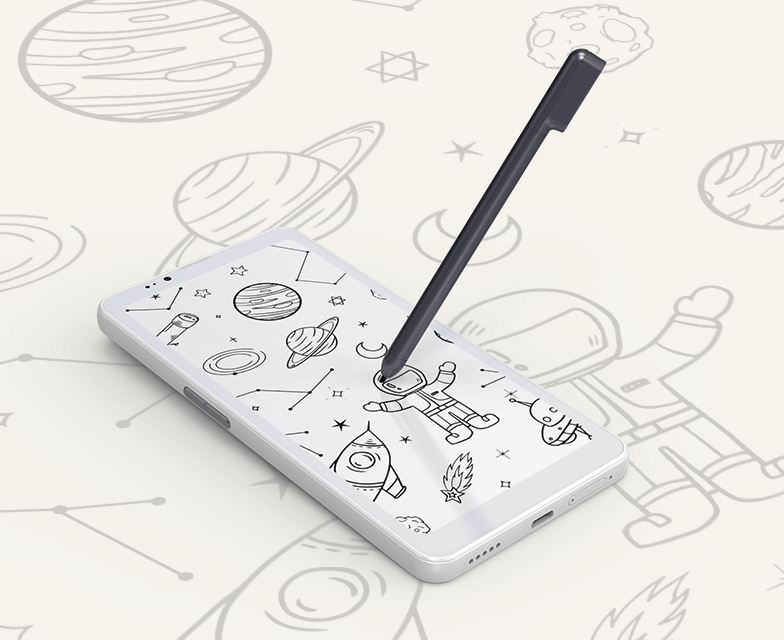
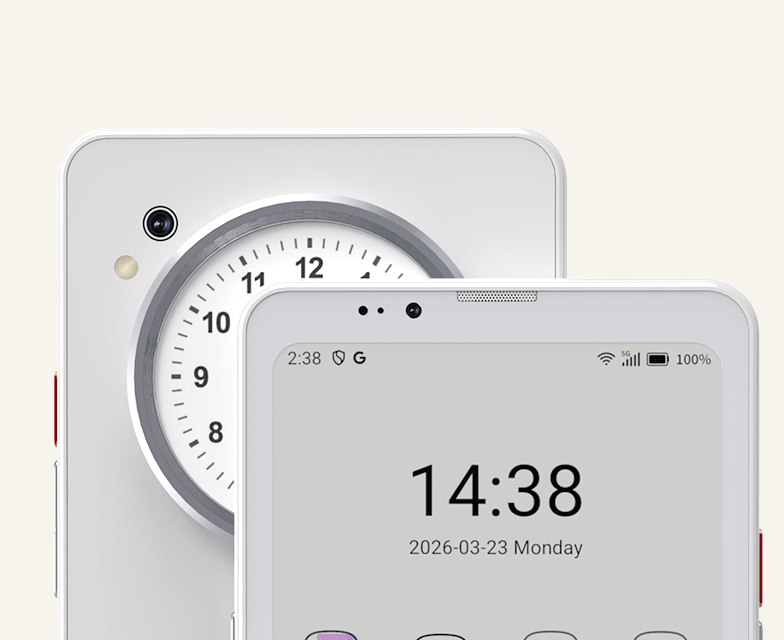


The main 6.13-inch screen is a pressure-sensitive, stylus-friendly colour e-ink unit, best suited for taking notes and reading, rather than resorting to an all-consuming sink into scrolling. Notifications are banished to the back to maximise focus, even though the device runs Android 14 and is fully Play Store compatible. This means most apps will run just fine, but the inherent lag and muted palette of e-ink should suck most of the distraction out of the device.
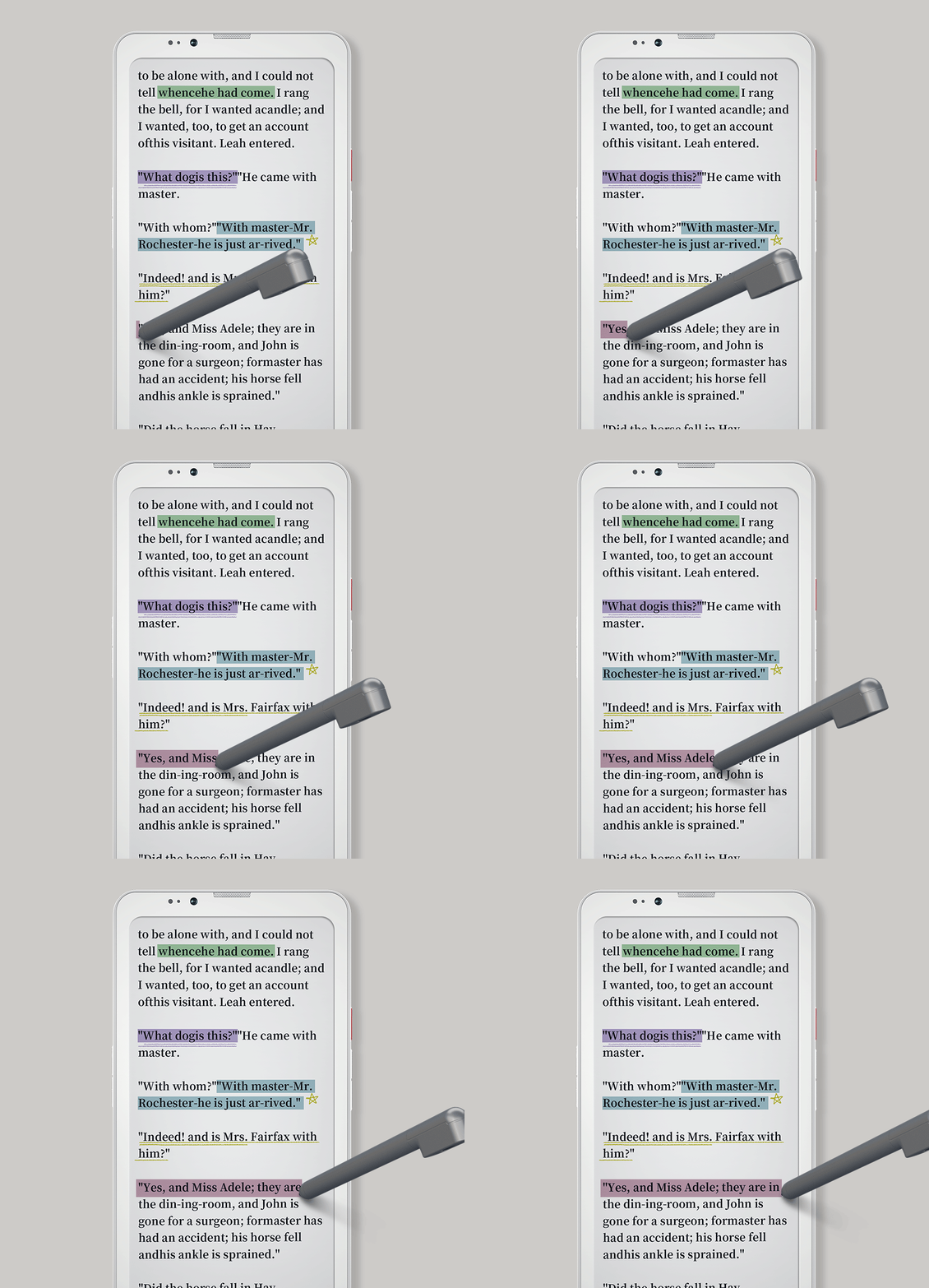
The HiBreak Dual has a stylus compatible e-ink main screen
Bigme HiBreak Dual, more information at Store.BigMe.vip, @BigMe.eink.tablet
The Meadow

The Meadow compact smartphone
An entirely different form factor is put forward by The Meadow, a square, super-pocketable device that aims to incorporate all the ‘essentials’ of smartphone usage without diving into dependability. That means you get apps like Maps, Spotify, Apple Music and Uber, all optimised for the three-inch screen, but no social media or web browser. Designed to connect via 4G networks (in the USA only for now), The Meadow is implicitly intended as a second device for being out and about.

The Meadow compact smartphone
The camera is more about snapping the moment than framing a masterpiece, while the actual connectivity is designed to link with a close circle of friends and not your entire digital Rolodex; just 12 contacts are able to reach you. The company hopes that by banishing email and the tyranny of social networks, group chats and doomscrolling you’ll be able to stay more in the moment.


Other functions considered essential include fitness tracking, a notes app and access to weather info and podcasts. The Meadow sounds like a bucolic place to spend time, but you’ll have to truly commit in order for it to fulfil its purpose – no sneaking a regular smartphone along for the ride.
The Meadow, $399, Meadow.so, @Meadow.so
Jolla Phone

Jolla Phone
Coming soon to EU markets (including the UK, Norway and Switzerland), the Jolla Phone is another device that promises independence of design, data privacy and an all-round different approach. Assembled in Finland, the Jolla Phone runs a Linux-based OS called Sailfish, with added support for Android apps on top. Benefits include more security and less of the innate trackability that comes with plugging yourself into Google’s eco-system.


The Jolla device itself has support for dual sim cards and microSD storage, while also offering a competitive hardware set complete with Sony cameras, fingerprint sensor and a Gorilla Glass 6.36-inch AMOLED screen. As with almost all these small-scale manufacturers, tech specs might not be the latest and greatest, but the speed of the market and the leftovers from the economy of scale ensure going independent is no longer about making a massive compromise.
Jolla Phone, €649 plus tax, Commerce.Jolla.com
MindOne Pro from iKKO

MindOne Pro from iKKO with Snap-in Case
iKKO’s forthcoming MindOne Pro wants you to have the best of all worlds. The main unit is an ultra-compact near-square format smartphone with a 180-degree hinged Sony camera unit and a tough screen that’s said not to need a separate screen protector. At 8.9mm thick, the MindOne Pro is pitching itself as a tiny powerhouse with no performance compromises.


Pair it with the optional Snap-in Case (available in five colours), however, and you have a Blackberry-style unit not unlike the Titan 2 Elite. The case also includes an extra battery to extend the daily usage, along with an almost-forgotten artefact of smartphone design, the 3.5-inch headphone jack. This is paired with a Digital Audio Converter from Cirrus Logic to boost the audio quality.

MindOne Pro with Snap-in Case
The only potential downside is iKKO’s insistence on bundling onboard AI services through its own AI OS that runs alongside regular Android. Translation and note-taking might be useful, but does anyone really need a phone that can serve up AI-generated podcasts?
MindOne Pro, iKKO, £324, iKKO.com
Clicks Communicator

Clicks Communicator
Finally, another entrant into the Blackberry-adjacent keyboard-based smartphone replacement. Created by the same team who create magnetically attached and integral keyboard cases for iPhones, the Communicator is an all-in-one device that could supplement or even replace your regular smartphone altogether.


Based on Android 16 underpinnings, the tiny Communicator has a 4.03-inch AMOLED screen, front and rear cameras, twin sim slots and microSD support and weighs in at 170g (an iPhone 17 Pro Max is 233g). With front and rear cameras and no compromises on Android app support, the Communicator is designed for those people tired of massive smartphone screens.

Clicks Communicator
The other benefit is of course the full Qwerty keyboard, which includes touch-sensitive scrolling controls, shortcut support and pairs with the touchscreen. A dedicated Message Hub consolidates your various comms apps, from WhatsApp through to Gmail and Telegram, making it easy to see at a glance where you are on the road to inbox zero.
Clicks Communicator, from $199, reservations at Clicksphone.com, @Clickskeys