Traditionally, Ferrari has farmed out its designs to one of the many styling houses that litter the industrialised plains of northern Italy. Bertone, Scaglietti, and Pininfarina in particular all established and defined key elements of the company's style, with the collaboration with Pininfarina continuing successfully into the modern era. The 458 Italia especially demonstrates that neither company has lost its touch when it comes to creating technically brilliant and visually beautiful machines. Now, however, Ferrari is turning its attention to a new generation of designers.
The brand invited future speculation about supercar design from fifty design schools with its World Design Contest. After an intense process of elimination, eight chosen schools went on to work on a series of detail design models, both in physical form and in 3D, using Alias software from competition partner Autodesk. The final seven were Turin's IED and IAAD, London's RCA, the European Design Institute Barcelona, Hongik University in Seoul, ISD France, Detroit's College For Creative Studies and China's Jiangnan University School of Design.
The brief was explicit: create the Ferrari of the future, 'a pure hypercar that uses the technologies and materials of the latest generation.' Unsurprisingly, the designs that resulted drew heavily on weight-saving materials, sci-fi forms and hugely powerful but still hypothetical powertrains, including hybrid systems and turbines.
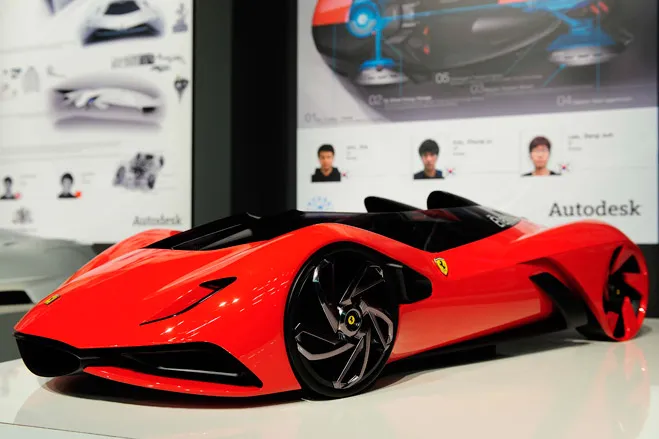
The winning team hailed from Hongkik. Kim Cheong Ju, Ahn Dre and Lee Sahngseok's 'Eternità' concept (pictured above) speculated on a mix of electric mobility, flywheel energy storage and a hydrogen-powered generator, wrapped up in a Barchetta-styled two-seater bodywork. Second prize went to Samir Sadikhov's 'Xezri' concept. Sadikhov, an Azerbaijani studying at IED Turin, a car designed to cut through the wind while also using inbuilt wind turbines to power onboard systems. The third jury prize was given to the RCA-designed 'Cavallo Bianco', created by Henry Cloke and Qi Haitao. Described as a 'winter hypercar for a frozen riviera; designed for racing over an ice lake and arriving in a luxury ski resort,' it was a design for a very different world, albeit one where the allure and appeal of the prancing horse still reigned supreme.

Sketches of ’Eternità’ by Kim Cheong Ju, Ahn Dre and Lee Sahngseok from the Hongik University, Seoul

Second Prize:
’Xezri’ by Samir Sadikhov from IED Turin, Italy

Third Prize:
’Cavallo Bianco’ by Henry Cloke and Qi Haitao, from the Royal College of Art, UK

Sketches of the ’Cavallo Bianco’ by Henry Cloke and Qi Haitao from the Royal College of Art, UK

The runners up:
’F-Estetico’ by Ryu Je Chan, Lee Jung Han and Choong Hyun Kim, from Hongik University, Seoul

’P27’ by Lee Han, Byung-Yoon Min and Soo-Yeon Kim, from Hongik University, Seoul

’382 Monaco’ by Leandro Alberto Martín, from IAAD Turin, Italy

’F25 Superfast’ by Riccardo Bordin and Diego Dellavalle, from IAAD Turin, Italy

’Ferrari Duelitri’ by Alessandro Di Gregorio, Andrea Amato and Masashi Matsumoto, from IAAD Turin, Italy

’Ferrari 428 Spyder Corsa’ by Alexander McGowen, from the College for Creative Studies, Detroit, USA

’Ferrari Achilleo’ by Jose Casas, from the College for Creative Studies, Detroit, USA

’F80’ by Jae Han Song, from the College for Creative Studies, Detroit, USA

’Ferrari Ethesian’ by Alessandro Nardolillo from IED Turin, Italy

’Ferrari Pegaso’ by Giuseppe Ceccio, Giacomo Pierin and Matteo Politano, from IED Turin, Italy

’Ferrari Pegaso’ by Giuseppe Ceccio, Giacomo Pierin and Matteo Politano, from IED Turin, Italy

’Ferrari F304’ by Manuel Varilla Gutiérrez and Gerard Lorente Romàn, from IED Barcelona, Spain

’Ferrari Trofeo’ by Alejandro Esteban Bustos, Guido Dodero and Marcel Moritz, from IED Barcelona, Spain

’F750’ by Marc Devauze, Vianney Brecheisen and Alexandre Labruyère, from ISD France

’Ferrari Flusso’ by Marc Devauze, Vianney Brecheisen and Alexandre Labruyère, from ISD France

’Ferrari GTE’ by Lena Knab, Paul Nichols and Adam Setter, from the Royal College of Art, UK

’Ferrari GTE’ by Lena Knab, Paul Nichols and Adam Setter, from the Royal College of Art, UK

’P425’ by Goran Ozbolt, Jan Rosenthal and Marianna Merenmies, from the Royal College of Art, UK

Jiangnan University School of Design, China

’The Drake’ by Pan Dai, Zhou Yimin and Wu Jia, from Jiangnan University School of Design, China

’Ferrari Unique’ by Marta Beltrán and Ruben Oya, from IED Barcelona, Spain