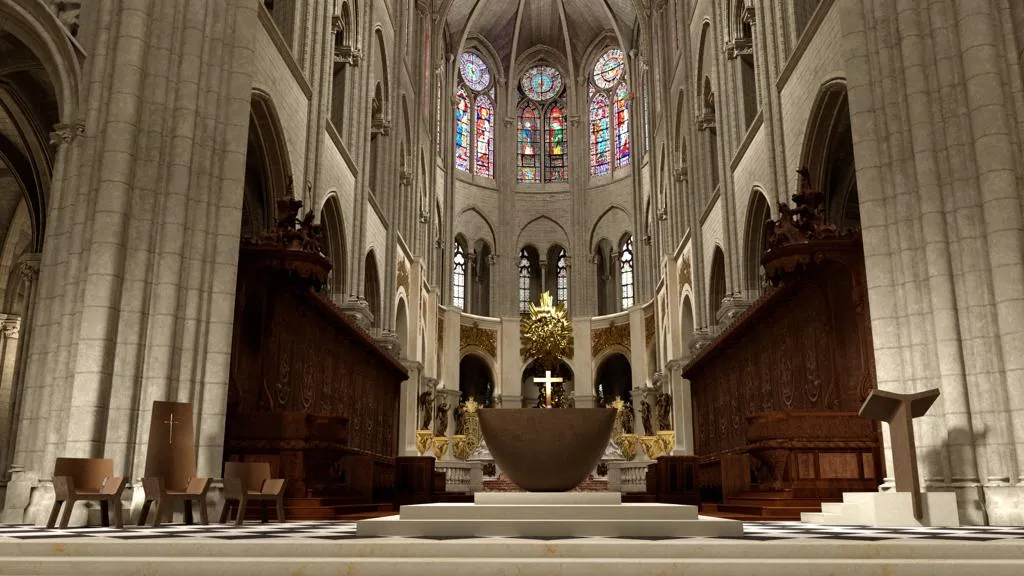
For the reopening of Notre-Dame de Paris, set for late 2024, French designer Guillaume Bardet created a series of liturgical objects and furniture. The Gothic cathedral was partly destroyed by a fire in April 2019, which resulted in the collapsing of its roof.
The renovation has involved carefully restoring the remains, while reproducing its Gothic architectural details as well as recreating the spire that was added in the 19th century by architect Eugene Viollet-le-Duc. Bardet, part of Paris' Galerie Kreo's roster and whose work is defined by a sinuous minimalism, was chosen by the Archbishop of Paris during a long and rigorous process.
Designing Notre-Dame de Paris: Guillaume Bardet's liturgical objects

The designer has been tasked with creating an altar, lectern, cathedra with seats, tabernacle, and baptistery, which he developed in bronze and favouring simple forms that exude a graceful approach that is guided by timelessness.
The T-shaped lectern, for example, is meant to symbolize freedom, and was the first piece he designed for this space. Similarly, the baptistery draws from the object's ritual circularity and is imagined with flow of people in mind. His intention with these objects, reads a note introducing the project, was 'to embrace organic shapes that evoke a profound sense of permanence and spiritual devotion.'

While the designs appear rigorous and solemn, the design gesture favoured by Bardet resulted in a series of gentle objects that discreetly inhabit the space. 'They should resonate with conviction for Catholics and captivate the attention of non-Christians,' he comments. 'Each element carries its own distinct identity, symbolism, and purpose, yet together they form a cohesive ensemble that engages in a meaningful dialogue. These pieces should exist within and beyond the realm of liturgy: not demanding attention, but also not hiding away. They should have a subtle yet undeniable presence.
'The pieces should embody the essence of the past, embrace the present, and welcome the future.'
Notre-Dame de Paris is set to reopen to the public on 8 December 2024


