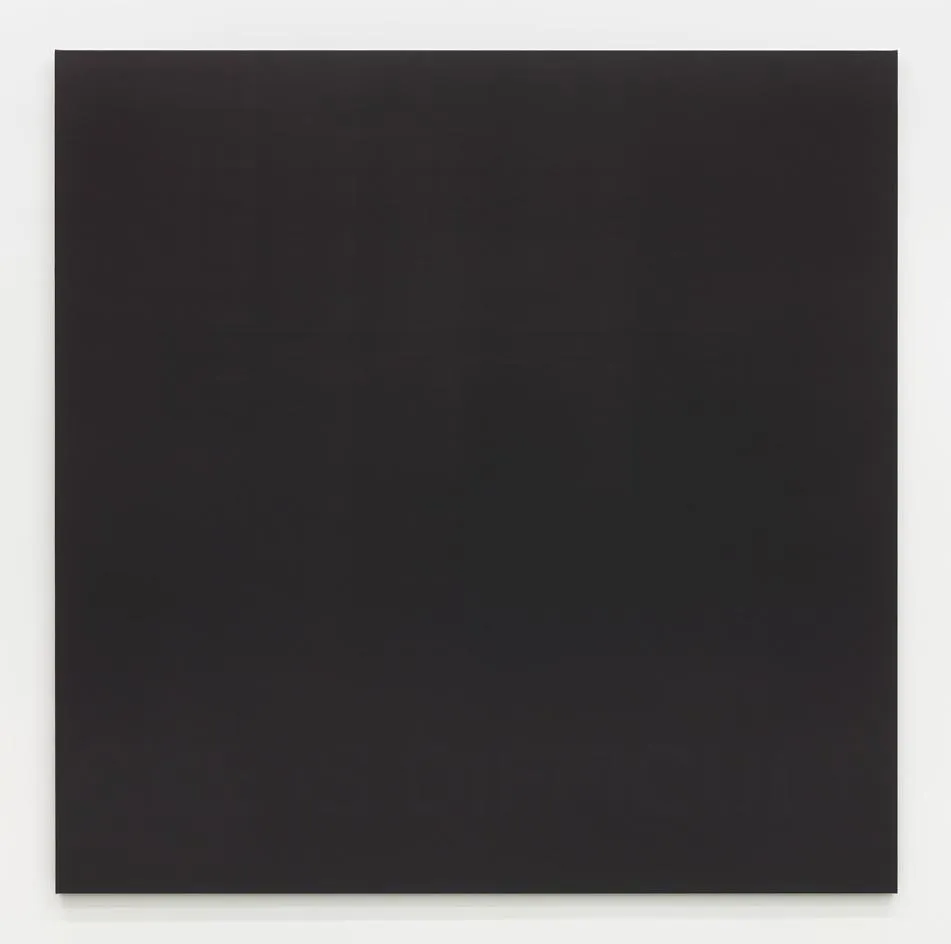
For her current exhibition 'Situational Diagram' at Dominique Lévy Gallery, Brazilian-born artist Karin Schneider has restricted herself to the production of black monochromes – a limitation that, in turn, allows for an expanded focus on the processual 'operations' applicable to the art object. Her monochromes are meticulously categorised and indexed as such: the Splits relate to Barnett Newman’s thin, vertical canvases; while Cancellations dialogue with Ad Reinhardt’s own black paintings, which eschewed representation in service of a purely phenomenological engagement with the materiality of paint.
However, that which is negated by abstraction is not exactly absent from Schneider’s works: her monochromes maintain residual connections to their respective signifieds. The spectre of the female form, for instance, is visible across Schneider’s series of Extractions, black neoprene cut-outs based on Matisse’s infamous Nu Bleu gouaches and Tarsila do Amaral’s 1928 painting Abaporu. These are placed – perhaps discarded – on the gallery floor. Elsewhere, in three paintings categorised as Namings, abbreviated references to Poland (POL), Syria (SYR) and Serbia (SRB) are faintly discernible in black-on-black text on canvas.
Schneider envisions these written signs as formalist elements, yet she acknowledges that the act of naming can serve to 'demarcate boundaries' and seems purposefully to draw focus to countries that have experienced political instability linked to the volatility of borders or competing ideological factions.In one of the most effective works in the exhibition, titled Situation, 16mm footage of the Adriatic Sea is itself 'monochromed', prompting reflection on the ways in which such expansive, borderless entities as seas are also subject to the politics of signification. A flickering, black field, bisected by swathes of sea and sky, the projection is itself framed by a wall drawing that extends across both second and third floor galleries.

It's a limitation that, in turn, allows for an expanded focus on the processual 'operations' applicable to the art object. Pictured: D (CW + BP) (Dependable), 2015

Schneider's monochromes maintain residual connections to their respective signifieds; the spectre of the female form, for instance, is visible across her series of Extractions. Pictured: E (HM/NB III-I) (Extraction), 2016

The Extractions are black neoprene cut-outs based on Matisse’s infamous Nu Bleu gouaches and Tarsila do Amaral’s 1928 painting Abaporu. Pictured: E (TA/AP) (Extraction), 2016
INFORMATION
’Karin Schneider: Situational Diagram’ is on view until 20 October. For more information, visit the Dominique Lévy Gallery website
Photography courtesy the artist and Dominique Lévy Gallery
ADDRESS
Dominique Lévy Gallery
909 Madison Avenue
New York, NY 10021