Margaret Howell and Kettle’s Yard unpack Japanese artist Kenji Umeda’s sculptural style
Following the discovery of a long-lost trunk belonging to the artist, previously unseen works, clothes and correspondence go on show in London and Cambridge

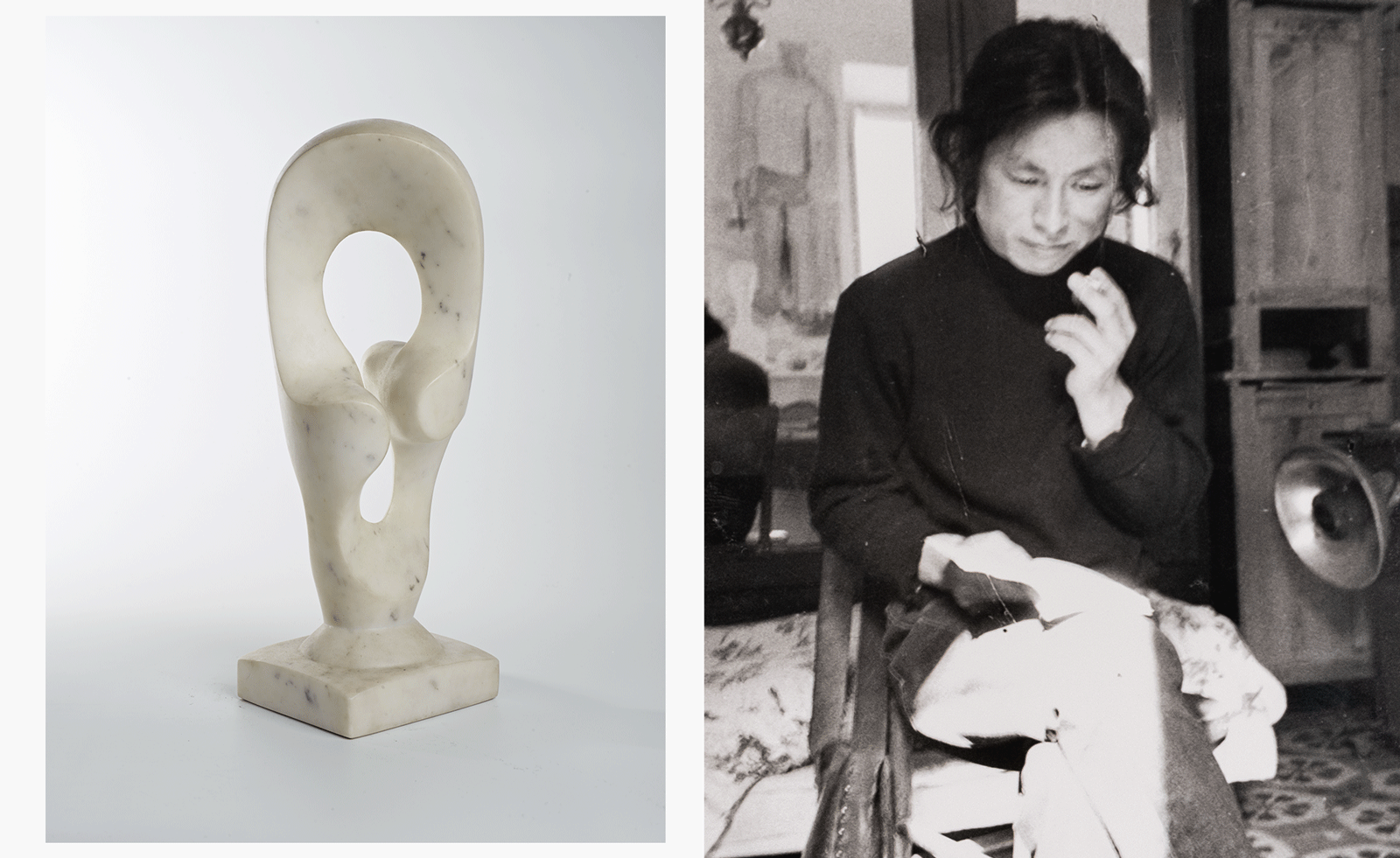
In 2024, a trunk was discovered in an outbuilding at the art gallery and house, Kettle’s Yard, in Cambridge. Inside, much to the great surprise of staff, was a collection of personal effects, including letters, photographs, drawings and clothing, belonging to the Japanese artist Kenji Umeda.
Umeda had been a consistent presence at Kettle’s Yard in the 1960s, after moving from Japan to Cambridge and befriending Kettle’s Yard founders Jim and Helen Ede. They invited Umeda to work at the house, in exchange offering support and advice on selling his work.

Letter from Kenji Umeda to Jim Ede, 27 October 1973
The discoveries in the suitcase offer new insight into the works, processes and thoughts of Umeda, as well as revealing a deep affinity with Jim Ede, whom Umeda describes as his ‘sensei’, or teacher, in the unearthed letters.
‘There is very little in the way of Umeda’s work openly accessible in the UK,’ says Inga Fraser, senior curator at Kettle’s Yard. ‘The Kettle’s Yard archive contains several photographs of his later works, but the sketches we discovered in the suitcase gave us valuable insight into the early years of his career, when he was developing as an artist. They show how his sense of observation, shape and form were honed in relation to what he was seeing in the Kettle’s Yard house.’
Discovering the suitcase prompted the Kettle’s Yard team to get in touch with Umeda’s family, who donated further gifts and works, creating a more comprehensive archive at the venue.

Kenji Umeda, Cantos - 1, 1982
Among the found items was Umeda’s extensive correspondence with Ede, demonstrating how their long friendship impacted both their lives. It was during his time at Kettle’s Yard that Umeda discovered Henri Gaudier-Brzeska’s sculptural works, later moving to Italy to study sculpture, and then on to America.
It was a relationship that went beyond Ede’s practical support. ‘The house had recently been extended, resulting in a quadrupling of floor space,’ says Fraser. ‘Ede was by this time in his seventies and needed help to clean and maintain the spaces and artworks – despite these being tasks he had always taken particular pleasure and care in performing. Ede’s example of loving attention to the house was clearly an inspiration for Umeda, who used the time [there] to study closely works by other artists.’ It was the Edes’ way of life, though, that had the greatest impact, adds Fraser, pointing out that the pleasure of domestic ritual is something that became essential to the artist in his life and work.

Kenji Umeda in Rome, March 1973
The correspondence is moving in its tracing of Umeda’s development as an artist, something that takes shape in the marble sculpture Spirality, 1977, which resides at Kettle’s Yard. ‘It is telling that he elected to send a work from this time to his “master” Jim Ede, then living in Edinburgh, and it is also telling that Ede felt the sculpture belonged to Kettle’s Yard and placed it there,’ says Fraser. ‘Umeda asked Ede to write a text for his exhibition catalogue, and the two pages of Ede’s notes for the text feature in our display. The correspondence between Umeda and Ede continued for many years, but I think it was most important for the artist during the period in which he was learning to be a sculptor, and Spirality was given in gratitude for Ede’s guidance.’

Letter from Kenji Umeda to Jim Ede, 28 January 1974
‘When I visited Kettle’s Yard to see the clothes Kenji had left in his trunk, I was struck by their timeless practicality and the quality of their make’
Margaret Howell
Before the works are gathered in Kettle’s Yard in April 2026, they are on display at Margaret Howell, in London. ‘When I visited Kettle’s Yard to see the clothes Kenji had left in his trunk, I was struck by their timeless practicality and the quality of their make,’ says Howell. ‘Many pieces could slip easily into a wardrobe today – a simple work jacket, a printed silk scarf, a classic trench coat. His way of dressing felt very familiar to me – we both come from a time when clothing was made to last, and when buying well was an investment rather than a disposable act.’

Kenji Umeda, Cantos - 2, 1982
Howell’s London store is a natural stop for Umeda’s work, which shares the designer’s reflective and sustainable philosophy. Adds Fraser: ‘I suppose discovering such a time capsule of someone’s possessions is inevitably telling of their particular way of life at that moment. The quality, the materials, and the classic shapes of the garments belonging to Umeda were striking, and this was mirrored in the small number of personal effects: a wonderfully carved wooden tobacco pouch with the edges softened with use, a pot for tea, a fan for the heat, his calligraphy materials.
'I loved seeing the books he had chosen to take with him, which were all neatly tied in bundles with string and remain so. One of these will feature in the display. The clothes do not look out of place today; they are styles that have endured, and have clearly been made carefully using materials that age well. I couldn’t help but think of Margaret Howell’s design philosophy when I first saw them.’

Kenji Umeda in the 1970s
‘Kenji Umeda: A Journey’ at Margaret Howell in collaboration with Kettle’s yard until 12 April 2026, then at Kettle's Yard from 25 April – 6 September 2026