
On a crisp, if unseasonably warm day in Reykjavík, Wallpaper* finds itself invited inside Alvar Aalto's Nordic House, a late-period masterpiece of Finnish modernism wherein an intimate one-off musical experiment is taking place. Designed and constructed in the 1960s with community functionalism in mind, it's the perfect vessel for a communal deconstruction of one of Icelandic composer and musician Ólafur Arnalds' most personal works to date.
A starkly beautiful collection of eight songs and instrumentals, the 2025 album A Dawning was the result of a profound creative union between Arnalds and his friend and collaborator, the late Irish musician Eoin French, known best by his stage name Talos. Despite the circumstances surrounding its completion – French passed away following a short illness in August 2024 – Arnalds is emphatic that this is not an album about death but, instead, a work defined by its own vitality. The mission to bring this music to the world was rooted in a specific promise made to French: a commitment to ensure the music reached as far and wide as possible.
'He made sure I wouldn't go home and just cry,' he states. 'He gave me something to do, and I promised him that I would do the best I could with this and take it as far as possible. And with that, I tried to fulfil his dream, meaning: promote the hell out of it. That's what he wanted. He really believed in this music. We both do.'

Ólafur Arnalds
Shortly after A Dawning was released in July 2025, Arnalds began thinking about how best to share the songs beyond the album itself. Crucially, any live iteration had to navigate a difficult personal boundary.
'I set myself a rule that I would never replace him,' Arnalds says. 'I'm never going to stand on stage and get a singer to come in and sing these songs with me, because he can't. I don't want to do that ever. I defined these rules in my mind – "It's OK if several people are doing it, because then it's a group. It's a community."'
It was this realisation that fundamentally shifted the ownership of the work.
'The music really didn't feel like it was mine anymore,' he continues. 'It became a part of our close-knit community. It was with us through the whole process of him passing and the funeral and everything. From the start, it always felt like it had a communal feeling to it… I think it's a beautiful feeling as a musician to actually feel like you don't own these songs.'
The solution to Arnalds' dilemma – how best to share an intimate, collaborative work without anchoring it to a sense of loss – would ultimately arrive thanks to a chance algorithmic encounter with the Gaia Music Collective, an NYC-based creative choir community, via YouTube.
'They came up performing in a car park,' Arnalds recalls, noting the group's rendition of Chappell Roan's ‘Good Luck, Babe!’. 'It fit all the things I'd been thinking about: I don't want to replace him, or make it about his passing. The music lives in the ether. Somehow, this is it. That's how you perform it. You just have people come and live inside of it and feel it and perform it, regardless of their ability or skill or experience, who they are, where they're from, because that's how we felt making it.'
He promptly pitched the idea to his label, Mercury KX, who duly obliged.
'I wrote an email saying, 'I've got something, I think it's gonna be cool, I think we should do something like this and just have a community choir and film it in a random location, not in a fancy concert hall… It's just us singing together for ourselves.' And then this happened.'

Inside The Nordic House
The choice of setting for the evening's proceedings feels particularly fitting too with both Nordic House's emphasis on community and its ultramarine blue ceramic rooftop designed to mimic the mountain silhouettes that surround it. It reflects a topography that Arnalds has spent his storied career translating into evocative soundscapes.
Inside, proceedings begin within the elegant surrounds of the Elissa Auditorium, with its white plaster walls and wood-slat acoustics serving as a unique sonic companion for Kliður (pronounced 'Klither'), a Reykjavik-based choir and art collective that meets weekly to sing songs and choral pieces devised by its members. Today they have been tasked with recording renditions of three of French and Arnalds' songs, which were re-arranged for choir by composer and orchestrator Geoff Lawson.
'There's a strange, very technical fine-tuning when you work with someone who's trying to translate your ideas into a different vehicle, in a sense,' Arnalds muses. 'Certain things can get lost because they're not the main featured element of a song – a lead line or a lead motif. But there's a lot of stuff that is very subtle and small that is equally important. A lot of our work is collaboratively talking about what those things are.'
As the evening draws in, members of Kliður are joined by a mix of competition winners, local singers and members of the general public – some of whom have travelled from as far as London to be part of the session. They prepare to be guided through a communal choir experience led by Gaia founder Matt Goldstein and his collaborator, fellow musician Asher Blank.

Founded in 2021 as a response to the isolation of the pandemic, Gaia's mission is rooted in reducing loneliness through accessible, non-auditioned one-day choirs. Over the course of a four-hour workshop, this newly formed collective will prepare a rendition of A Dawning's title track – a feat Arnalds had previously considered impossible to replicate live without French. For Goldstein and Blank, the day represents a unique intersection between professional artistry and a burgeoning global movement of community singing.
'Most of the time we do that in a room with whoever wants to show up: everyday folks who feel like coming in and singing,' Goldstein reflects. 'But every once in a while, we get these cool opportunities where an artist has created some art and they feel the possibility of letting community into their art in a bigger way.'
By multiplying the lead vocal by 50, French and Arnalds' already deeply moving soundscapes move firmly into the realm of shared experience. It is a village effort – a concept that has become foundational to Arnalds after his community of musicians rallied around him during the album's final recording sessions.
'It is foundational to a fault, I would say,' Arnalds observes. 'It's become such a thing for me that it's become really difficult for me to do anything that doesn't have the level of dedication and meaning that this did.'
The group workshop serves as an unlocking of what Asher Blank cites as 'dormant skills' that, in Gaia's experience working with participants from all walks of life, can be found almost universally.
'Choral music is such a core part of a lot of people's schooling, especially in the States,' he notes. 'There are a lot of adults who emerge from high school or college, and they've got these innate skills built into them, that are just dormant. There's some teaching involved, but it's also just about unlocking those skills and the intuitive way of singing that people already know how to do – they just don't have space for.'
The session begins with the group discussing the core philosophy of the music in question, with Goldstein describing the first hour of the workshop as a means of discovery to 'wake up the piece,' noting that 'it will start messy. And it does.
Undeterred, however, the participants break off into groups – sopranos, altos, tenors and bass – to navigate the technical fine-tuning of the translation. Arnalds notes the complexity of moving from electronic motifs to the human voice.
'A choir has at least four voices, we're working with eight because we do two on each section. But the song doesn't have eight voices, so he's gonna have to add notes that are not in the original. And that's the tricky part, right? It's what you should not remove... it's about reducing a lot of, like, what you don't bring over.'

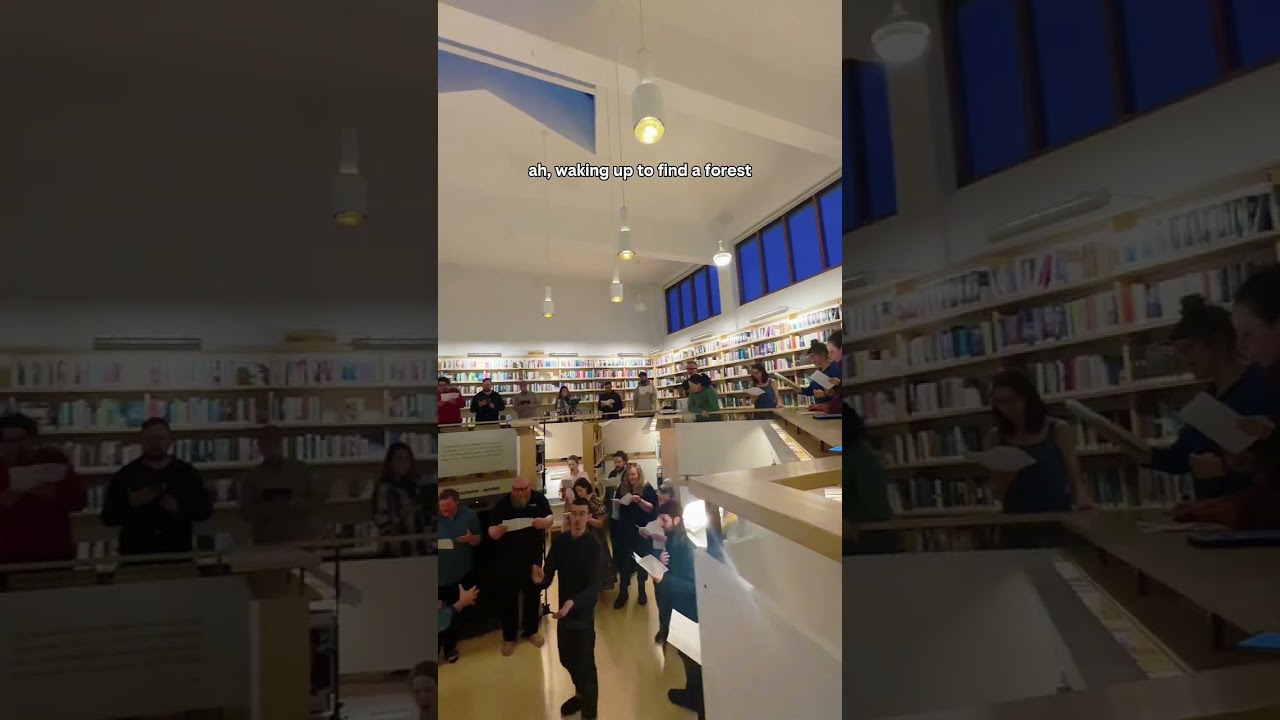
As the night sets in, the choir relocates from the auditorium to the Nordic House library, where the final rendition of A Dawning will be performed in the round, with singers circling the central well – a signature Aalto design element. Before the final take, the group reflects on how their interpretation of the song has changed throughout the day.
'It's always been really special to watch these artists actually in the receiving of other people's meanings,' Goldstein enthuses. 'Oftentimes we think of artists as offering unto the community, offering their art, their music, their performance. In these settings, that becomes a two-way street. An artist is able to really offer their artistry and also receive from people more than just, 'I love your album.' To hear what some of these words, melodies and feelings are and how they're living in people.'

The result is an extraordinary sensation of revelation. Arnalds, returning to witness the final performance following an evening of childcare duties, characterises the experience as being akin to a group therapy session, noting that his friend would have loved it. Far from a sombre memorial, the session feels more like an act of defiant, contemplative celebration.
As the notes fade, the silence that follows the immediate aftermath of the final take carries the weight of a community that has, for a few hours, helped carry the legacy of a lost friend. In the circular glow of Nordic House's library, French and Arnalds' music has taken on a new purpose.
'You come to this very simple conclusion and everybody knows it's almost cheesy to say it, but music is about bringing people together,' Arnalds concludes. 'We all know that. We didn't want to be playing for people. We wanted to be playing with people.’