Painter Hurvin Anderson’s blend of memory and history is mesmerising at Tate Britain
The artist presents his first major retrospective, in which bold and joyful works zigzag between places, memories and motifs
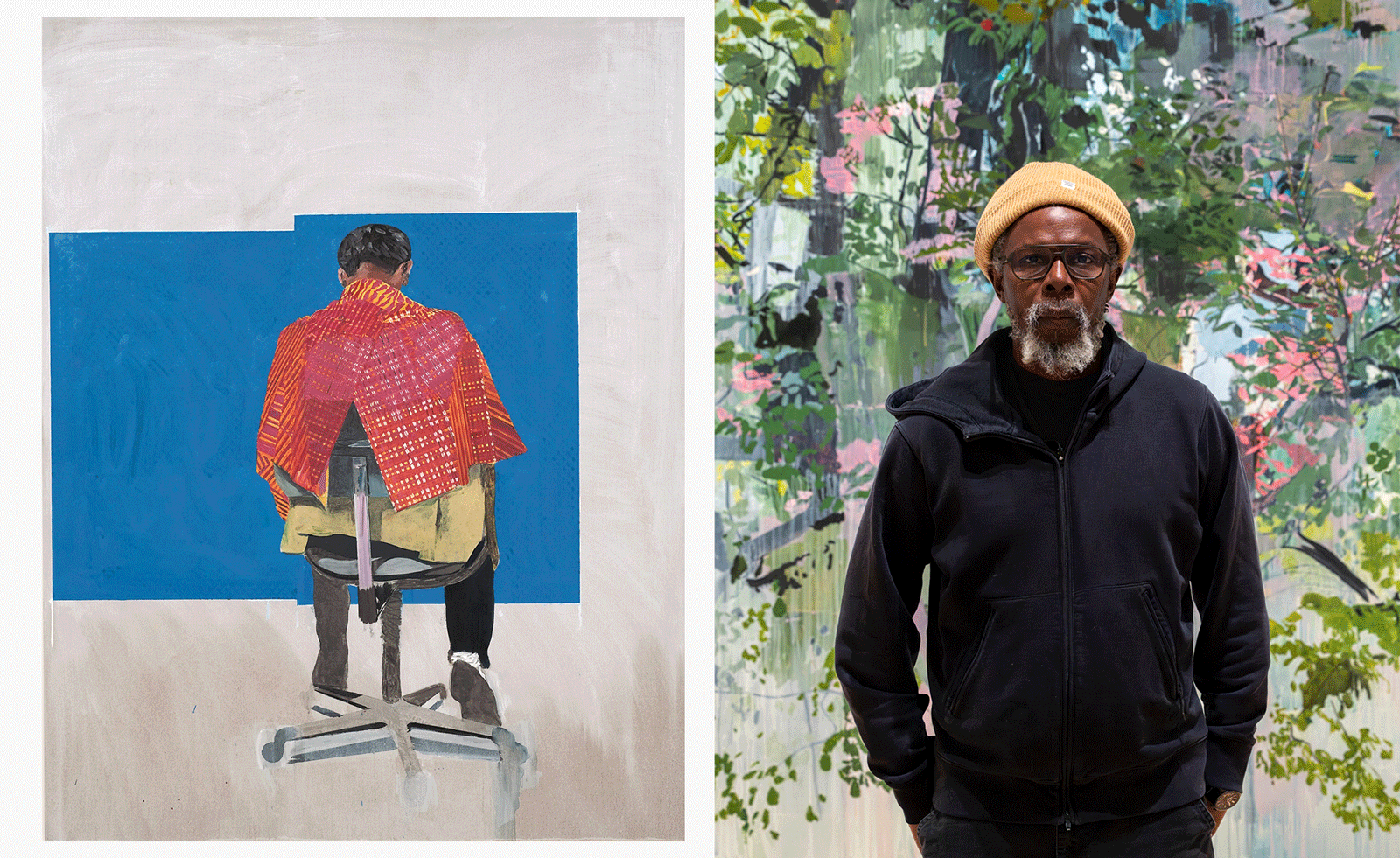
‘In a painting, you are presenting the world in front of you. I want to create something that people could enter into in some way,’ says Hurvin Anderson, speaking at the opening of his major retrospective at the Tate Britain.
The exhibition, composed of 80 works and spanning Anderson’s entire career, is long overdue. It marks the first comprehensive survey for the artist, who creates an immersive, atmospheric space in Tate Britain’s classical halls. Works, defined by bold and joyful colour, zigzag between places, memories and motifs, anchored by an almost tangible emotionality.

Hurvin Anderson, Jersey, 2008
In 1961, Anderson’s father emigrated to the UK from Jamaica, making Anderson the first member of his family to be born in England. His childhood in Birmingham, where his family settled, is interspersed here with scenes from his time spent in the Caribbean, which he first visited at age 14. Further and frequent visits, including his time as an artist-in-residence in Port of Spain, Trinidad and Tobago, in 2002, triggered a new focus on lush landscapes.
‘People use colour in a very different way in the Caribbean’
Hurvin Anderson
In the early 1990s, Anderson left Birmingham for London, to attend the Wimbledon College of Art, followed by the Royal College of Art. His early works featured images of family and friends. One of his first series spotlighted Caribbean homes in England, a juxtaposition of cultures he continues to explore.
‘The first time I visited [the Caribbean], I was shocked at just being able to run around and be free somehow, in a way I hadn’t been before,’ he says. In his series of Caribbean-based works, this freedom and joy are translated into vibrant colours, the antithesis of the muted, although beautiful, greys of his paintings that reflect on his childhood in Birmingham. ‘People use colour in a very different way in the Caribbean,’ he says.

Hurvin Anderson, Limestone Wall, 2020
Alongside this sense of freedom, Anderson is making sense of his status as an outsider. A Caribbean bar is partly obscured by a red security grille; elsewhere, Jamaican foliage is glimpsed through a beaded curtain. The physical separation becomes a web that spins throughout the complexity of belonging, a thread Anderson unpicks in works where the grille becomes the sole focus. In these works, the grille is reduced to its parts in Cubist-inspired displays that break down its form into purely geometric silhouettes.

Hurvin Anderson, Welcome: Carib, 2005. Private Collection
‘You feel a kind of energy, in the sense of when you're painting, you are painting yourself into a box in some way,' says Anderson. 'The beaded curtains became me being a bit more playful with this idea of being locked in. What can you do with these motifs? How can you break them down in some way? How can they be yours?’ By devoting canvases solely to the red, white and black grids of these paintngs, Anderson makes them his own. ‘It feels like a playful way to break this thing down, for it to become something else. It's essentially, “don't come in, brothers, beware”, but in terms of painting, you rethink it.’

Hurvin Anderson, Beaded Curtain (Red Apples), 2010
These motifs populate the work. Anderson is adept at taking symbols, places or details – barbershops, display cabinets, swimming pools – and bringing a poignancy to them. In their specificity, they trigger our own memories. There is something so familiar in the outlines of the building against the grey sky he passed every day on Livingstone Road, infused with that hazy, half-remembered quality. The unreliability of memory, and its revealing relationship with reality, fascinates Anderson.

Hurvin Anderson, Shear Cut, 2023
‘When you use a photograph, you are almost trying to relive that moment. You're trying to capture something from that moment’
Hurvin Anderson
While Anderson works from photographs most of the time, they are more of a starting point for him, rather than a direct source material for his work. ‘I have a love/hate thing with the photographs. I am probably more at ease with using them now. They are a start, and then you are taking things apart. When you use a photograph, you are almost trying to relive that moment. You're trying to capture something from that moment, or there's something in the photograph that you recognise that even the photograph doesn't have somehow, and you're trying to draw out what you think that is.’

Hurvin Anderson, Maracus III, 2004
This almost surreal distance occasionally fades into abstraction – faces in his paintings aren’t quite glimpsed in neighbourhood scenes, or bodies on the beach dissolve into abstract symbols. The feeling is remembered, rather than the details.
It is an emotion that crystallises in the last room of the exhibition, where four new works reflect on the activity of rafting, drawing from both Anderson’s memory and historical sources. Anderson cites as inspiration France-born, Jamaica-based lithographer and printer Adolphe Duperly (1801-1864), who captured rafters in a series of anthropological studies. ‘In Jamaica, you go to the tourist team and they might suggest you go rafting. He had this one photograph of a couple going rafting, and it was an interesting moment to see that kind of normality given to this tourist activity. You never think of the people of Jamaica rafting, it is more tourists. It was a reclaiming of this thing, reclaiming some kind of freedom.’
Hurvin Anderson at the Tate Britain, 26 March – 23 August 2026, tate.org.uk

Hurvin Anderson, Maracus III, 2004

Hurvin Anderson, Hollywood Boulevard, 1997