Artists’ skewing of the financial crisis takes a satirical turn at London’s ICA
A new group exhibition, ‘Genuine Fake Premium Economy’, considers the implications of the 2008 financial crisis
What effect has a fractured global economy had on our society? It is a question preoccupying three artists at London’s Institute of Contemporary Arts (ICA), who look beyond the societal collapse that accompanied the 2008 financial crisis in a multi-media exhibition, ‘Genuine Fake Premium Economy’.
For the three featured emerging artists, Jenna Bliss, Buck Ellison and Jasmine Gregory, the issue is a pertinent one. All born in the United States in the mid-1980s, each has experienced the consequences of living and working in a time of financial collapse, translating these experiences into sharply satirical works.

Jasmine Gregory, Investment Piece no. 10, 2026
‘My images do not simply reflect society; they actively reinforce a system in which identity is tied to ownership, lineage, and exclusion,’ says Jasmine Gregory, who undercuts a video installation, Deliver Us From Evil, with a Patek Philippe advertisement. ‘By unsettling [the] coherence [of the images], the work resists that model rather than reproducing it, making visible both its limits and the lives that exist beyond its frame.’
In her Investment Pieces series, Gregory repaints Patek Philippe advertisements, which advise owners to ‘look after their watches for the next generation’, in a hazy grey, shifting the focus away from the watches and onto the father and son.
‘The Patek Philippe advertisements function less as aspirational images than as mirrors of the social order that produces them,’ she adds. ‘They condense and aestheticise the core values of capitalism, such as inheritance, continuity, exclusivity, and ownership. into intimate familial scenes. By repeatedly staging the transfer of a watch between father and son, the ads naturalise the idea that value, like wealth, should pass seamlessly along predetermined lines, obscuring the structural inequalities that make such continuity possible in the first place.’

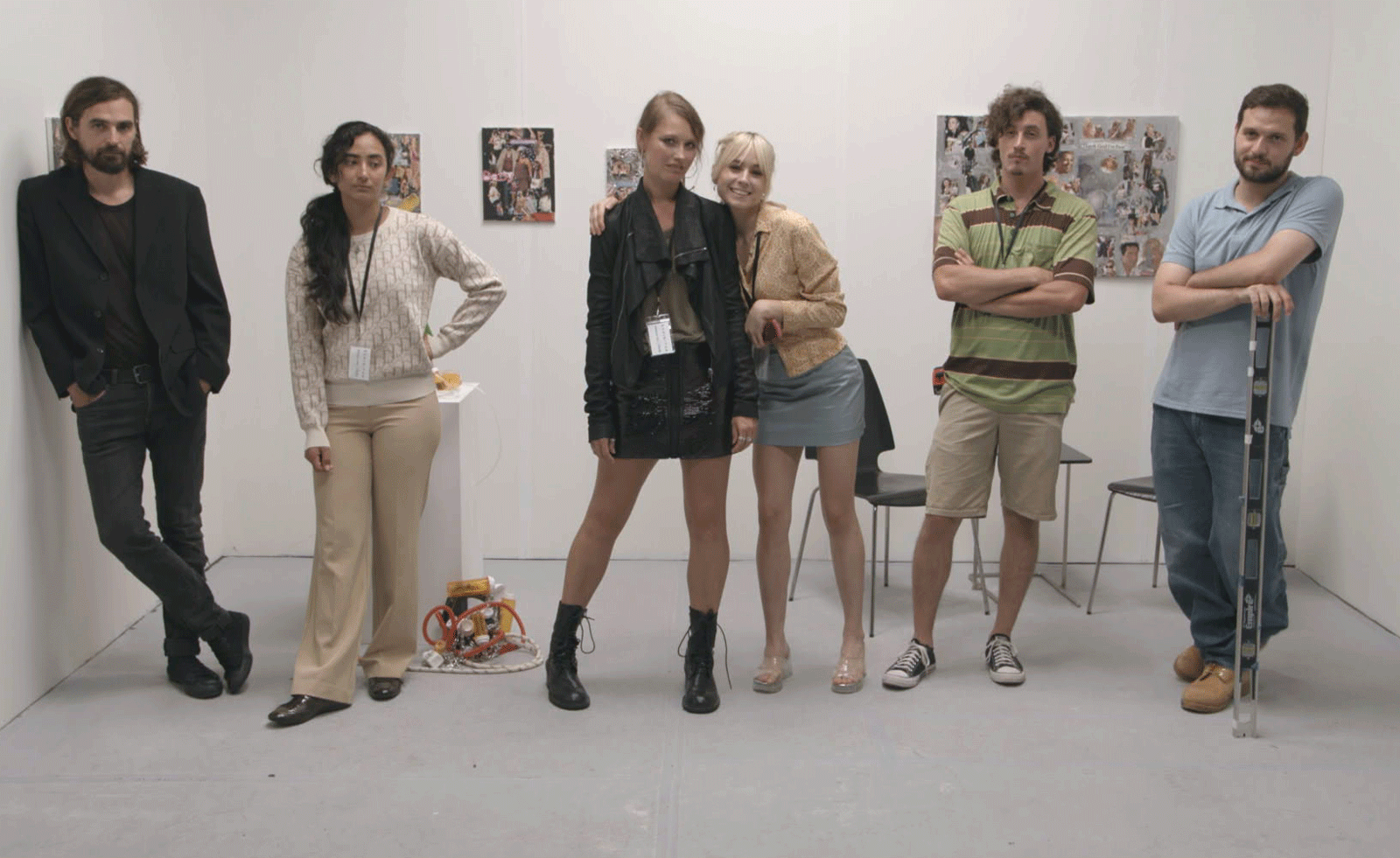
Jenna Bliss, True Entertainment, 2023, film still
For Jenna Bliss, this inequality takes shape in the art world. In her film, True Entertainment, set within a fictional art fair, an episodic narrative presents snappy soundbites that strip back art world stereotypes, revealing the instability underneath.
‘There wasn’t really an artistic intervention on my part, but rather a borrowing of a mass media form that was already exploring the interplay of fact and fiction,’ Bliss says. ‘It has a sitcom structure and lacks the confessional-type interviews we often see in reality TV, but the non-actors are playing themselves. In the finale of [reality TV series] The Hills, the camera pulls out to reveal a sound stage and the couple that just “broke up” approach one another again and hug, ostensibly answering the question viewers are always asking, with “no, it is not real”. But there is something hyper-real about reality TV.
‘There may be a relationship here to finance, especially with derivatives trading like we saw leading up to the [2008] crash. Derivatives deal in abstractions, but people lost their real homes as a result.’

Buck Ellison, Science, 2026
It is a hyper-reality also considered by Buck Ellison, whose walnut-framed lightboxes advertise a fictional private bank. In his works, corporate speak becomes confused with theoretical philosophies, with [Scottish economist and philosopher] Adam Smith’s teachings manipulated into supporting the growth of personal wealth. ‘My goal with these works was not to copy appearances from a distance, but to adopt a system’s language, aesthetics, and strategies to examine how it operates from within,’ he says.
In creating the distinctive aesthetic, Ellison cites research that shows that banks prefer the colour navy, creating distance over warmth. ‘It is fitting for institutions that manage risk. They pair serif and sans serif typefaces to balance heritage and neutrality. For [imagined private bank] Orlo & Co, I chose Baskerville, widely used around the bank’s fictional incorporation date (1798), to evoke continuity and elegance, and Helvetica, designed in 1957 in Switzerland, to signal neutrality and institutional anonymity. I also crafted taglines that blend and recontextualise adages, and layered them over images of historical paintings – a strategy I observed in private banking materials, where art itself helps manufacture trust and legitimacy.’
'Genuine Fake Premium Economy’ from 1 May – 5 July at ICA London, ica.art

Buck Ellison, Jack’s Office (detail), 2026