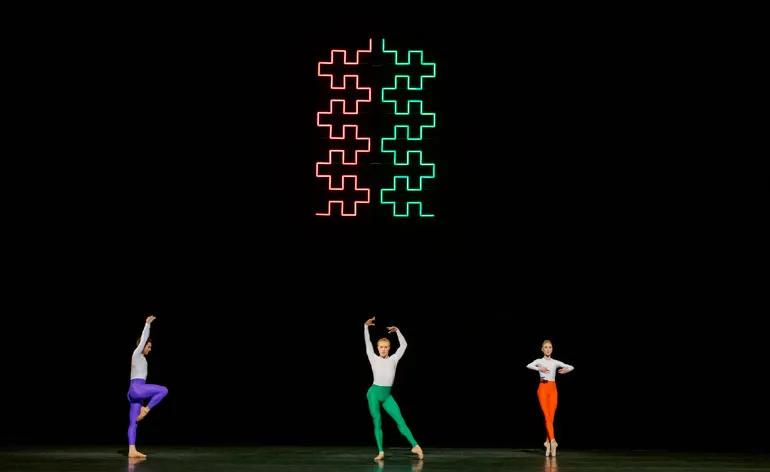
Choreographer Wayne McGregor has long drawn strength from the creative partnerships he forges outside the sphere of dance, with former collaborators numbering architect John Pawson and artist Julian Opie. For his new production at the Royal Opera House in London, ‘Tetractys – The Art of Fugue’, based on Johann Sebastian Bach’s final musical work, he turned to American artist Tauba Auerbach to create the striking set and costume designs.
Best known for her paintings, the New York-based artist – and Wallpaper* Handmade collaborator – has long been fascinated by the principles of mathematics, physics, language and semiotics. Having formally trained as a traditional sign painter, Auerbach devised a series of illuminated geometric glyphs for McGregor’s latest production, her first ever foray into ballet.
‘Designing the sets and costumes for Tetractys was a steep learning curve - I’m used to making sculptures that you can walk around and see from every angle,’ says Auerbach. ‘Here I needed to create a 3-D work that was still compelling from every angle, but that would be visible from only one angle for each person in the audience. Each person’s vantage point would be different but equally important.’
Using numerology and geometry as the springboard for their creative venture, McGregor and Auerbach were mutually drawn to Bach’s The Art of Fugue (it is rumoured that the German composer infused the score with musical codes, such as weaving his name into the final stanza, just before its strange and abrupt ending). The ballet is divided into seven sections, each featuring one of Auerbach’s glyphs, which are infused with their own symbolism and codes.
Composer Michael Berkeley’s orchestral adaptation of the score was equally influential on Auerbach’s designs. ‘I have a habit of thinking about things in a very graphic and linear way and the insight I got from his arrangement was the way he dealt with the music as a set of swelling volumes,’ explains the artist. ‘I wanted to incorporate that way of reading the music into visuals as well.’ To wit, Auerbach complements the fluid musical arrangement with colour gradation in the costumes, reflected also in the ever-changing patterns of her glyphs.
Supported by Outset, ‘Tectractys – The Art of Fugue’ is being shown as part of a triple bill at the Royal Opera House, alongside Frederick Ashton’s classically romantic ‘Rhapsody’ and Kenneth MacMillan’s harrowing ‘Gloria’, a poignant tribute to the generation lost in World War I. Elsewhere in London, Auerbach will celebrate her first UK solo museum show (opening 15 April at the ICA) with a new series of photographs and sculptures inspired by symmetry and reflection.

Having formally trained as a traditional sign painter, Auerbach responded to the geometry she heard in Bach's score with a striking series of illuminated glyphs. © ROH / Johan Persson, 2014

Echoing the musical score is a highly conceptual and considered geometric scheme designed by the artist. The 'subject glyph' (far left) forms the basis to the series; Auerbach responded to the structure of the music, scaling, inverting and expanding it to the form the other glyphs. © ROH / Johan Persson, 2014

The ballet is divided into seven sections, each featuring one of Auerbach’s glyphs, which respond to the music. © ROH / Johan Persson, 2014

One of Auerbach's bold costume designs. © ROH / Johan Persson, 2014

Auerbach complements the fluid musical arrangement with subtle colour gradations in the costumes. © ROH / Johan Persson, 2014

Choreographer Wayne McGregor has a long and memorable history of creative partnerships. His 2006 production for the Royal Ballet, 'Chroma', featured a stark, minimalist set by architect John Pawson. Photography: Bill Cooper / ROH

'Chroma', 2006, with set design by John Pawson. Photography: Bill Cooper / ROH

In 2008, he teamed up with artist Julian Opie for 'Infra', 2008, also for the Royal Ballet. Photography: Bill Cooper / ROH

McGregor has collaborated several times with interactive designers Random International. For his 2010 production of Far at Sadler's Wells, the UK-based practice devised a giant, pulsating screen of light with an ever-changing pattern. Photography: Ravi Deepres

Far, 2010, with set design by Random International. Photography: Ravi Deepres

Far, 2010, with set design by Random International. Photography: Ravi Deepres

McGregor teamed up with Random International again in 2012, creating a performance based around its 'Future Self' installation at Berlin's MADE Gallery. Courtesy of Random International

'Future Self', 2012, with set design by Random International. Courtesy of Random International

'Future Self', 2012, with set design by Random International. Courtesy of Random International

Dancers from Wayne McGregor | Random Dance inhabited Random International's 'Rain Room' installation, 2012, in the Barbican's Curve gallery, performing continuously evolving interventions, with a score by contemporary composer Max Richter. Photography: Sidd Khajuria

'Rain Room' by Random International, with interventions by Wayne McGregor | Random Dance, at the Barbican, London, 2012. Photography: Sidd Khajuria

'Rain Room' by Random International, with interventions by Wayne McGregor | Random Dance, at the Barbican, London, 2012. Photography: Sidd Khajuria

'Azimuth', 2013, saw Wayne McGregor | Random Dance choreograph a performance to correspond with Conrad Shawcross’ 'Timepiece' installation at Roundhouse in London. Photography: Ravi Deepres and Alicia Clarke

'Atomos', 2013, is McGregor’s production with his company, Wayne McGregor | Random Dance, with video by Ravi Deepres and costumes by innovative designers-cum-technologists Studio XO. Watch the collaborative process between McGregor and Studio XO unfold in this film. Photography: Ravi Deepres

'Atomos', 2013, with video by Ravi Deepres and costumes by Studio XO. Photography: Ravi Deepres

'Atomos', 2013, with video by Ravi Deepres and costumes by Studio XO. Photography: Ravi Deepres
ADDRESS
Royal Opera House
Bow Street
Covent Garden
London WC2E 9DD4