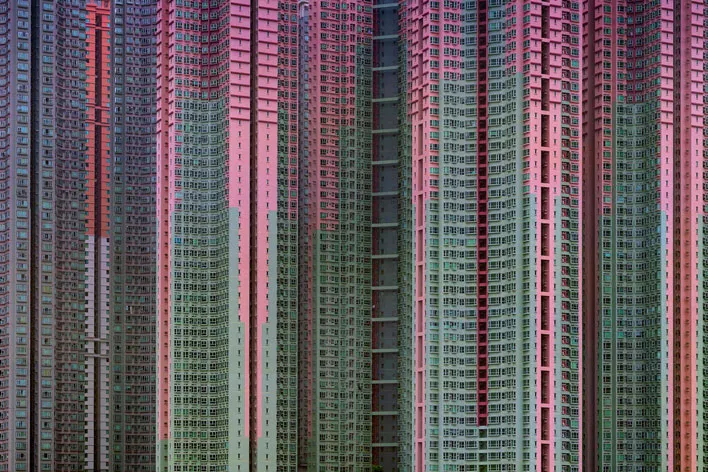
When Michael Wolf's photographs first emerged in the 1990s they predated any online fascination with large scale photography and other-worldly architecture. Depicting the dense urban structure of Hong Kong - where Wolf went to live in 1994 - the 'Architecture of Density' series, currently on show at London's Flowers Gallery, veers between the inhuman size and monolithic repetition of the city's apartment complexes and the intimate details of the lives lived within them.
We've become rather blasé about high-rise culture, but in the past three decades Hong Kong has consolidated its status as one of the densest - and dearest - urban centres on the planet. Wolf's project began with a strict focus on the relentless uniformity of the city's façades, their monotony barely alleviated by splashes of colour and only humanised through the initially imperceptible details - an open window, a string of washing.
At the same time, his camera captures the inevitable chaos that emerges from the order - the random installation of essential air conditioning units, for example. These are paired with smaller images of the everyday, be they shrines, street-side store cupboards or simply the evidence of daily life carrying on in between the seams.

Wolf's large-scale photographs depict the city's dense urban structure, veering between the inhuman size and monolithic repetition of the city's apartment complexes and the intimate details of the lives lived within them

Like with 'Architecture of Density #119', the images hone in on the relentless uniformity of the city's façades.

At the same time, Wolf's camera captures the inevitable chaos that emerges from the order, like the random streetside assemblage in 'My Favourite Thing #75'.

These are paired with smaller images of the everyday, be they shrines, street-side store cupboards, decaying taxis or simply the evidence of daily life carrying on in between the seams. Pictured is 'My Favourite Thing #90'.

'Architecture of Density Scout #61'

'Industrial #1'

In 'Architecture of Density #75', the building's monotony is alleviated by splashes of colour.

Installation view of the 'Architecture of Density' exhibition

'My Favourite Thing #06'

'My Favourite Thing #21'

In the past three decades Hong Kong has consolidated its status as one of the densest - and most expensive - urban centres on the planet. 'Architecture of Density Scout #36', shows a barely recognisable complex under construction.

The apartments in 'Architecture of Density Scout #22' are only humanised through the initially imperceptible details, such as an open window or a string of washing.

'My Favourite Thing #08'

'Small God Big City #115'

'Architecture of Density #13b'.
ADDRESS
Flowers Gallery
21 Cork Street
London W1S 3LZ