Smiljan Radic’s 2014 Serpentine Gallery Pavilion is unveiled in London’s Kensington Gardens

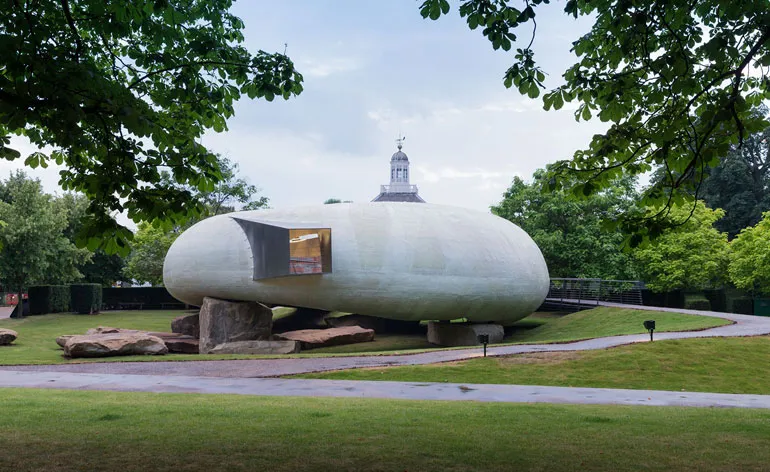
A shimmering, shell-like volume resting on rocks has arrived in London's Kensington Gardens, courtesy of the Serpentine Gallery. Designed by Chilean architect Smiljan Radic, it is the 14th Serpentine Pavilion in the esteemed gallery's series of summer commissions from leading architects for the capital.

See past Serpentine Gallery Pavilions
Recalling a modern-day Neolithic Dolmen, Radic's Pavilion comprises a translucent structure, made from glass-reinforced plastic, moulded in a ring shape that sits on quarry stones. The pavilion sits lightly on its firm base, offering shelter from the elements to the park's visitors, while its translucent material filters soft light through to the main multi-purpose, timber-floored area.
'I am not a creator of new shapes', said Radic, when we spoke to him earlier in the year about his design approach (see our latest issue, W*183, for the full article). 'I always want to begin from a project that I thought about or saw before, or existing sketches, or architectural history, but I never start with a white page. I always use references.' And so he did with this project, drawing from an earlier work entitled The Castle of the Selfish Giant (in turn inspired by Oscar Wilde's famous story), which also takes a shell-like form.
For the Serpentine commission, Radic also intended to play with the idea of the folly. 'It has been used historically in big gardens and parks, always proposing something extravagant, an atmosphere of other places,' he says. 'This is a fake ruin but at the same time proposes a continuity. […] It helps dissolve the limits between architecture and nature.'
Partly prefabricated in the York workshop of engineers Stage One (the stones also come from a nearby quarry), the pavilion was assembled on site in London earlier in the month. The engineering and technical feat was achieved with the help of AECOM, overseen by David Glover, who has worked on the pavilions since 2000. 'The design process in our day is so prolonged and this is instantaneous. It's the challenge [that attracts me to the pavilions],' says Glover. Adds Radic: 'It looks almost handmade, which sounds easy, but it was in fact really difficult to achieve.'
The Pavilion, including a café, resting and meeting area, opens to the public on 26 June and will also host the Serpentine's Park Nights series - eight site-specific events on art, poetry, music, film, literature and theory - over the summer season.

Opening to the public this Thursday, the pavilion treads lightly on its firm base, offering shelter from the elements to the park's visitors. Photography: Iwan Baan

Its translucent material filters soft light through to the main multi-purpose, timber-floored area. Photography: John Offenbach

A strip of light snakes its way through the structure, illuminating the interior at night. Photography: John Offenbach

The glass-reinforced plastic shell was cast at the North Yorkshire workshop of engineering firm Stage One. Photography: Leon Chew

Radic played with the idea of the folly for this commission. 'It has been used historically in big gardens and parks, always proposing something extravagant, an atmosphere of other places,' he says. 'This is a fake ruin but at the same time proposes a continuity. […] It helps dissolve the limits between architecture and nature.' Photography: John Offenbach

The Pavilion, including a café, resting and meeting area, will host the Serpentine's Park Nights series - eight site-specific events on art, poetry, music, film, literature and theory - over the summer season. Photography: John Offenbach
