...
Armani
By far the best example of a family man who has kept an iron grip on his private empire is Giorgio Armani. Since launching his cutting-edge menswear in 1975, he's created a €1.8bn-a-year business empire that has attracted schools of corporate sharks, none of whom have been able to get their teeth into the business. Currently flanked by two nieces and a nephew, Armani is elegantly side-stepping the question of whom to pass the baton to.
Giorgio Armani (second from right), 78, CEO, managing director of Giorgio Armani
Rosanna Armani (left), 73, sister, former art director of Giorgio Armani and creative director of Emporio Magazine
Silvana Armani (centre), 57, niece, women's design director
Roberta Armani (right), 42, niece, head of entertainment industry relationships worldwide
Andrea Camerana (second from left), 42, nephew, director of Giorgio Armani
Wallpaper*: Would you like to leave the company in the hands of your family?
Giorgio Armani: I'm considering the possibility of a foundation. I can say that as long as I am here, I am the boss.
W*: Yours is one of very few global luxury brands still privately owned. Was it hard to expand without outside investment?
GA: It has never occurred to me to make investments with money that wasn't mine. Each new step has always been carefully explored and the company's solidity has always been backed by our solvency. This gives us an enormous advantage. We can make choices that are not conditioned by outside factors. The fact that my group's net liquidity is once again so high proves that I have made the right choices.
W*: How did you avoid selling to bigger companies in the 1980s and 1990s?
GA: I believe independence is the only way to expand organically. The 1980s and 1990s were crucial for me; my company was shaped distinctly in those years. Selling then would have been unnatural to the whole growth process. I am glad I didn't succumb to outside pressures and offers, of which there were many.
W*: What is so special about the Italian family business model?
GA: Strength and a focus on the future.
W*: What are the challenges moving from the first to second generation?
GA: It's delicate and crucial. I have family members on the board and they also work in the press office and design department. They submit management ideas as well.
W*: How did you develop their roles?
GA: Each one of them joined the company in a very organic way, based on their qualities, inclinations and character. I feel they've acquired excellent experience on the job, which is the only way to learn.
But what is it like be part of Mr Armani's family, yet also an employee? We turned to his nephew and nieces to find out more...
W*: What have you learned most from Mr. Armani?
Andrea Camerana: That one can't speak of strategy without being aware of the importance of details, even the apparently most insignificant ones. Which is also why certain 'experts', who are especially skilled at what they do because they have a profound understanding of their craft, deserve a lot of respect.
Roberta Armani: I have always admired my uncle: his vision, his determination, his attention to detail, his sense of beauty and elegance. I feel that they are qualities of mine as well because these are the values I grew up with. I learned to love hard work from my uncle. I also learned about self-criticism, and being meticulously careful about details, subtleties and nuances, as well as the importance of staying grounded.
Silvana Armani: I have learned never be satisfied!
W*: What is the best part of working with one's family?
Andrea Camerana: Probably, some minor logistical privileges. As well as the feeling that I am working for my future, ultimately investing in it, while I'm doing my daily job.
Roberta Armani: Ever since I can remember our working relationship - both with my uncle and other family members - it has always been based on utter clarity and professional attitude. The advantage of working with one's family is that strong sense of belonging and responsibility, which are also very stimulating.
Silvana Armani: Well, working with family, I obviously feel very much at home...
W*: Are there any difficult aspects to it?
Andrea Camerana: As 'just an employee' I would probably question myself less before taking a course of action and I would probably make myself heard more without the fear of coming across as an arrogant person.
Roberta Armani: Working with family can be complicated if boundaries are not clearly defined. It is crucial to separate family relationships from one's working relationships. On the job, of course I am still a niece or a sister, but I am above all an employee.
W*: Did you always imagine working at Giorgio Armani?
Andrea Camerana: No, I didn't - it all just sort of happened at the beginning of the 2000s, when I joined the Group as it was going through a transitional period.
Silvana Armani: I started working for him when I was 20, as a model, and I certainly would never have imagined then that I'd still be here now, but it's what I enjoy doing. I love it. It's my job.
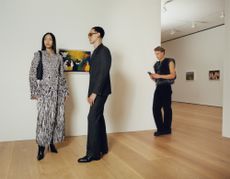
The Armani family are pictured at Giorgio's home in Milan
Photography: Jonathan de Villiers
From the Armani archives:
Giorgio Armani (left) and Sergio Galeotti (right) founded Giorgio Armani on 24 July 1975
From the Armani archives:
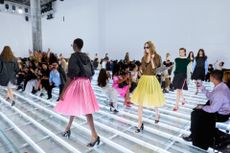
A fashion show and advertising campaign from the 1980s, shot by Aldo Fallai
From the Armani archives:
An advertising campaign for the A/W 1993 collection, shot by Peter Lindbergh
From the Armani archives:
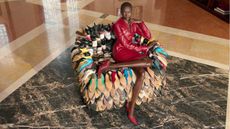
The fashion brand launched the Armani/Casa furniture and homeware collection in 2000. Pictured is the 'Balloon' armchair
From the Armani archives:
The first Armani hotel opened in 2010 in the Burj Khalifa tower in Dubai (left). It was swiftly followed by a hotel on Milan's via Manzoni (right)
B&B Italia
If there’s one company that knows first-hand the perks and perils of looking outside the family circle for investment and growth opportunities, it’s B&B Italia, which sold a majority stake to private equity fund Opera in 2003 only to buy
it back eight years later. Founded in 1966 as C&B by Cesare Cassina and Pier Ambrogio Busnelli, B&B quickly became the gold standard for sleek Italian furniture, and now boasts €158m in revenue, seven giant flagship stores and 23 mono-brand shops worldwide.
Giorgio Busnelli (left), 60, son of founder
Pier Ambrogio Busnelli, president
Emanuele Busnelli (not pictured), 48, son of founder, CEO, responsible for contract
Massimiliano Busnelli (centre), 34, son of Giorgio, architect in research and development centre
Francesca Busnelli (right), 30, daughter of Giorgio, marketing manager
Wallpaper*: What was the rationale behind selling to Opera?
Giorgio Busnelli: The desire to take the company public. We’d opened very important flagship stores in 2001 and
the family money wasn’t enough.
W*: Knowing what you know now, would you have sold a piece of the company?
GB: No. We would have gone public ourselves. Funds have no understanding of our market or business. I think that private equity can only be useful in a short-term situation.
W*: But isn’t going public going to have the same short-term pressures?
GB: If the majority of interest is inside
the company, rather than an investor
who wants to dump quickly, then no.
W*: Can you manage to grow without going public?
GB: In our sector, you need to ask why more companies aren’t public. Our €160m revenue is peanuts compared to most companies. It means there’s a problem of growth. When someone buys one of our sofas, they plan to have it their whole life. It’s a finite market. We make
a product that is timeless. If we’re good, our product lasts 20 years.
W*: What about new markets?
GB: China is now 30 per cent of the big fashion brands’ market, but we do less in China than we do in Switzerland. There’s a different culture. Design will arrive slowly, once they start coming to the hotels and see our superior products.
The Busnelli family are pictured at the Renzo Piano-designed B&B Italia HQ near Milan
Photography: Jonathan de Villiers
From the B&B Italia archives:
A 1969 advertisement for the 'Up Series' seating collection, designed by Gaetano Pesce. At this stage the company was still known as C&B Italia
Art direction: Enrico Trabacchi. Photography: Klaus Zaugg
From the B&B Italia archives:
A 1972 advertisement for 'Le Bambole' seating collection, designed by Mario Bellini. The collection won the Compasso D'Oro prize in 1979
Art direction: Enrico Trabacchi. Photography: Oliviero Toscani
From the B&B Italia archives:
A 1986/7 campaign for the 'Sity' system, designed by Antonio Citterio. It won the Compasso D'Oro prize in 1987.
Agency: STZ. Art direction: Fritz Tschirren. Photography: Jean Pierre Maurer
From the B&B Italia archives:
'Charles' sofas system, designed by Antonio Citterio, 1997. This product is still a B&B Italia best seller. It is characterised by its feet in the shape of inverted 'L', made of cast polished aluminium. The structure consists of steel frame and flexible polyurethane foam and can be upholstered in fabric or leather
From the B&B Italia archives:
'Grande Papilio' chair, designed by Naoto Fukasawa in 2009
From the B&B Italia archives:
'Bend Sofa', designed Patricia Urquiola in 2010
De Padova
Maddalena and Fernando de Padova rocked 1950s Milan with the outré Scandinavian design they sold at their via Montenapoleone shop. But the couple became true pioneers when they founded ICF, a production and distribution company that brought Herman Miller and Dieter Rams to Italy for the first time. Cultivation of star design talent, from Vico Magistretti to Ingo Maurer, for the company’s signature collection was a speciality of Maddalena’s, who retired four years ago. Management is now in the hands of her son Luca, who has set his sights beyond the brand’s single beautiful flagship store in Corso Venezia.
Maddalena de Padova (right), 84,
mother, founder
Luca de Padova (left), 59, son, CEO
Wallpaper*: What did you learn most from your mother?
Luca de Padova: To always fight, to bring things forward and to make the work move. She had a strategic vision: let’s
go for Scandinavia; let’s be a design company, not a distributor; let’s produce. It was very innovative.
W*: How have you managed to take over the reins of a company so connected with the personality of your mother?
LdP: It’s not easy. There’s not a culture of preparing for this succession of the second generation. You learn on the job. I started getting involved because I was forced to, but I saw how much my parents put into the company. I started my own furniture company in the 1990s which helped a lot. The idea now is to focus on comprehensive management, not just a structure built around my mother. Now we have a creative director, Apartamento editor in chief Marco Velardi.
W*: How will you expand without major outside investments?
LdP: It’s hard to tap into growth potential without big money, but we’re going forward. We’ve opened many markets without huge investment. We’re respected. People know us, our quality, our style.
We have huge expansion potential to tap into. The awareness of De Padova is much bigger than our actual production.
The family are pictured at Maddalena's home in Milan
Photography: Jonathan de Villiers
From the De Padova archives:
The first De Padova showroom on via Montenapoleone in Milan opened in the 1950s
From the De Padova archives:
In the 1960s, De Padova founded ICF, a production and distribution company that brought Herman Miller and Dieter Rams to Italy for the first time. Pictured is the ICF factory in Vimodrone, near Milan
From the De Padova archives:
A collection of furniture produced by ICF in the 1970s
From the De Padova archives:
In the 1980s, De Padova ceded the ICF brand with the license to make Herman Miller products, and launched a line of furniture and objects under the De Padova trademark. 'Edizioni De Padova' was founded, which would later become 'è De Padova', with the collaboration of leading designers like Achille Castiglioni and Dieter Rams, and above all Vico Magistretti
From the De Padova archives:
Vico Magistretti creations for the è De Padova collection in the 1990s
From the De Padova archives:
Maddalena De Padova won the Compasso d'Oro in 2004 for achievements in the design industry
From the De Padova archives:
The 2012 De Padova advertising campaign, showing a 1989 chair by Vico Magistretti and the new Pilotis sofa by Philippe Nigro, presented at this year's Salone del Mobile
Etro
Founded in 1968 by Gimmo Etro as a high-end producer of richly decorated textiles, the Etro brand quickly expanded into finished products, including men and womenswear and a home collection, thanks to the swift involvement and creative imprint of his four children. Diversification began in the mid-1980s with leather goods and home accessories, and now full fashion collections featuring the brand’s riotous prints and exotic paisleys of impeccable quality are sold in more than 210 directly operated stores.
Gimmo Etro (right), 70, father, president
Jacopo Etro (second from left), 49, son, director of home and textiles
Kean Etro (centre), 47, son, creative director
of menswear
Ippolito Etro (left), 45, son, CFO/COO
Veronica Etro (second from right), 38, daughter, creative director of womenswear
Wallpaper*: What was your first job working at Etro?
Veronica Etro: I had a place at London’s Royal College of Art to do a Masters, but
I realised fashion is not like medicine where you need to study for seven years. Kean was doing all the collections and wanted me to come back. We did the first fashion show in 1997, my first year, so
I saw how everything developed.
W*: What’s it like working with family?
Kean Etro: It has always been a friendly, simple and straightforward working environment. You could do what you want, but it had to work. I found it comfortable but challenging. Our differences make the company richer. It’s like in a marriage: one’s a good cook and one’s a good eater.
W*: How do you successfully pass a company on to the next generation?
KE: Papa started textiles and we joined the company immediately after, almost as if we were the first generation. He’s only 21 years older than Jacopo. He said let’s start [the expansion] together.
W*: How have you handled the pressures of globalisation while staying private?
KE: This was the big question 15 years ago when everyone was buying companies and merging. It was tougher then; it seemed like the future. Then the future arrived and 60 per cent of those companies were not making money. Many are still not. Companies are so much about blood, intensity, human objectives, striving, passion and ideas.
W*: Will family-run companies always exist in Italy?
KE: Italians are rooted in a personal approach, even in the way we eat. With everything going global, it’s not easy to keep this local attitude. Family companies might collapse when you no longer find
a great risotto Milanese on the table.
The family are pictured at the Etro fabric archive in Milan
Photography: Jonathan de Villiers
From the Etro archives:
Etro pret à porter and haute couture fabrics from 1968: the year it all began. Today the silk, cashmere, linen and cotton fabrics preserve this traditional flavour, but now come in host of daring colours and innovative combinations
From the Etro archives:
In 1977, Etro's Art Nouveau-style building on via Spartaco underwent refurbishment, doubling the work and design areas. The Etro library acquired rare books on textile art
From the Etro archives:
In 1989, Etro introduced a collection of exclusive perfumes, produced using traditional techniques
From the Etro archives:
The brand's first American flagship store opened in 1996 on 720 Madison Avenue, New York
From the Etro archives:
Etro opened a new store on London's Old Bond Street in 2011
Poliform
In an exemplary case of blood-relation fairness, cousins Giovanni Anzani, and Aldo and Alberto Spinelli all currently share the title of CEO at Poliform, while the top position of president is rotated among them every three years. The furniture company, founded by all three cousins’ parents in 1942, is now into its third generation, boasting ten full-time family employees. With some of the best closet systems and beds in the business, Poliform is now sold in 76 countries, operates 65 mono-brand stores and has
an annual turnover of €115m.
Alberto Spinelli (left), 66, cousin, CEO
Aldo Spinelli (fourth from left), 64, cousin, CEO
Giovanni Anzani (centre), 62, cousin, CEO
Roberto Spinelli (third from left), 36, son of Aldo, managing director of Varenna
Luca Spinelli (not pictured), 38, son of Alberto, vice-president Poliform Contract
Marco Spinelli (second from right), 28, son of Aldo,
corporate manager
Simona Spinelli (third from right), 35, daughter of Aldo, style department manager
Laura Anzani (second from left), 32, daughter of Giovanni, corporate manager
Marta Anzani (right), 28, daughter of Giovanni, corporate manager
Gaia Spinelli (fourth from right), 25, daughter of Alberto, export area manager
Wallpaper*: What made you decide on a system of three co-CEOs?
Alberto Spinelli: It happened because we are all about the same age and joined the company at the same time. Usually the boss is the oldest, but we were all young.
W*: How do you avoid clashes with three people required to approve decisions?
AS: We’ve never overlapped. We have great respect for and trust in each other.
W*: How have you managed to grow while still staying private?
AS: This has been a huge task. Every cent that we invest in new markets is our own money. We’ve had many offers from funds. We’ve always said no. Our third generation is here now and we think we have a future together, unified. It would never be done with as much passion
by outsiders. As long as the ownership
is in the family, decisions are so quick.
We never have to go to a board.
W*: Do you think family-run companies will continue to be important in Italy 50 or 100 years from now?
AS: It’s a good question. They developed after the Second World War when there was a huge desire to do things. Everything had to be rebuilt. Our parents worked
so hard to get the results. Now the Asians are much more aggressive than us.
We are no longer hungry. They are very hungry, so it will be harder for Italians.
The family are pictured at Alberto Spinelli's home in Inverigo, Como
Photography: Jonathan de Villiers
From the Poliform archives:
Designed in 1970 by Franco Guanziroli, the 'Tilt' kitchen collection comprises modular elements that can be assembled to give different heights and rational use of space
From the Poliform archives:
The 'Morgana' bed
, designed Paolo Piva, 1983
From the Poliform archives:
'Senzafine' wardrobe by Poliform, 1990
From the Poliform archives:
'BB' Chair by Riccardo Blumer and Matteo Borghi, 2008
From the Poliform archives:
'Metropolitan' sofa, designed by Jean Marie Massaud, 2010
Ferragamo
With six children and 23 grandchildren descended from its namesake founder, Salvatore Ferragamo boasts the biggest Italian family company bloodline. A brood this big, even if effectively overseen by Salvatore’s still sprightly, 90-year-old widow Wanda, posed complexities for a brand that had swelled from shoemaking to a full luxury company with revenues of €986m in 2011. The family set up a strict list of entry requirements in the 1990s for its third generation and finally, last year, decided to float 25 per cent on the stock exchange, a move that knocks out tricky inheritance issues, but still keeps family members in active management roles.
Wanda Ferragamo Miletti (centre), 90, mother, honorary chairwoman
Ferruccio Ferragamo (left), 67, son, chairman
Giovanna Gentile Ferragamo (right), 69, daughter, deputy chairwoman
Massimo Ferragamo (not pictured), 55, son, chairman of Ferragamo USA
Fulvia Visconti Ferragamo (not pictured), 62, daughter, vice president
of Ferragamo Finanziaria
Leonardo Ferragamo (not pictured), 59, son, CEO of Palazzo Feroni Finanziaria
James Ferragamo (second from right), 40, grandson, women’s leather product director
Angelica Visconti (second from left), 38, granddaugher, director of retail for Italy
Wallpaper*: What made you decide to take the company public?
Ferruccio Ferragamo: Because we love the company. Family companies are fantastic, essential for any business to grow to a certain level. But then things change. Succession needs to be thought about. Having a public company helps it maintain its health. We’ve found the right mixture of family involvement that looks to the long term and management that is focused on the short-term results.
W*: Do you think family-run companies have a future in Italy?
FF: I hope so, although it’s not a given that it’s a winning formula. When people don’t get along it’s a disaster, but when it works, it adds tremendous energy. Our father left us a company that was a well-known name in women’s shoes only. The second generation made it was it is today.
Wanda Ferragamo Miletti: If they maintain their values, family companies can continue. It’s important that our children are not spoiled. They know they can’t have swollen heads.
W*: What rules apply to third-generation family members?
James Ferragamo: The most important thing is knowing how to work with a boss. In a family business, it’s important you can do the job better than anyone else, otherwise you’re hurting the company.
The family are pictured at Palazzo Ferragamo in Florence
Photography: Jonathan de Villiers
From the Ferragamo archives:
A women's Court shoe by Salvatore Ferragamo (patent no. 6937), from November 1929. The pattern echoes Avant-garde art, such as the geometric work of Sonia Delaunay
From the Archivio Centrale dello Stato, Rome
From the Ferragamo archives:
When the Villa dei Misteri in Pompeii was discovered, it inspired a new wave of contemporary art and graphics. Ferragamo created a line of shoes called 'Pompeian', including the 'Coturno' sandal, which was laced at the ankle like a Roman sandal and hence evoked the classical world. It became the preferred image on the shoemaker's early advertising material, realised by the futurist painter Lucio Venna. This image is from 1930
From the Ferragamo archives:
The 'Invisible' sandal from 1947, featuring nylon fishing thread and a wooden wedge heel covered in calf leather, won Ferragamo the Neiman Marcus Fashion Award - the Oscar of the fashion world - in 1947
From the Ferragamo archives:
This brown crocodile and beige suede high heel pump was created for Marilyn Monroe in 1959. It was Munroe who made the designer's five-inch-heel pumps famous, shoes that forced her to wiggle her hips as she walked, so seductively and in a manner that was all her own, unlike anyone else
From the Ferragamo archives:
This Moccassin, in pink satin and decorated with beads and strass, was created for Salvatore Ferragamo's eldest daughter Fiamma in 1967. Fiamma followed her father's footsteps, becoming the shoe designer after his death
From the Ferragamo archives:
The 'Vara' shoe was created in 1978 by Fiamma Ferragamo and remade every year in different colours and materials
From the Ferragamo archives:
The 'Gancino' chain belt with purse is from the S/S 1993 collection. 'Gancino' is one of the Ferragamo symbols. In Italian, the word denotes a small metal clasp used to hang or hook various objects
From the Ferragamo archives:
The 'Varina' shoe from S/S 2008 collection was inspired by the earlier 'Vara' model
From the Ferragamo archives:
Kate Moss, portrayed by Mikael Jannson for Ferragamo A/W 2013 campaign
Flexform
Originally founded by four brothers and known as Figli di Giovanni Galimberti, Flexform took on its modern guise in
1967 with its second generation of family management. Today, four cousins from the third generation continue the tradition of producing superbly crafted Italian furniture in Meda, splitting their duties right down the middle.
Saul Galimberti (not pictured), 42, cousin, owner/sales manager
Giuliano Galimberti (centre), 42, cousin, owner/export sales manager
Matteo Galimberti (right), 38, cousin, owner/marketing communication manager
Luca Galimberti (left), 43, cousin,
production manager
Wallpaper*: Would you consider an outside investment in Flexform?
Matteo Galimberti: Our goal is to stay private for another 100 years with the family. That means we sacrifice outside investment, but keep full control and maintain the vision of our parents. Other companies went to investment funds and it turned out badly. They don’t understand how our businesses work. We’re looking for quality, not just the numbers.
W*: How can you grow the company without outside investment?
MG: Our strategy has been to utilise
trade shows to communicate and get ourselves known. We also rely on local partners in new markets. But I believe these companies can only go forward
if they are run by families.
W*: How was the transition from the second to third generation managed?
Giuliano Galimberti: You spend a lot of time with the generation before. You learn by watching. It’s the model. There isn’t a course you can take. It doesn’t work that way. We all entered with patience and humility and started with very simple tasks. Once we understood what we were doing, we were then able to make more decisions and have more responsibility.
The family are pictured outside their offices in Meda, north of Milan
Photography: Jonathan de Villiers
From the Flexform archives
The Galimberti brothers (pictured in the 1960s), the three founders of Fratelli Galimberti company that in 1967 became Flexform
From the Flexform archives
A 1970s Flexform advertising campaign, featuring the 'Tube' chair, by Joe Colombo
From the Flexform archives
'Max' sofa, designed by Antonio Citterio in the 1980s, pictured at the Triennale in Milan
From the Flexform archives
The 'ABC' armchair, designed by Antonio Citterio, in the 1990s
From the Flexform archives
A 2010 advertising campaign, shot by photographer Maria Vittoria Backhaus, featuring the 'Groundpiece' sofa by Antonio Citterio
From the Flexform archives
A 2012 advertising campaign, shot by photographer Gianni Berengo Gardin, featuring the 'Soft Dream' sofa by Antonio Citterio
Flos
The full-beam dazzler of modern lighting design, Flos was founded in 1962 by Dino Gavina and Cesare Cassina. Two years later, Sergio Gandini became chairman, plugging into two hot designers, Achille Castiglioni and Tobia Scarpa, as the company’s image-makers. Today, the tradition continues with Sergio’s son, Piero, a gutsy business brain who has pushed out unproductive family members while fostering the creative talent
of young designers and house creative director, Philippe Starck. Gandini’s mother, Piera Pezzolo Gandini, a former design retailer, has overseen Flos’ archive for the past six years.
Piero Gandini (back), 49, son, chairman
Piera Pezzolo Gandini (front), mother, director of Flos archive
Wallpaper*: What are the difficulties
of passing a family-run company on to the second generation?
Piero Gandini: The transition doesn’t work when the old generation is too rigid to move with the times and the young ones are too polite to shake things up.
In 1993, Flos was a very complex, totally nepotistic system with uncles and other family members involved. I see a lot of companies in Italy dying like this. I forced my father to make a decision.
W*: What is the best part of working with family members?
PG: It was not that fun to be honest.
I made everyone leave. But it has been fun having my mum back. She has an incredible memory of certain things.
W*: Has it been difficult to grow without outside investments?
PG: If you produce avant-garde products, you are in a niche market. The new way
to penetrate a market with such products is not just about money. You need intelligence. When I took the company over, we redesigned the processes,
the functionality. We were very aggressive in the innovation of the product line, bringing in new people, new designers.
W*: What are the advantages to staying small and private?
PG: You’re more flexible. You make decisions very quickly. When a designer comes to the company they speak with me. I’m the board.
W*: Will family companies continue to exist in Italy?
PG: The biggest risk to the family system is slow renovation. I want to see more young people taking more crucial, gutsy decisions in companies. I noticed a few years ago everyone was getting old with me, so we decided not to hire anyone older than 40. It’s a new policy.
The family are pictured at Piera's home outside Brescia in northern Italy
Photography: Jonathan de Villiers
From the Flos archives:
A sketch of the 'Arco' lamp by Achille Castiglioni, 1962
From the Flos archives:
The opening of the Flos store, designed by Achille Castiglioni, in Turin in 1972
From the Flos archives:
Flos began its collaboration with Philippe Starck in 1988. Pictured is the 'Arà' lamp he designed in the same year
From the Flos archives:
The 'May Day' lamp, designed by Konstantin Grcic, 1998, was later awarded the Compasso d'Oro in 2001
From the Flos archives:
Flos acquired a majority stake in Valencia-based Spanish architectural lighting company Antares in 2005 and Flos Architectural Lighting was born. Pictured is the showroom
From the Flos archives:
'Wallpiercing' by Ron Gilad, 2010, from the Soft Architecture collection. The adaptive lighting system for vertical surfaces became part of the permanent collection at MoMA, New York, and the Art Institute, Chicago, in 2012
Marni
Fashion brand Marni has become a cult favourite since its launch in 1994, but the roots of the family business can be traced to the 1940s when Gianni Castiglioni’s grandmother Maria opened Pellicceria Motta, a made-to-measure furriers
in Milan. From that shop, his father,
Primo, then founded CiwiFurs in 1950,
a company that continues today, producing furs for brands such as Prada and Louis Vuitton. Castiglioni now manages both CiwiFurs and Marni, the latter being creatively led by his wife Consuelo. With both children now in
the company, Marni has 100 stores worldwide and revenues of €120m, but still plans to keep its niche status.
Gianni Castiglioni (right), 58, father, CEO of CiwiFurs, CEO of Marni
Consuelo Castiglioni (second from right), 59, mother, creative director of Marni
Carolina Castiglioni (left), 31, daughter, director of special projects and
Marni website
Giovanni Castiglioni (second from left), 25, son, Marni
sales team
Wallpaper*: How has a family approach contributed to Marni’s success?
Gianni Castiglioni: It’s helped us focus on the product and the artisan quality. As a family, we’re always together. It’s much less structured than a huge company, but the answers come much more quickly.
W*: Do you think the family-run company has a future in Italy?
GC: I think it can be maintained. It’s very particular to Italy and it’s one of our strengths. But we need to create more structures and focus on new markets.
W*: How did you manage to grow Marni without outside investment?
GC: It’s the result of a lot of work. We spend less on communications than the big brands. We don’t have the obligations to the stock market. We want to stay small, but we are growing. We will have revenues of €130m for 2012.
W*: Is it a challenge working in tandem with your wife?
GC: The important thing is to keep the roles very separate. You need to respect the field of the other and allow them their space. She handles all of the design and creativity, while I handle the business. This is a formula that has worked in many Italian fashion companies.
The family are pictured at Carolina's house in Milan
Photography: Jonathan de Villiers
From the Marni archives:
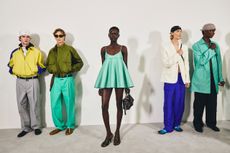
A look from the S/S 2009 menswear collection
Photography: Catwalking.com
From the Marni archives:
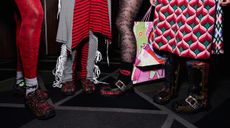
Backstage at the S/S 2012 womenswear show
Photography: Jason Lloyd-Evans
From the Marni archives:
In April 2010, Marni flexed its design muscle during the Salone del Mobile in Milan by commissioning architect Matteo Thun to create a series of installations that would provide a dialogue about the life cycle of a product. His 'Wooden Beacons' featured sustainable red oak panels that seemed to project from the earth, interspersed by Marni fabrics, hanging jewellery or floating paper lanterns
From the Marni archives:
At this year's Salone, Marni launched another design venture - a collection of chairs conceived by the brand and woven by Colombian ex-prisoners
Kartell
Founded in 1949 by the late Giulio Castelli, father-in-law of Kartell’s current president Claudio Luti, Kartell dazzled the design world from the start with
its unorthodox choice of plastic as its
star material. Progressive moves have continued at the furniture company
since Luti joined in 1988, after 11 years as partner at another family-run company, Versace. Now his children have joined
the enterprise that pulls in revenues of €105m per year.
Claudio Luti (right), 63, president, father, CEO
Lorenza Luti (centre), 34, daughter, director
of marketing
Federico Luti (left), 32, son, sales
area manager
Wallpaper*: Why are there so many family-run businesses in Italy?
Claudio Luti: There’s a long tradition
of individual entrepreneurs who always
used their own money to push ahead. Companies grew out of families. Those that did well didn’t want to lose control. There is neither the desire nor the experience to bring in outside partners
or to go public, like in France or the US.
W*: Is it important to have a tough approach to your children’s involvement in the company?
CL: There are two requirements: they have to want it and they have to be capable
of doing it. There’s a risk in assuming your children are geniuses. At Kartell, it’s a meritocracy. But their presence gives me enormous drive to continue. If they weren’t involved, I probably would have already sold the company.
W*: How are the private equity deals you’ve been involved with in the past different from how you manage Kartell?
CL: With the private equity deals, the outlook is always short term. You need results in three years, so it’s another way of thinking completely. When you run a family company, you are always aiming for the long term. You want to pass it on in perfect condition. This can be a handicap at an international level because family companies don’t have access to capital or investment. It can be a limit for growth. We’ve avoided this because we have great sales and profits.
The family are pictured in Claudio's home in Milan
Photography: Jonathan de Villiers
From the Kartell archives:
Kartell-founder Guilio Castelli and his wife Ana dancing in 1949, the year of brand's birth
From the Kartell archives:
'KS1068' dustpan with handle, designed by Gino Colombini in 1957, in shock-resistant polystyrene
From the Kartell archives:
The '4999' children's chair, designed Marco Zanuso and Richard Sapper in 1964, was first home décor item in the Kartell collection and the first chair in the world manufactured entirely of plastic. The foldable chair won the Compasso d'Oro award in the same year
From the Kartell archives:
Kartell participated in the 'Italy: the New Domestic Landscape' exhibition at the Museum of Modern Art in NY in 1972, contributing three habitat modules designed by Gae Aulenti, Ettore Sottsass and Marco Zanuso
From the Kartell archives:
Claudio Luti's arrival at Kartell in 1988 brought about a collaboration with Philippe Starck. The first product by the French designer was the 'Dr Glob' chair of the same year
From the Kartell archives:
'Bookworm' shelving unit, designed by Ron Arad in 1994. It was the first flexible bookcase that could be freely configured - 'a release from slavery to the straight line'
From the Kartell archives:
'Louis Ghost' chair, designed by Philippe Starck in 2000 came two years after the birth of 'La Marie': the first polycarbonate chair. Louis XV seats were radically redesigned in a small armchair - an example of polycarbonate injection in a single mould. The chair became the most widely sold design chair in the world
From the Kartell archives:
The 'Masters' chair, designed by Philippe Starck with Eugeni Quitllet in 2011, is a tribute to three contemporary design icons - the 'Series 7' by Arne Jacobsen, the 'Tulip' armchair by Eero Saarinen and the 'Eiffel' chair by Charles Eames - interwoven into a sinuous hybrid
Minotti
Over the past 40 years, brothers Renato and Roberto Minotti have transformed their father’s small artisan furniture company into an upholstery powerhouse, with their signature low-rise sofas becoming as hot and ubiquitous as low-rise jeans. Now, much more than
just a sofa company, Minotti is sold
in 61 countries in the world and has 24 mono-brand stores.
Renato Minotti (second from left), 57, brother, co-CEO
Roberto Minotti (second from right), 52, brother, co-CEO
Alessio Minotti (left), 36, twin son of Renato, research and development manager
Alessandro Minotti (right), 36, twin son of Renato, sales manager
Wallpaper*: As co-CEOs, how do you and your brother divide responsibilities?
Renato Minotti: Our strength is that we don’t divide. We’re very cohesive in developing strategies, from product design to logistics. It’s the daily interface that makes us work well. Four eyes see better than two.
W*: Have you ever thought of selling a stake in the company?
RM: Offers have always come up. We’ve never even considered them. We’re a family company. We don’t work just for the numbers, but for the dream. The company becomes like a child you care for.
W*: How do you ensure the next generation has the necessary skills?
RM: I started working here when I was 21. I have travelled the world, met every client, know all the resellers. I have studied the technology, production, design. I am 57 years old now. Finding
a manager that has the know-how
my brother and I have is impossible –
no one has our experience. I’d rather teach my sons myself.
W*: How did you manage to grow without outside investment?
RM: Twenty years ago we started really focusing on business outside of Italy –
we knew that we had to expand and evolve. There was a strong marketing and sales campaign. We always looked and studied what each market and client needed. We opened our first retail store in Asia in 1995.
W*: Will family companies continue to exist in Italy?
Roberto Minotti: I think it’s added value for a company. When the management
is just calculating numbers, you lose perspective. As long as the companies are healthy, I believe they will always try to stay private and under the control of individual families.
The family are pictured in the Minotti showroom outside Milan
Photography: Jonathan de Villiers
From the Minotti archives:
The 'Sayonara' lounge chair, designed Gigi Radice in 1968, comprises a stainless steel frame and upholstered seat covered in leather
From the Minotti archives:
'Piacere' sofa, designed by Bob H Miller in 1986
From the Minotti archives:
'Pollock', designed by Rodolfo Dordoni in 1999
From the Minotti archives:
'Hamilton' sofa, designed by Rodolfo Dordoni in 2004
From the Minotti archives:
'Sherman' multifunctional seating system, designed by Rodolfo Dordoni in 2012
Missoni
In 1953 Missoni founders Ottavio and Rosita Missoni built their knitwear company HQ and factory on a stretch of idyllic countryside in the middle of nowhere. Family life and fresh eggs may have come first, but that did not smother the passion the couple had for designing and producing magical, eye-popping knits, a pursuit now carried on by their three children. Today, Missoni boasts
30 directly operated stores, plus a newly installed third generation.
Rosita Missoni (left), 80, mother, creative director of Missoni Home
Angela Missoni (centre), 53, daughter,
creative director
Vittorio Missoni (not pictured), 58, son, head of institutional affairs
Luca Missoni (not pictured), 56, son, head of Missoni museum and exhibitions
Margherita Maccapani Missoni (right), 29, granddaughter, head of beachwear
and accessories
Wallpaper*: Will family-run businesses continue in the future? Or is this a special chapter of Italian history?
Angela Missoni: It is impossible to call
a family business like Missoni a special chapter of Italian fashion. It’s impossible to conceive our business in a different way. We were all born and raised fully immersed in the business. It’s a way of life, a matter of identity, a way to think,
of being, of growing, of making projects for the future.
W*: What effect does globalisation have on the Italian family business?
AM: Missoni has been an international brand for decades. Globalisation will hopefully mean success in new markets, bringing the Missoni language to new forms – hotels and restaurants around the world, for example. But we wouldn’t move production abroad. We want to remain an artisanal, peculiar expression of Made in Italy.
W*: Was there any doubt while growing up that you would join the company?
Margherita Maccapani Missoni: Absolutely. For years I did other things, such as studying philosophy and acting, and I truly believed my future lay there.
I am now conscious of the fact that I
had a strong need to identify who I was.
I wasn’t sure if I would even exist outside of that big knot of my family and the Missoni brand.
W*: Is it hard working with your family?
MMM: Family dynamics can suddenly pop up at the most inappropriate moments. There’s a little bit more screaming involved than in a normal working relationship. But the making up
is so much faster – it often happens in
the same sentence as the screaming.
The family are pictured at their apartment in Milan
Photography: Jonathan de Villiers
From the MIssoni archives:
One of the first Missoni dresses, designed in 1958
From the MIssoni archives:
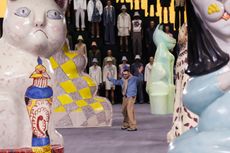
A scene from the first Missoni catwalk show at the Teatro Gerolamo in Milan in 1966
From the MIssoni archives:
The Patchwork pattern, from 1970
From the MIssoni archives:
The Fiammato pattern from S/S 1989 collection
From the MIssoni archives:
A map of Italy in cotton Jacquard from 1992
From the MIssoni archives:
Photography duo Mert & Marcus capture Kate Moss for the A/W 2003 collection
From the MIssoni archives:
Juergen Teller captures the Missoni family for a recent advertising campaign
Molteni
‘The genius of my grandfather was having three sons and three companies,’ says Francesca Molteni. ‘So they each got one and there were no fights.’ Her nonno Angelo Molteni, who founded the family business in 1934, was, by the 1970s, also smart enough to diversify with companies in three separate yet complementary sectors: Molteni & C for home furnishings, Unifor for office furniture and Dada for kitchens. With the formidable Carlo Molteni as CEO of Molteni & C, the furniture empire has recently seen an injection of savvy third-generation family members with international experience.
Carlo Molteni (second from right), 70, father, CEO of Molteni
Mariangela Molteni (right), sister, director
of administration
Andrea Molteni (second from left), 35, nephew, research and development manager of Dada
Francesca Molteni (third from left), 38, daughter, independent film maker and director
of Molteni’s Gio Ponti project
Giulia Molteni (left), 32, daughter,
retail manager
Pietro Molteni (front), 32, nephew,
Unifor Administration
Giovanni Molteni (third from right), 27, son,
Molteni Production
Wallpaper*: Does the family business model have a future in Italy?
Carlo Molteni: It depends on the
family and the quality of the younger generations. You can’t control this, obviously, but you need to be disciplined. If there’s no one capable, you must go outside the family for talent.
W*: How difficult has it been to grow without outside investment?
CP: It’s not so hard. You just need to do things gradually. We’ve been expanding, consolidating markets one at a time.
W*: Are you happy to see your children in the company?
CP: Yes, it gives you a bigger sense of responsibility. I started working here at
18 and went to college while I worked. There was no doubt my brothers and I would join the company, but we wanted to give our children the choice. Happily, they decided to come on their own.
The family are pictured at the Molteni & C HQ outside Milan
Photography: Jonathan de Villiers
Stylists: Francesca Cefas, Emil Rebek
From the Molteni & C archives:
The '505' system has been in the Molteni & C collection since 1972, and has been updated year-by-year. Pictured is the latest version, launched in April this year
From the Molteni & C archives:
This Molteni & C campaign from the 1980s shows the 'Mount' system by Afra & Tobia Scarpa, and the 'Carteggio' drawer unit and 'Milano' chair, by Aldo Rossi
From the Molteni & C archives:
The 'Less' table, designed by Jean Nouvel in the 1990s, was conceived as a part of an office system that was realised to furnish the Cartier Foundation in Paris
From the Molteni & C archives:
'Skin' chair, designed by Jean Nouvel the following decade
From the Molteni & C archives:
The Gio Ponti collection, revived by Molteni & C and presented at the Salone last April
Armani
By far the best example of a family man who has kept an iron grip on his private empire is Giorgio Armani. Since launching his cutting-edge menswear in 1975, he's created a €1.8bn-a-year business empire that has attracted schools of corporate sharks, none of whom have been able to get their teeth into the business. Currently flanked by two nieces and a nephew, Armani is elegantly side-stepping the question of whom to pass the baton to.
Giorgio Armani (second from right), 78, CEO, managing director of Giorgio Armani
Rosanna Armani (left), 73, sister, former art director of Giorgio Armani and creative director of Emporio Magazine
Silvana Armani (centre), 57, niece, women's design director
Roberta Armani (right), 42, niece, head of entertainment industry relationships worldwide
Andrea Camerana (second from left), 42, nephew, director of Giorgio Armani
Wallpaper*: Would you like to leave the company in the hands of your family?
Giorgio Armani: I'm considering the possibility of a foundation. I can say that as long as I am here, I am the boss.
W*: Yours is one of very few global luxury brands still privately owned. Was it hard to expand without outside investment?
GA: It has never occurred to me to make investments with money that wasn't mine. Each new step has always been carefully explored and the company's solidity has always been backed by our solvency. This gives us an enormous advantage. We can make choices that are not conditioned by outside factors. The fact that my group's net liquidity is once again so high proves that I have made the right choices.
W*: How did you avoid selling to bigger companies in the 1980s and 1990s?
GA: I believe independence is the only way to expand organically. The 1980s and 1990s were crucial for me; my company was shaped distinctly in those years. Selling then would have been unnatural to the whole growth process. I am glad I didn't succumb to outside pressures and offers, of which there were many.
W*: What is so special about the Italian family business model?
GA: Strength and a focus on the future.
W*: What are the challenges moving from the first to second generation?
GA: It's delicate and crucial. I have family members on the board and they also work in the press office and design department. They submit management ideas as well.
W*: How did you develop their roles?
GA: Each one of them joined the company in a very organic way, based on their qualities, inclinations and character. I feel they've acquired excellent experience on the job, which is the only way to learn.
But what is it like be part of Mr Armani's family, yet also an employee? We turned to his nephew and nieces to find out more...
W*: What have you learned most from Mr. Armani?
Andrea Camerana: That one can't speak of strategy without being aware of the importance of details, even the apparently most insignificant ones. Which is also why certain 'experts', who are especially skilled at what they do because they have a profound understanding of their craft, deserve a lot of respect.
Roberta Armani: I have always admired my uncle: his vision, his determination, his attention to detail, his sense of beauty and elegance. I feel that they are qualities of mine as well because these are the values I grew up with. I learned to love hard work from my uncle. I also learned about self-criticism, and being meticulously careful about details, subtleties and nuances, as well as the importance of staying grounded.
Silvana Armani: I have learned never be satisfied!
W*: What is the best part of working with one's family?
Andrea Camerana: Probably, some minor logistical privileges. As well as the feeling that I am working for my future, ultimately investing in it, while I'm doing my daily job.
Roberta Armani: Ever since I can remember our working relationship - both with my uncle and other family members - it has always been based on utter clarity and professional attitude. The advantage of working with one's family is that strong sense of belonging and responsibility, which are also very stimulating.
Silvana Armani: Well, working with family, I obviously feel very much at home...
W*: Are there any difficult aspects to it?
Andrea Camerana: As 'just an employee' I would probably question myself less before taking a course of action and I would probably make myself heard more without the fear of coming across as an arrogant person.
Roberta Armani: Working with family can be complicated if boundaries are not clearly defined. It is crucial to separate family relationships from one's working relationships. On the job, of course I am still a niece or a sister, but I am above all an employee.
W*: Did you always imagine working at Giorgio Armani?
Andrea Camerana: No, I didn't - it all just sort of happened at the beginning of the 2000s, when I joined the Group as it was going through a transitional period.
Silvana Armani: I started working for him when I was 20, as a model, and I certainly would never have imagined then that I'd still be here now, but it's what I enjoy doing. I love it. It's my job.
The Armani family are pictured at Giorgio's home in Milan
Photography: Jonathan de Villiers
...
8 August 2012 | Fashion
Wallpaper* Tudor Style File is back for another year-long season
Bespoke promotion

Tweet this
Share this on Facebook