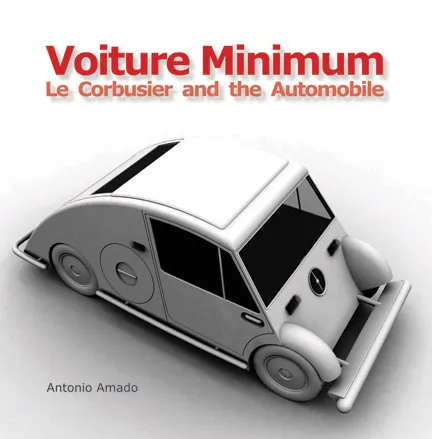
The motor car has completely overturned our old ideas of town planning,' wrote Le Corbusier in 1924, in Towards an Architecture. The Swiss architect was one of the first to directly link the production of automobiles and buildings, and like many of his contemporaries, he saw the automobile as a symbol of modernity.
Le Corbusier continued: 'If houses were built industrially, mass-produced like chassis, an aesthetic would be formed with surprising precision.' He was particularly concerned with perfecting car design through utility and form. Thus in 1936, with the help of his cousin Pierre Jeanneret, the architect designed what he noted as 'a minimalist vehicle for maximum functionality' - the Voiture Minimum.
Written by Spanish architect and University of La Coruña professor, Antonio Amado, Voiture Minimum: Le Corbusier and the Automobile documents this project as well as the architect's lifelong love and involvement with the car. The book also explores other ideas on cars and mobility at this crucial junction in history.
Amado is a natural storyteller and weaves together a rather charming narrative that leads us to the story of Voiture Minimum. The journey includes a brief history of the French inventor and industrialist Gabriel Voisin whose avant-garde ideas for minimalist transport, such as the Biscooter, were to make a lasting impression on Le Corbusier.
The Biscooter's almost anti-design three-seater never quite appealed to the French public when it was unveiled at the 1949 Paris Motor Show. It did, however, prove to be just right for post civil war Spain, and was subsequently manufactured there under the name Biscuter-Voisin, staying in production for almost ten years.
We also learn of other key architects' involvement with the automobile in the context of both town planning ideas and automotive design. There are chapters on Joseph Maria Olbrich, Adolf Loos, Walter Gropius, Jean Prouvé, Buckminster Fuller and Frank Lloyd Wright - all well illustrated to capture the spirit of the time.
The author even dedicates time to car design between the wars, exploring key trends in automobile design, crucially the impact of aerodynamics and the American aesthetic, as well as the story of Volkswagen's 'people's car', the Beetle.
Incidentally Le Corbusier claimed that his Voiture Minimum inspired the iconic German car, saying that his design for the 1936 SIA competition originated in 1928, long before Ferdinand Porsche penned the Beetle. Amado, however, disproves this, suggesting that in fact the influence may have gone the other way.
The chapters on Voiture Minimum itself are lavishly illustrated and exhaustively documented containing copies of original letters written by Le Corbusier to various car manufacturers energetically promoting his car, proposal after proposal, and endless sketches that ultimately lead to the final design.
Alas Voiture Minimum was never to be made into a production car. However, Italian car designer Giorgio Giugiaro of Italdesign created a full-scale model in 1987 for L'Aventure Le Corbusier: 1887-1965, an exhibition held at the Pompidou Centre in Paris. Two years later a similar prototype was constructed to mark the opening of London's Design Museum. Voiture Minimum: Le Corbusier and the Automobile is a compelling story of a perfectionist striving to create the perfect automobile.

Silhouette of the Voiture Minimum by Le Corbusier, 1936

Frontal elevation of the Voiture Minimum by Le Corbusier© The MIT Press

Rear elevation of the Voiture Minimum by Le Corbusier

The Voiture Minimum from above, showing its expansive sun roof

Geometric analysis of the section of the Voiture Minimum using √2 modulation

Realistic rendering of Voiture Minimum by Le Corbusier in steel plate and painted in black gloss

A virtual wire reconstruction of the Voiture Minumum

A full-scale wooden model made in 1987 for the Le Corbusier centenary exhibition at the Pompidou Centre, Paris

A reinterpretation of the interior of Voiture Minimum by Giugiaro in 1986

The fibreglass model of Voiture Minimum, 1987