
The Metropolitan Museum of Art’s Costume Institute will open the doors to its spring 2026 exhibition on Sunday 10 May 2026 – an expansive show spanning prehistory to the present day which will pair works from The Met’s collection with fashion, to reveal an inherent connection between clothing and the body through time and cultures. ‘Costume Art’ is the inaugural exhibition to take place in the institution’s newly opened gallery space, but before doors officially open to the general public, the show has been marked, in traditional fashion, by the annual Met Gala. The event, which took place 4 May, took its starting point from this same collision of art history and style, with attendees turning out in accordance with the dress code ‘Fashion is Art’.
It’s a love affair that has existed for centuries. From antiquity, fine art in all its forms has documented and preserved the history of dress, through works which survive longer than garments, providing a visual narrative of how civilisations lived and what they wore. In turn, designers have combed the annals of painting, sculpture, film, photography and more for inspiration and, on the way, created clothes worthy of the name ‘art’ in their own right. In honour of this interwoven heritage, and in anticipation of the First Monday in May, Wallpaper* selects eight key encounters between fashion and art.
Elsa Schiaparelli x Salvador Dalí

Models wearing wool suits with Salvador Dali-inspired bureau drawer-like pockets by Schiaparelli in Vogue in 1936
Throughout V&A’s major Schiaparelli retrospective, are many infamous collaborations the designer Elsa Schiaparelli (‘that Italian artist who makes clothes’, as her contemporary Coco Chanel dubbed her) conceived with surrealist artists. There was the curvaceous bust-shaped perfume bottle with Leonor Fini, or the dress embroidered with an optical-illusion portrait-slash-vase-of-flowers with Jean Cocteau, or the 1936 jewellery collection featuring figures by Alberto Giacometti cast in metal. And yet it’s the Dalís which have endured in the public imagination, the perfect marriage of commercially savvy provocateurs. Their first, a suit with tromp l’oeil cabinet drawers for pockets is quintessentially surrealist. The suggestiveness of the phallic, painted lobster on a dress worn by Wallis Simpson, she who stuck her own proverbial claws into the British establishment, thus forever altering its course, is delicious in its knowing wink. The sheer absurdity of the high-heel shoe hat. Together, they created the blueprint for all future collaborations between these two disciplines.
The Mondrian Dress, Yves Saint Laurent (1965)

A group of models wearing the Yves Saint Laurent Mondrian dress in 1966
‘I am a failed painter.’ So The Observer quoted Yves Saint Laurent, in 1992. The designer, who treated dresses like canvases in a way rarely seen before, believed his work to be secondary to those fine artists he so rarified. And yet, when he applied the principles or compositions of his idols to his designs they were a phenomenon, and none more so than the 1965 Mondrian collection, which saw Dutch artist Piet Mondrian’s harmonious, neoplasticist paintings from the 1920s and 30s re-appropriated onto wool jersey cocktail dresses in a miniature shift style. Few fashion presentations have achieved quite the same perfect cohesion of past, present, and future, or so deftly demonstrated the unique properties of clothing as artistic medium. If Mondrian’s edict was that ‘pure abstract art becomes completely emancipated’, then Saint Laurent made emancipation his trademark too.
Scenario, Merce Cunningham x Rei Kawakubo (1997)
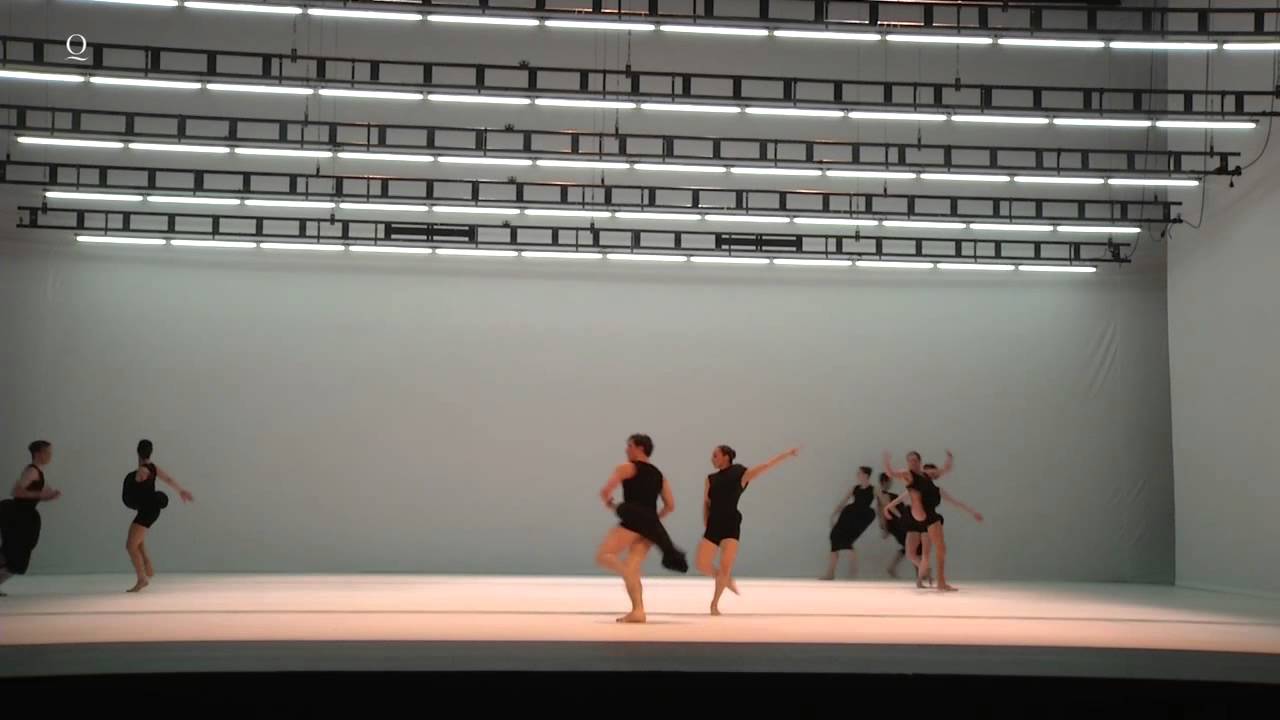
Comme des Garçons’ Rei Kawakubo collaborated with choreographer Merce Cunningham on his ballet Scenario – not just, as one may expect, on the costume design, which was taken from the ‘Body Meets Dress, Dress Meets Body’, S/S 1997 collection, but on sets and fluorescent lighting too. The garments worn by Cunningham’s company of dancers featured strange lumps and bumps of padding beneath the fabric – stripes, gingham and Kawakubo’s signature all-black – which exaggerated the movement of the body and created unusual proportions and distortions, an echo of the modern, avant-garde way of dancing which Cunningham pioneered. For Kawakubo as for Cunningham, these statements and new way of thinking about their art have always been less about pretty, and more about challenging paradigms, pushing boundaries, and communicating an, at times unsettling, perspective which is wholly their own.
Prada Marfa, Elmgreen & Dragset (2005)

Elmgreen and Dragset, ‘Prada Marfa’ (2005)
There is something about this beguiling artwork that still has the power to confound people. The permanent installation, conceived by the artist duo Elmgreen & Dragset on a rural Texas highway, has been in situ since 2005 and is something akin to Lourdes in its sanctity for fashion pilgrims, but to this day, there are those who can’t quite figure out whether it’s actually a functioning store. (It’s not.)
Although Prada was complicit in its construction, giving not only items from its A/W 2005 collection but also access to the trademarked logo, the 15 ft × 25 ft adobe brick building is a sculpture, pure and simple, created in the spirit of Pop Art, which re-appropriates the imagery of mass culture and consumerism (and which plenty of fashion houses, Prada included, have drawn from). While many artists have incorporated commercial branding into their work, there’s never been something quite on the scale of Prada Marfa, and it’s its simultaneous uncanniness and familiarity, and its position in the open air, outside of gallery walls, which make it an almost singular fashion dupe.
Kim Jones and The Bloomsbury Group

Kate Moss at the Fendi Couture S/S 2021 runway show, which drew inspiration from the Bloomsbury Group
The sexually liberated gang of modernist writers, theorists and painters (and one token economist) who orbited the beautiful, erudite Stephens sisters have been rich fodder for a range of fashion brands, from Burberry, where painterly brushstrokes in typical Omega Workshops style adorned the A/W 2014 collection, to Erdem, who invoked the spirit of Lady Ottoline Morrell back in 2022. But cut Kim Jones open and he bleeds Bloomsbury. The designer is vice president of Charleston House, the East Sussex home of Vanessa Bell and Duncan Grant which he first visited on a school trip, he has an enviable collection of original objects in his personal archive, and has referenced the group and their works continually throughout his career. The zenith of this obsession was in the hotly anticipated debut for Fendi, which was also Jones’s first outing in haute couture, and first womenswear collection to boot. The Bloomsbury Group themselves were hardly the types to go in for much couture, but it must be said that they had a certain eccentric style, and Jones’s tribute was a suitably romantic, decorative and chosen-family-oriented affair.
The Delphos Gown, Fortuny (circa 1907)

American ballet dancer Cynthia Gregory models an evening gown by Fortuny
‘Faithfully antique but markedly original,’ was how Marcel Proust described Mariano Fortuny’s gowns in the fifth volume of À la Recherche du temps perdu, and none is more so than the Delphos Gown. Created in the early years of the 20th-century, the Delphos was a collaboration between Fortuny (who patented the design), and his wife Henriette Negrin (who actually designed it), and takes both its name and its impetus from the articulation of the cloth of an Ancient Greek bronze statue Charioteer of Delphi (circa 470 BC). Where the original chiton, as worn by the charioteer, would have served as both under and over garment, the draped silk pleats of Fortuny’s creation were designed to enfold the body, but evoked a less artificial silhouette than the popular Gibson Girl shape of the period, which was achieved through constricting swan-bill corsetry and bustled petticoats. In that sense, the Delphos was a fairly radical proposition, and as well as being referenced or replicated across other art forms (the aforementioned Proust, as well as paintings including Joaquín Sorolla’s 1909 portrait of his daughter Elena), surviving examples are preserved in museum collections as artworks themselves.
Louis Vuitton x Stephen Sprouse (2000)

Louis Vuitton S/S 2021 runway show, which featured a collaboration with Stephen Sprouse
Although the late Stephen Sprouse was himself a fashion designer, the seminal collaboration with Louis Vuitton in 2000 is nearly always positioned as one between a brand and a visual artist. The ready-to-wear and accessories collection, instigated by then-creative director Marc Jacobs, took Sprouse’s bold marker-pen scrawl as its calling card – one so seemingly at odds with the luxurious status symbol of Louis Vuitton leatherwear. Unexpected and brash, the graffiti-look logo ‘hacked’, as it were, by Sprouse, was the gesture that launched a thousand ships, setting a precedent for branding iconoclasm that has been much imitated, but rarely bettered.
Portrait of Madame X, John Singer Sargent (1884)

John Singer Sargent, Madame X (Madame Pierre Gautreau), 1883–4, Metropolitan Museum of Art
It’s important to note that the relationship between art and fashion doesn’t just flow in one direction: clothing’s power to tell a story about its wearer – be it status, respectability, temperament, or profession – has been recognised and utilised as a narrative device by artists through history. What the subject of a portrait is wearing, and how they are wearing it, is one of the most immediate indicators of who that person is, not just in name, but in totality.
Few examples of this premise are as storied as the American artist John Singer Sargent’s Portrait of Madame X– depicting an alabaster-skinned Virginie Avegno Gautreau in a dramatic sweetheart-necklined black dress which hugs close to her body. Madame Gautreau was a professional society beauty with a taste for the audacious. She dyed her hair and wore rouge during a time when these predilections were usually the preserve of the lower orders, and she eschewed conservative fin de siecle style in favour of something more singular. It is not definitively known who made the daring, statuesque LBD captured in her portrait, arguably the most famous dress committed to canvas and one that oozes sex appeal, but some scholars attribute it to the couturier Félix Poussineau, known contemporaneously for his silhouettes but otherwise largely forgotten by history. What is known though, is that Sargent initially painted Gautreau in a rather more déshabillé state, with one sparkling strap falling sensually from her lily-white shoulder. Gautreau’s reputation as a ‘fast woman’ was well-documented in the scandal columns of the period, but to have such wanton feminine sexuality exhibited at the Paris Salon was a step too far. Sargent repainted this section.