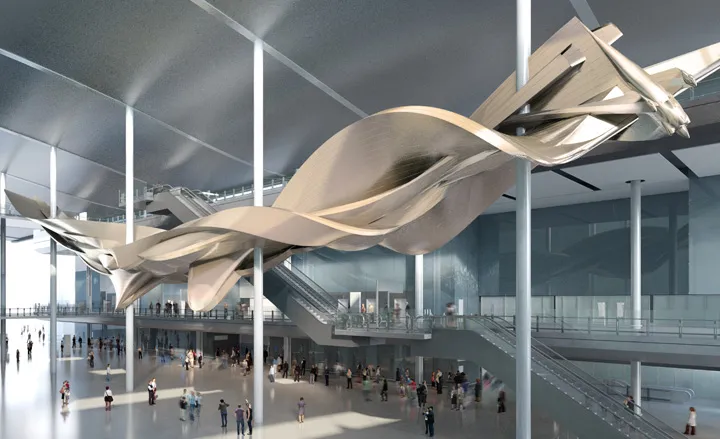
Within the realm of contemporary sculpture, Richard Wilson’s technically wondrous creations force us to rethink our ideas of space, perspective, material and structure. Which is why Heathrow Airport needed little coaxing when it came to choosing the British-born artist to create an installation for the soon-to-be renovated Terminal 2.
Sporting a dramatic wave-like roof, the shiny new terminal – which is due to open in 2014 - is swiftly taking shape under the direction of Foster + Partners, in collaboration with Luis Vidal and HETCo. The new space will feature a central light-filled courtyard (similar in size to the Tate Modern’s Turbine Hall) in which Wilson’s oscillating structure, titled ‘Slipstream’, will be suspended 20m above the ground.
‘This work is a metaphor for travel,’ says Wilson of the design. ‘It is a journey from A to B, where sensations of velocity, acceleration and de-acceleration follow us at every undulation.’
Inspired by photographer Eadweard Muybridge, whose series ‘Human figure in Motion’ captured moving moments, Wilson’s mission was to create a sculpture that did just that. ‘If you set your lens at one-thousandth of a second, you can capture that wonderful moment in time,’ explains Wilson.
Using the somersaulting, spiralling and twisting motions of a small stunt plane in flight, Wilson started off with a series of sketches and then enlisted the help of structural engineers Price & Myers as well as specialist fabricators Commercial Systems International (CSI), who used aeronautical computer technology to translate his concept into a three-dimensional reality.
Measuring over 70 metres long and weighing in at 77 tonnes, the larger-than-life creation will be formed by a wooden skeleton covered in plywood, while the external layer will be fashioned out of semi-polished aluminium. ‘A very elegant sculpture, with a streamlined, undulating surface that reflects the light in all sorts of ways,’ says Wilson of his creation. 'The riveted aluminium surface will highlight the contours of the piece.’
Wilson’s sculptures never cease to inspire and provoke, and ‘Slipstream’ is bound to be a visual delight, reminding us that the boundaries as we know them are only the beginning.

Sporting a dramatic wave-like roof, the shiny new terminal – which is due to open in 2014 - is swiftly taking shape under the design work of Foster Partners, in collaboration with Luis Vidal and HETCo

The new space will feature a central light-filled courtyard (similar in size to the Tate Modern’s Turbine Hall) in which Wilson’s oscillating structure, titled ‘Slipstream’, will be suspended 20m above the ground

Inspired by photographer Eadweard Muybridge, whose series ‘Human figure in Motion’, captured moving moments, Wilson’s mission was to create a sculpture that did just that

Using the somersaulting, spiralling and twisting motions of a small stunt plane in flight, Wilson started off with a series of sketches

One of Wilson's original sketches depicting a plane in motion

He then enlisted the help of structural engineers Price & Myers as well as specialist fabricators Commercial Systems International (CSI) who used aeronautical computer technology to translate his concept into a three dimensional reality

The three dimensional stage after the sketches, showing the mathematical process used to create the final models and renderings

The final solid model, created to the same scale used in aeroplane designs

A view of the solid model from underneath
The final rendering showing the plane's movement, depicting its undulations, twistings and spirallings and eventually, the beginning of the sculpture. 'Once out the other side, imagine the vast void left by the plane’s path is filled with fast-setting plaster, therefore making the void the solid,' explains Wilson