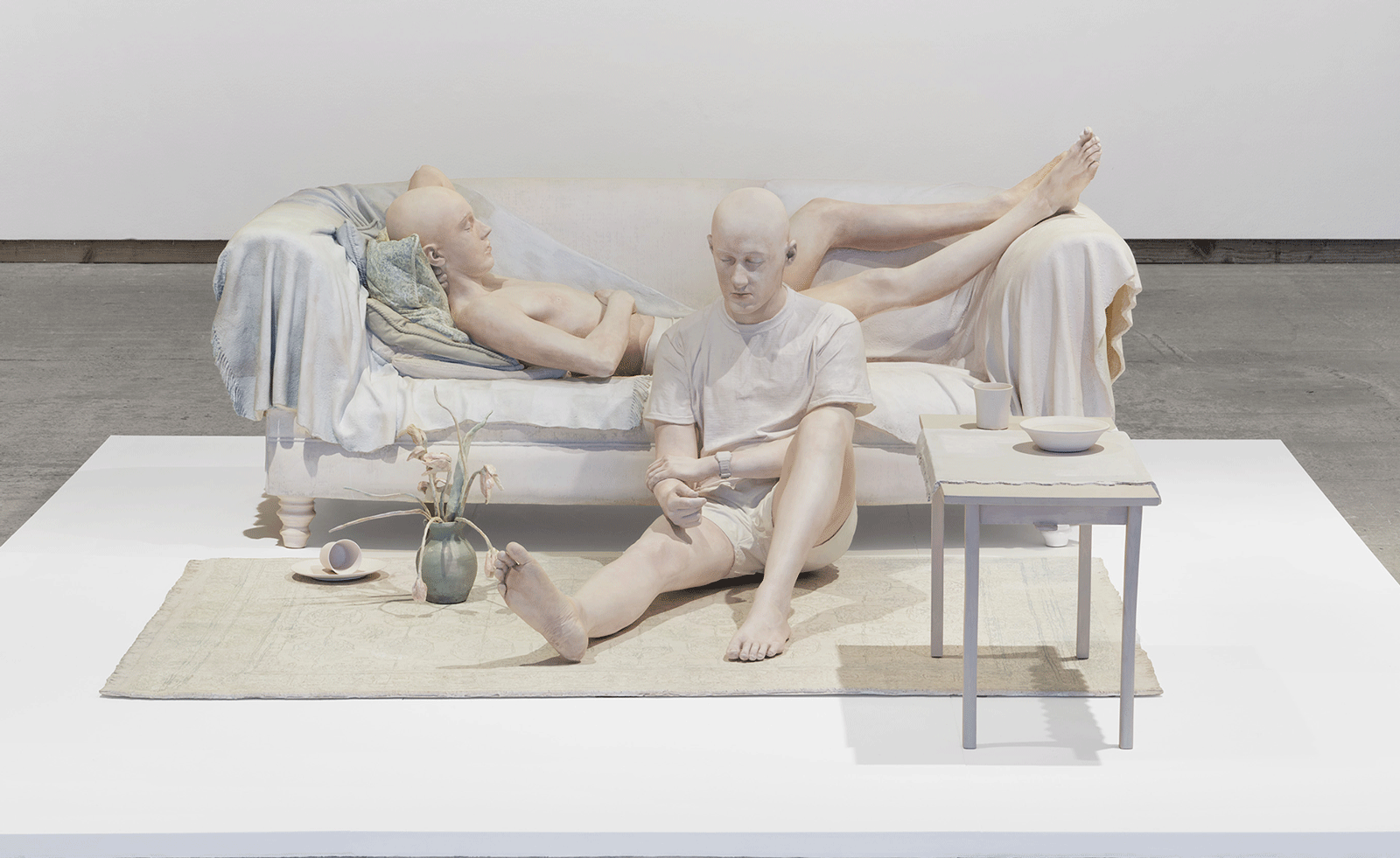
I’ve been staring at Daphne Wright’s sons for around 20 minutes before she walks into Frith Street Gallery. Not her actual sons, obviously: life-sized casts in painted Jesmonite. One lies along a couch in his boxers, his head propped up by cushions, one hand behind his neck, the other on his belly, his feet resting on one arm. The other sits on the floor with his back against the couch, head bent slightly forwards and down. He’s in a T-shirt and shorts. There’s a watch on his wrist and his left hand grips his right forearm. Next to him, on the rug he’s sitting on, is a vase of wilting flowers, frozen in the moments just before the petals drop.
Wright and I sit opposite one another in a room adjacent to the gallery, where Sons and Couch (2025) is partially visible through the glass doors. Occasionally, as she speaks with the soft, lyrical lilt of her home country, her eyes wander to her sculptural sons.

Daphne Wright, Kitchen Table (2014)
Wright grew up in rural Ireland and though her parents weren’t artists, they were handy. While they were constructing the farm buildings from the ground up, Wright would take the materials left lying around – gravel, sand, bricks – and combine them with found objects – stones, things pinched from the kitchen table – to make her own little constructions. ‘I don’t ever remember not making something,’ she says. But it wasn’t until she was 18, when someone suggested she go to art college and she enrolled at Sligo RTC, that she understood making could also be a career.
Her early influences came from the spaces that surrounded her: the grand buildings that punctuated the Irish countryside, their scale asserting authority, and the crumbling Georgian aesthetic of Dublin, where she continued her education at the National College of Art & Design. Formative works such as Still Life: Greenhouse (1995), a full-sized structure composed of ornate plaster leaves, and Indeed, Indeed (1998), an installation of towering tinfoil rock-like structures, reflect her interests in architecture, as well as in the tension between fragility and strength that continues to underpin her practice.

Daphne Wright, Stallion (2009)
But for Wright it always comes back to material. ‘Sometimes I’m drawn to a material without knowing why and it takes me around seven years to develop it, to understand it so that I can move on and leave it behind,’ she explains. That understanding is registered by a feeling of completeness or expulsion, of having travelled to the absolute limits of what she’s working with. At this point she will typically create video work, which serves as a ‘notebook’ for that period, but also a ‘premonition’ for what comes next. ‘It’s a very brutal way to make work because each time you’re having to reinvent yourself, but if you’re not doing that, if you’re not inquiring, I don’t see the reason for doing it,’ she says of her process.
For those who have only encountered the quiet stillness of Wright’s sculptures through photographs, ‘brutal’ might seem like an extreme choice of word. But after an hour of talking with her, it’s clear that she’s someone who is as precise and rigorous with her language as she is with her material – every word, like every form she makes, is selected to produce a particular effect or test out an idea. Her sculptures, though static, are almost always fraught with tension.

Daphne Wright, Sons (2011)
Take Stallion (2009), a sculpture of an upturned horse, partially flayed and seemingly wrought with pain, cast in marble dust and resin or, a less obvious example: Fridge Still Life (2021), which casts the artist’s small-sized family fridge, including its contents – a modestly sized chicken, two trays, one with a bottle placed inside it and a few stalks of asparagus. On the one hand, it offers a tantalising peek into someone’s personal life, even more intimate, one could argue, than turning out their handbag.
‘If you look into someone's fridge, it tells you everything. It tells you their economic budget. It tells you whether they're looking after themselves, what kind of diet they’re following,’ says Wright. But it is also a staged artwork. The asparagus, like the oversized vase of flowers that sits atop the fridge, is a nod to the Dutch still life tradition rather than a replica of reality. ‘[Asparagus] wouldn’t have been something we ever got around to being able to afford at the time,’ Wright admits. The work was shown for the first time at the Ashmolean in Oxford as part of her exhibition ‘Deep Rooted Things’, which responded to the museum’s historical collections.

Daphne Wright at Frith Street Gallery
Wright’s sensitivity to material reached new heights when she had her first child. ‘I could not work with material. I had such a revolt to it that I would want to vomit,’ she remembers, drawing a link between the demanding physicality of birthing and caring for a newborn. For a while, it led to her collaborating with other people, a move, she says, that ‘really opened up her world’ and to later making smaller-scale work with clay at home, which eventually led to her exhibition ‘A quiet mutiny’, first staged at Crawford Art Gallery in Cork in 2019. The show was titled after what Wright calls the non-verbal ‘sulking’ power of clay – ‘the way it watches and withholds itself’ – but it could also be seen as her own mutiny against perceptions of artist parents at that time. ‘My biggest fear at the time of having children was that you would disappear because you’re not visible, but at the same time, you don’t care, you just make your work. I would make my work no matter what.’
Prior to the exhibition, however, she’d already begun incorporating her sons into her work – in a way, another kind of mutiny against prevailing ideas around what makes serious art. The first cast she made, Sons (2011), two busts of her children, then aged eight and ten, was inspired by her observation of parents’ obsession with getting their babies’ feet cast as keepsakes. This led to the much larger installation work Kitchen Table (2014), in which one of the boys sits cross-legged on the tabletop while the other sits slumped in a chair, his head resting in the palm of his hand. Her intention was to cast them again in their teenage years, though this time she found she had to wait until she had their permission, which involved many conversations around the genealogy of the work as well as the role of the mother and the artist as both creators and carers. Wright recalls the first work, Sons, making some audiences feel uncomfortable, questioning her right to have used them in such a way, not despite her role as their mother but because of it.

Daphne Wright at Frith Street Gallery
When we encounter Sons and Couch, this is the dialogue we are stepping into – but not only this. As the vase of flowers alludes, that moment has already passed; the Jesmonite sons no longer exist. They have already been altered by time and will continue to be altered until Wright captures their forms again. I ask whether she’s ever considered casting herself beside her sons. She answers quickly: ‘No, but I did cast my own mum. I’ve shown it once but I haven’t been able to let it out again.’
Daphne Wright, 'Expectations' until 18 April 2026 at Frith Street Gallery, London